

TL;DR: Traditional finance tells you to “buy everything” to stay safe. They call it diversification. I call it diworsification. Buying 500 mediocre companies doesn’t make you rich – it makes you average.
Diworsification is what happens when diversification goes too far – adding so many positions to a portfolio that you dilute your winners and drag returns toward mediocrity. Peter Lynch coined the term. I made it a religion.
You have heard the advice a thousand times: “Don’t put all your eggs in one basket.”
So you buy the index. You buy the ETF. You buy the “Global Balanced Growth Fund.” You own a tiny slice of everything, which means you have no opinion on anything.
You feel safe. But there is a difference between Safety and Success.
After years of research and devouring hours of financial content, I developed a personal philosophy that rejects the safe advice.
I believe in concentration.

More ≠ Better (The Soup Problem)
Let’s talk about diworsification. This is what happens when you add so many investments to your portfolio that you dilute your winners and increase your exposure to garbage.
Think of it like cooking. If you add three great ingredients, you have a gourmet meal. If you add every ingredient in the kitchen, you have sludge.
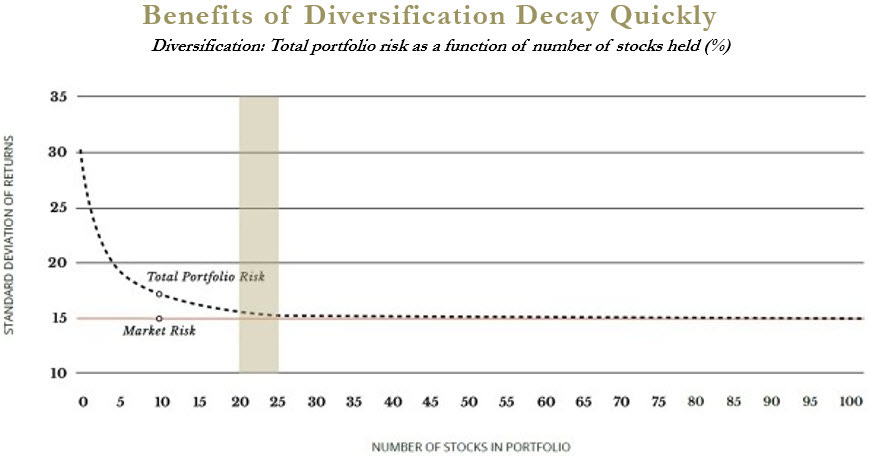
The Law of Diminishing Returns: The benefit of diversification (reducing risk) decays rapidly.
Going from 1 stock to 10 stocks? Huge reduction in risk.
Going from 20 stocks to 50 stocks? Negligible reduction in risk.
At a certain point, you aren’t hedging against volatility. You are hedging against your own potential upside.
Preserve vs. Build
Here is the rule that changed how I see money:
Diversification preserves wealth. Concentration builds it.
If you already have $10 million, buy the index. You’ve won the game; now play defense. But if you’re trying to get to $10 million on 7% annual returns, you’re bringing a spoon to a knife fight and wondering why dinner takes forty years.
I adopted a strategic approach: High Conviction.
Instead of buying dozens of stocks I don’t understand, I focus on a select few that I have researched obsessively.
I don’t want the haystack. I want the needle.
The Conviction Edge
The Conviction Edge is the advantage you gain when concentration forces you to actually understand what you own. If 20% of your net worth is in one company, you read the quarterly reports. If you own 500 companies, you read nothing.
If you own the S&P 500, you don’t feel attached. You don’t study the product. You’re a passenger. If a substantial amount of your net worth is in just one company, you bet your ass you are paying attention.
Conviction acts as a filter. It prevents you from panic-selling when the market dips.
If you know why you own it, you can hold through the drawdown.
Risk is the Price of Admission
Especially when you are young, Volatility is not the enemy. Volatility is the price you pay for performance.
When you have decades ahead of you, you can afford to take calculated risks. You can afford to be wrong occasionally if your winners are big enough to cover the losses.
The Asymmetric Bet:
The most you can lose is 1x your money (it goes to zero).
The most you can make is infinite (10x, 50x, 100x).
You only need a few of those to change your life. You won’t find them if you dilute them with 400 losers.
Over-diversification is a hedge against ignorance. If you don’t know what you’re doing, sure, buy everything. But if you are willing to do the work? Ditch the safety net.
Building wealth isn’t about being a passive participant in the economy. It’s about making a call. I’ve made mine. Ask me in ten years if it worked.

Disclaimer: This is my personal philosophy, not financial advice. Never listen to some random guy on the internet. Even if he uses some killer gifs.
[Update, 2025: I still believe this, but with more caveats. See “Everything is a Ponzi Scheme” for the darker side of the thesis.]

[Update, 2026: 3 years later, this philosophy put 44% of my portfolio into obscure AI infrastructure companies. See if the thesis is playing out.]

Still here? Check out the vulnerability of being wrong: ⬇️

And the framework behind what wealth means: ⬇️

More on the midwit trap in concentrated investing: Don’t Mid-Curve It ⬇️

I would love to have a discussion about this the next time we hang out :)
Great content!
With this you have knowledge to talk your family's ears off for several days. :)