

TL;DR: The bell curve meme is more than just a joke; it’s also a philosophical diagram. And if you’re reading this, you’re probably in the middle.
I built this into an interactive quiz! Find out where you fall on the bell curve: midwit.huliwood.com
There’s a specific kind of “smart” that makes you miserable, ineffective, and broke.
The best explanation for this comes from a meme.
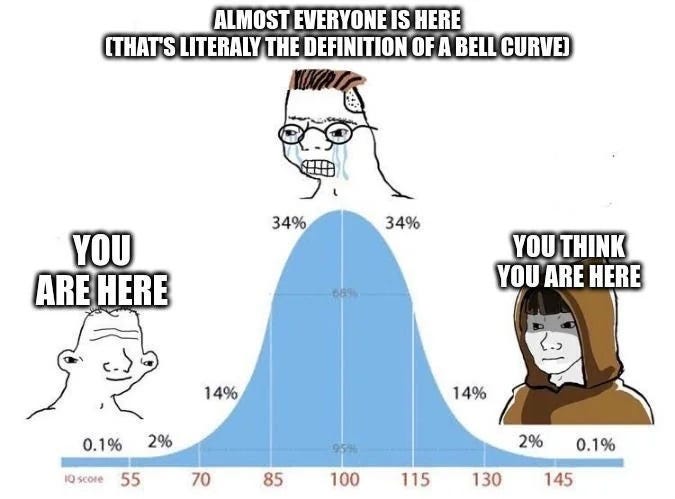
Introducing: The Bell Curve
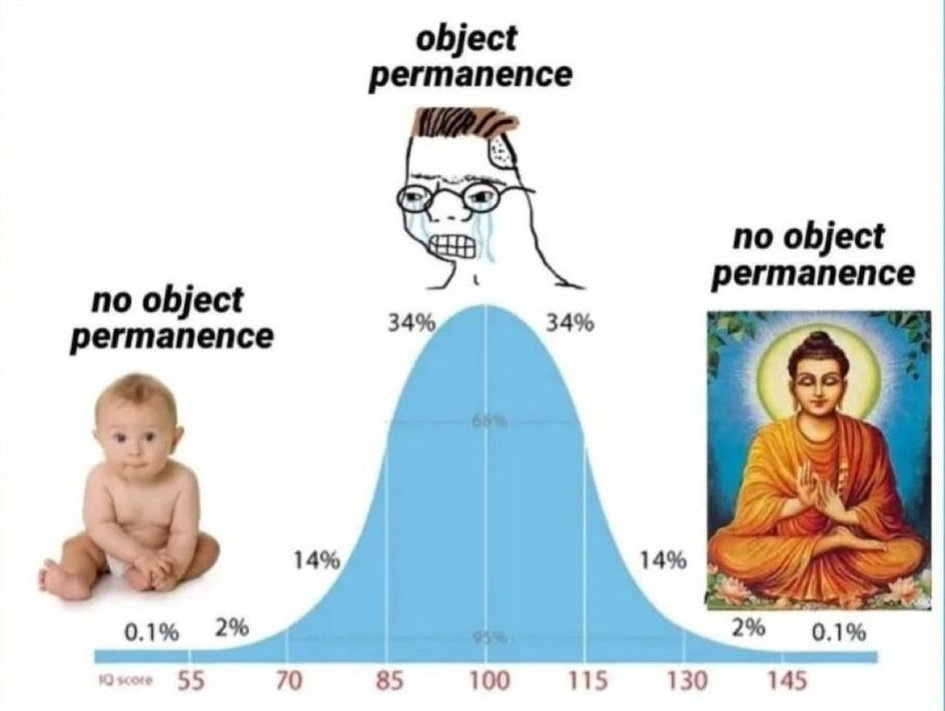
The bell curve meme (also called the midwit meme or IQ bell curve meme) is a format that shows three levels of understanding: the beginner and the expert agree on a simple answer, while the person in the middle overcomplicates it.
The punchline: overthinking is its own trap.
Memes are data compression. A good meme does what a thesis statement does – it transmits a complex cultural idea instantly, skipping the explanation entirely. You don’t need to read Dunning and Kruger’s paper to understand the bell curve meme. You just need eyes. That’s the compression ratio academic papers dream about.
Three types of people:
The “Brainlet” (Left): Holds a simple, straightforward opinion.
The “Midwit” (Middle): Holds an overly complicated, nuanced, “sophisticated” opinion.
The “Jedi” (Right): Holds the same simple opinion as the Brainlet.
The “dumb” guy and the “genius” agree. The guy in the middle is the only one who’s wrong.
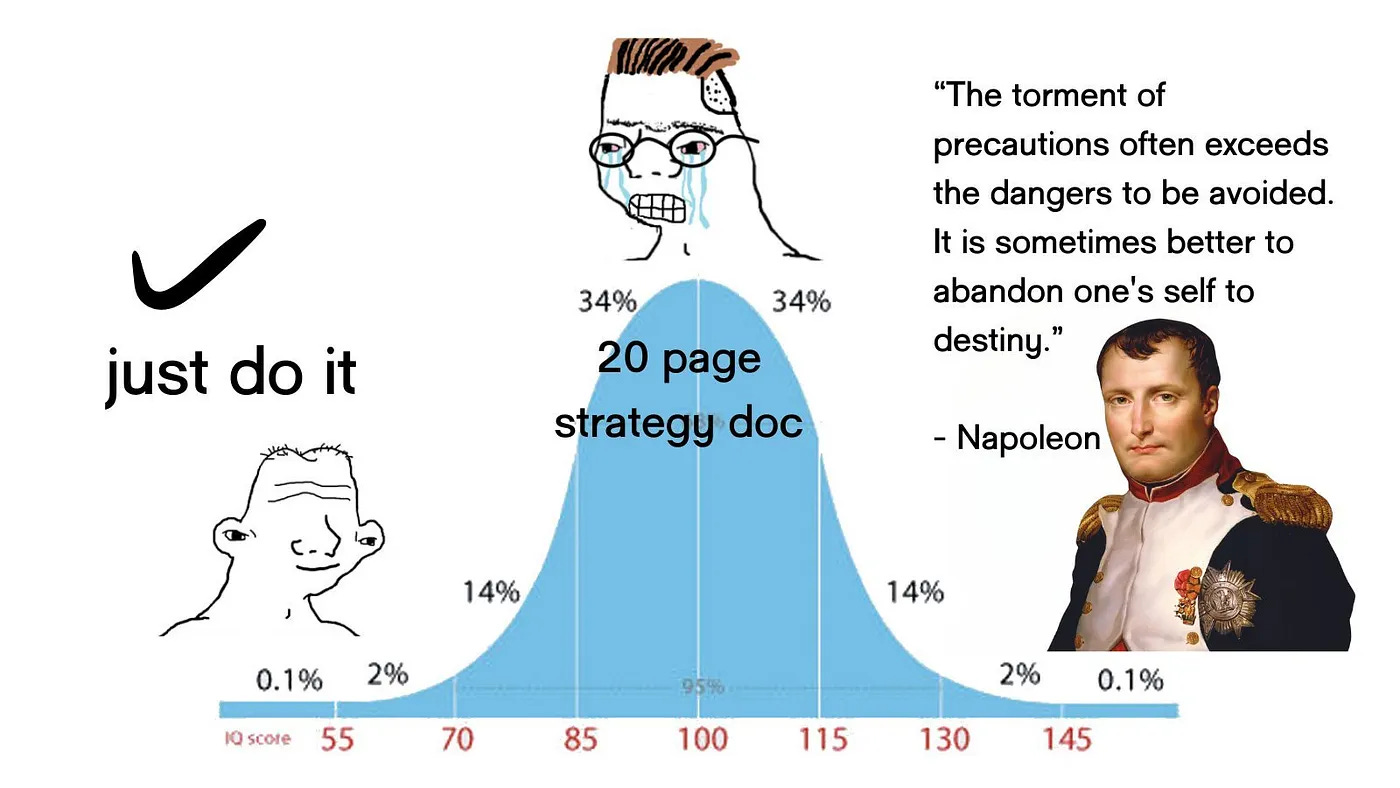
The Midwit Trap
A midwit is someone stuck in the cognitive dead zone – smart enough to see complexity, not experienced enough to see through it. The Midwit Trap is what happens when that becomes your default setting.
The science backs half the meme. In the original 1999 Dunning-Kruger study, participants who scored at the 12th percentile rated themselves at the 62nd percentile – a 50-point overestimation. Meanwhile, top performers underestimated their ability by roughly 15 points. The confident end of that data is the meme’s left-hand figure, though; the midwit zone itself never shows up in the paper.
The midwit understands nuance but can’t filter it. They’re obsessed with appearing intelligent. They love jargon, credentials, and “best practices.”
Example – investing:

The Brainlet: “I buy Bitcoin because number go up.”
The Midwit: “Well, you have to consider the macroeconomic headwinds, the correlation with the Nasdaq, the regulatory environment, and the Sharpe ratio...”
The Jedi: “I buy Bitcoin because number go up.”
The Brainlet is right for the wrong reasons. The Jedi is right for the right reasons. The Midwit is broke.
Spot the Midwit
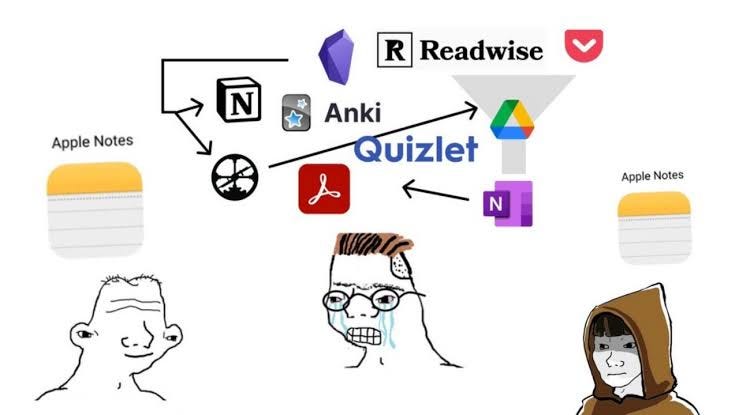
The pattern is everywhere once you see it.
Housing – Left: “I need a roof over my head.” Middle: “I need a 4-bedroom colonial with a heated garage for the rowing machine I don’t use and a guest room for people I don’t like.” Right: “I need a roof over my head.”
Corporate work – Left: “Let’s build the product.” Middle: “Let’s have a 5-hour brainstorming workshop to define the ‘who, what, where, and why’ of our synergistic go-to-market strategy.” Right: “Let’s build the product.”
Cooking – Left: “Salt, heat, eat.” Middle: “I need a sous vide circulator, a Japanese mandoline, and a 14-day dry brine schedule I found on a subreddit.” Right: “Salt, heat, eat.”
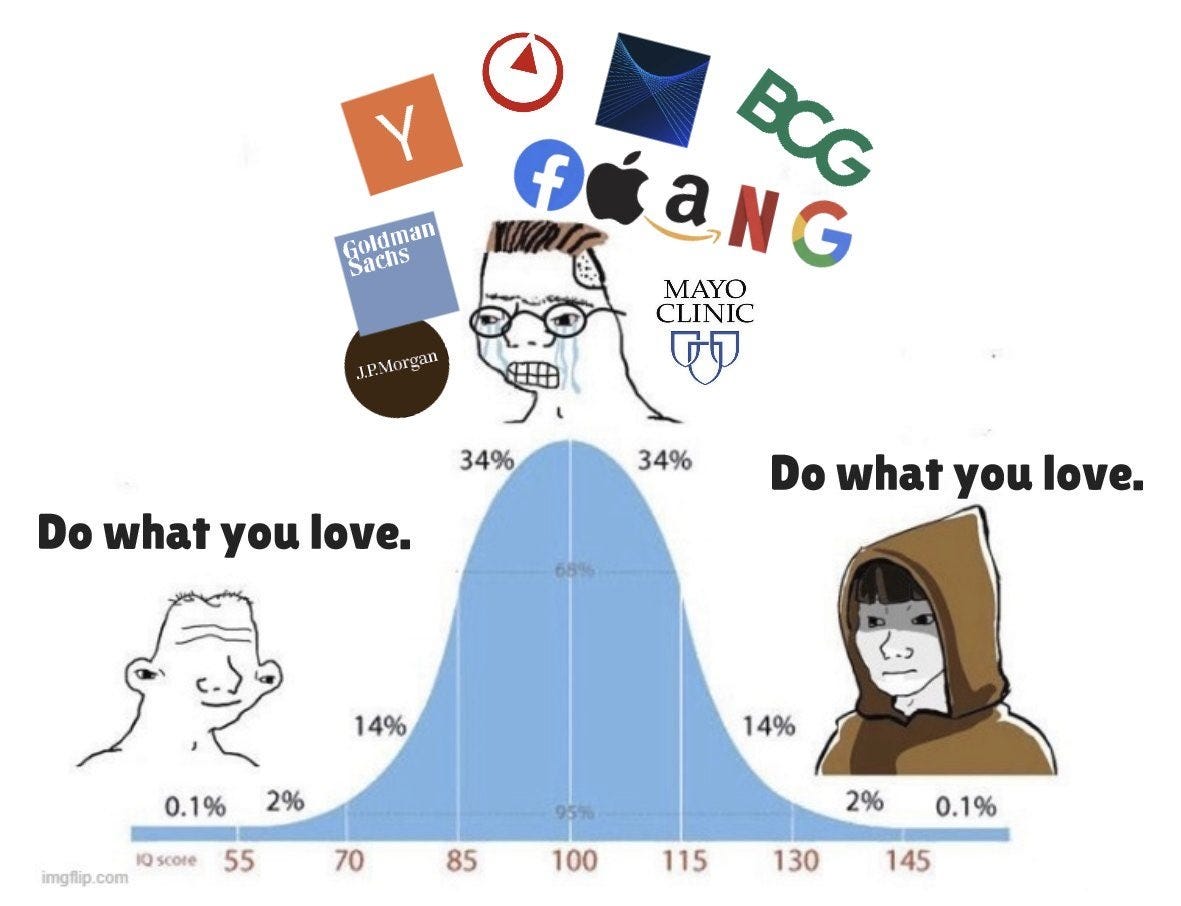
The best tool is no tool. The best meeting is no meeting. But the Midwit is terrified of simplicity because simplicity looks dumb.
Where the Alpha Is
The middle of the curve is where everything is “priced in.” Common knowledge. Average returns, average stress, average results.
The tails of the distribution are where the alpha is. Also the bankruptcy. The bell curve’s edges are where genius and catastrophe hold hands and jump together. The difference is a thin membrane called “conviction” – and most people don’t have enough of it to fill a thimble.
Truly great ideas sounded stupid to the Midwits. The airplane was a toy. The internet was a fad. The iPhone was a phone without buttons – who would want that?
By the time an idea sounds good to everyone, it’s probably too late.
Confessions of a Recovering Midwit
I know all this because I’ve been the midwit.
I sold everything I owned, quit my job, and bought a backpack. But not before spending weeks building a spreadsheet to model whether I could afford to. Scenario analysis. Sensitivity tables under twelve spending assumptions. A decision matrix... you get the idea.
All I needed was one number: how many months of runway do I have?
I quit anyway. Not because the spreadsheet told me to – it never would have. I quit because the sheet was the trap.
I’d already put my savings into a handful of AI stocks I had conviction in. No diversification. No “balanced portfolio.” Every financial advisor I’ve ever met would have a stroke reading my brokerage statement. The Brainlet says: “AI go up, I buy.” The Midwit says: “Well, you have to consider sector rotation, correlation risk, and the drawdown implications of a concentrated position in a single thematic.” I say: “AI go up, I buy.” Same words. Different reasons.
Selling everything and buying a backpack was just me finding out if I could apply the same logic to the rest of my life.
I’d love to tell you I’ve fully recovered. But two years later I literally built two interactive tools to explain concepts that fit in a sentence. The midwit never dies. He just finds smaller spreadsheets.
Melbourne, April 2024.
Related: More Information ≠ More Informed – why more input doesn’t make you more informed · Everything Is a Ponzi Scheme – the market as a confidence game · The Art of Simplifying · Keep It Simple, Stupid

Frequently Asked Questions
What is the midwit meme?
The midwit meme is a bell curve format where the low-IQ person and the high-IQ person agree on a simple answer, while the middle of the curve overcomplicates it. It started on 4chan around 2017 and blew up on X/Twitter in 2020. The joke works because it’s true – the people with the least and most experience often reach the same conclusion. Everyone in between gets lost in the options.
What does midwit mean?
A midwit is someone smart enough to see complexity but not experienced enough to see through it. They know enough to identify problems but not enough to know which ones matter. The term spread on 4chan (circa 2013) and it’s not really about IQ – it’s about the gap between knowing things and knowing what to do with them.
What is the midwit trap?
It’s the tendency to overcomplicate decisions that both beginners and experts handle simply. Beginners go with gut instinct because they haven’t seen enough to doubt it. Experts do the same, but only after they’ve internalized decades of complexity and come out the other side. The midwit sits in between – just enough knowledge to second-guess every instinct. Dunning-Kruger gets cited here, but it found something else: people in the bottom quartile overestimated their rank by 50 points, while top performers slightly underestimated theirs.
Is the bell curve meme based on real psychology?
Partly. The Dunning-Kruger effect (1999) is the usual citation, but it cuts the other way – low performers wildly overestimated, high performers slightly underestimated, and miscalibration shrank as skill rose. Expertise research does find a U-shaped curve where beginners and experts converge while intermediate practitioners diverge. Three panels, one real phenomenon.
Where can I take a midwit test?
There’s an interactive one at midwit.huliwood.com. It gives you a question and three positions – beginner intuition, overthinking middle, and expert simplicity – and you see where your instinct lands on the curve.
Memes apart, you're hinting at a slippery but pervasive subject rather difficult to put your finger on. One that surely will accompany you throughout all your life, and surprisingly you may find yourself wading the ins and outs of the concept several times, curiously not getting any clearer perspective each time ;-)
Yet, keeping at it is not an option but the way our brains are wired...