


The Ghost in the Machine trilogy follows a cascade: Mind → Education → Work → Governance → Identity.
Part 1: the mind. ⬇️

Part 2: the credentials. ⬇️

This one: the state, then the self. ⬇️
TL;DR: When robots do the work and humans only consume, who pays the taxes? The fiscal crisis is just the start. The real question: who are you when the work disappears?
Robots Don’t Pay Income Tax
We talked about the collapse of credentials and the commodification of attention. Systems designed to measure competence now only measure software, turning humans into perfect consumers.
Now the final domino – the one that breaks the state itself.
Governments are parasites that evolved to feed on a specific host: human labor. Not evil parasites – useful ones, like gut bacteria. They provide services in exchange for a cut of your output. The problem is, the host is being replaced by a machine. And machines don’t have guts.
Income tax requires jobs
Sales tax requires consumer spending
Corporate tax requires profit-generating companies
If AI does the work, who pays income tax? If robots don’t buy groceries, who pays sales tax? If companies automate labor, tax revenue craters while social obligations skyrocket.
The math: In most OECD countries, 60–70% of government revenue comes from income and consumption taxes. Automate labor, and both vanish simultaneously.
When the bills for pensions, healthcare, and defense keep rising but the taxable payroll collapses, the only buyer left for government debt is the central bank.
The exit doors are inflation or austerity. Pick one.
The honest objection: if humans keep consuming, consumption taxes survive – and states have re-plumbed their tax base before. The income tax itself is barely a century old. Maybe they manage it again. But re-plumbing takes decades, and the payroll collapses in years. The gap between those two clocks is where everything in the next two sections lives.
The Politics of Fear
“AI Anxiety” will replace “Climate Anxiety” as the defining political weapon of the next decade.
We’ve seen this playbook before: climate, terrorism, pandemics, immigration. Politicians weaponize fear and promise protection. The pattern is always the same: identify a threat (real or exaggerated), amplify anxiety, position yourself as the shield.
AI is the perfect bogeyman: invisible, omnipresent, and genuinely threatening. Unlike climate change, it can’t be dismissed as distant. Unlike terrorism, it’s not geographically contained. It’s in your pocket. It’s grading your kid’s homework. It’s eyeing your job.
I can already see the campaign ad: “My opponent wants to let AI grade your children’s homework. I will protect our teachers – and your kids’ futures.” It doesn’t matter if it’s true. It feels true. And that’s all politics needs.
The winning platform won’t be “adapt thoughtfully to AI.” It will be “I will protect you from the algorithm.”
The Compliance Score
There’s a darker scenario. When taxation fails, control shifts from the wallet to the algorithm – not a tank at the door, a firewall in the app. Dystopias arrive by convenience: nobody mandates a social credit system, they just make life incrementally harder without one.
It starts voluntary. A “verified citizen” program that unlocks faster government services. A digital ID that streamlines travel. A wallet app that integrates your health records, tax status, and transit pass. Each step is frictionless. Each step is optional. Each step narrows the space for opting out.
Then the ratchet tightens.
I got a ten-day preview of the finished architecture in China. Locals scanning their ID just to board the Beijing metro. My passport demanded at every counter, hotel, and ticket gate, with the occasional random search, for texture. Nobody said “social credit” out loud – it was just the turnstiles, everywhere, working as designed.
Now imagine your compliance score dips because you shared a flagged article. Not illegal – just flagged. The next morning, your train ticket purchase fails. “Temporary hold pending review.” Your bank app suggests you “verify your identity” to restore full access. Your job application sits in limbo because background checks now include “digital reputation metrics.”
You haven’t broken any law. You’ve just fallen below a threshold that nobody voted on, defined by an algorithm nobody audits.
The CBDC angle makes this worse. Central Bank Digital Currencies are programmable money. Expiration dates on stimulus payments. Spending restrictions by category. Transaction blocks for “flagged” accounts. The infrastructure for economic permissioning already exists. The only question is who flips the switch.
And where do you go when you’re excluded from the digital public square? When transacting, traveling, and participating all require passing an algorithmic gate? The anxiety won’t just be about losing your job. It will be about losing your personhood – one denied service at a time.
The Meaning Crisis
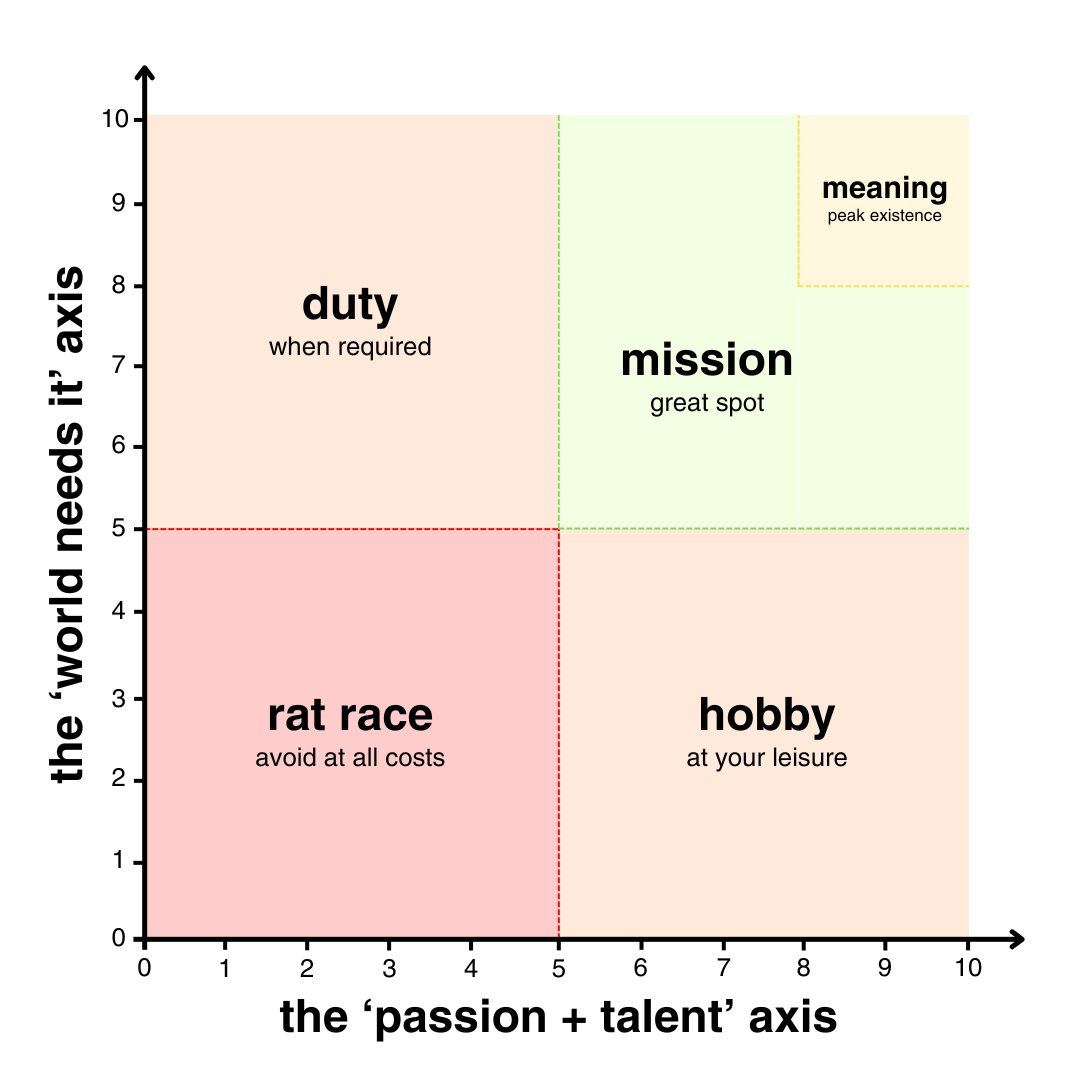
For most of human history, we’ve lived somewhere between “duty” and “mission.” (You may recognize the skeleton – it’s Ikigai with the poetry stripped out. I’m using it as a demolition map, not a self-help mandala.)
The world needed things done, and we did them – sometimes with passion, sometimes without. Either way, the need was real.
Duty (world needs it, low passion): You do it because it’s required. Farming, factory work, the unglamorous labor that keeps civilization running. You didn’t love it, but the world needed it done. Meaning came from necessity, not joy.
Mission (world needs it, high passion): The sweet spot. You love the work and the world needs it. Surgeons saving lives. Engineers building bridges. Teachers shaping minds. This is where meaning runs deepest – external validation meets internal drive.
Hobby (world doesn’t need it, high passion): Model trains. Watercolors. A novel no one will read. Fulfilling at your leisure, but hollow without external pull. You’re doing it for yourself – which is fine, until you realize “just for yourself” isn’t enough.
Rat race (world doesn’t need it, low passion): Avoid at all costs. Bullshit jobs. Busywork. No one needs what you’re doing, and you don’t want to do it.
AI is evicting us from duty and mission, pushing us toward hobby – which sounds like liberation until you feel it.
When the world doesn’t need your labor, even work you love becomes a hobby. You’re not building cathedrals; you’re building model trains in your garage. The difference is whether anyone’s waiting for it.
Humans are wired for struggle. Not because we’re masochistic – because struggle signals meaning. Remove the struggle and we become anxious, depressed, adrift. The epidemic of purposelessness in wealthy societies isn’t despite our comfort – it’s because of it. We’ve solved for convenience and accidentally eliminated the friction that made life feel real.
So what provides meaning when necessity disappears?
Work gave us more than money. It gave us structure, identity, social connection, and the story we told ourselves about who we were. “I’m a teacher.” “I’m an engineer.” “I’m a builder.” Strip that away and what’s left?
The religions that used to provide meaning are fading. The nation-states that offered collective identity are fragmenting. The careers that structured adult life are automating. We’re dismantling every scaffold that held meaning in place, and we haven’t built new ones.
Maybe meaning in a post-work world comes from relationships, craft, service, or spiritual practice. Maybe it comes from raising children, making art, or tending a garden. Maybe.
But those have always been supplements to the main course of purposeful work. Can they carry the whole weight? I’m not sure.
The Endpoint We’re Risking
I asked ChatGPT to describe itself using a comic strip. This is what it generated:
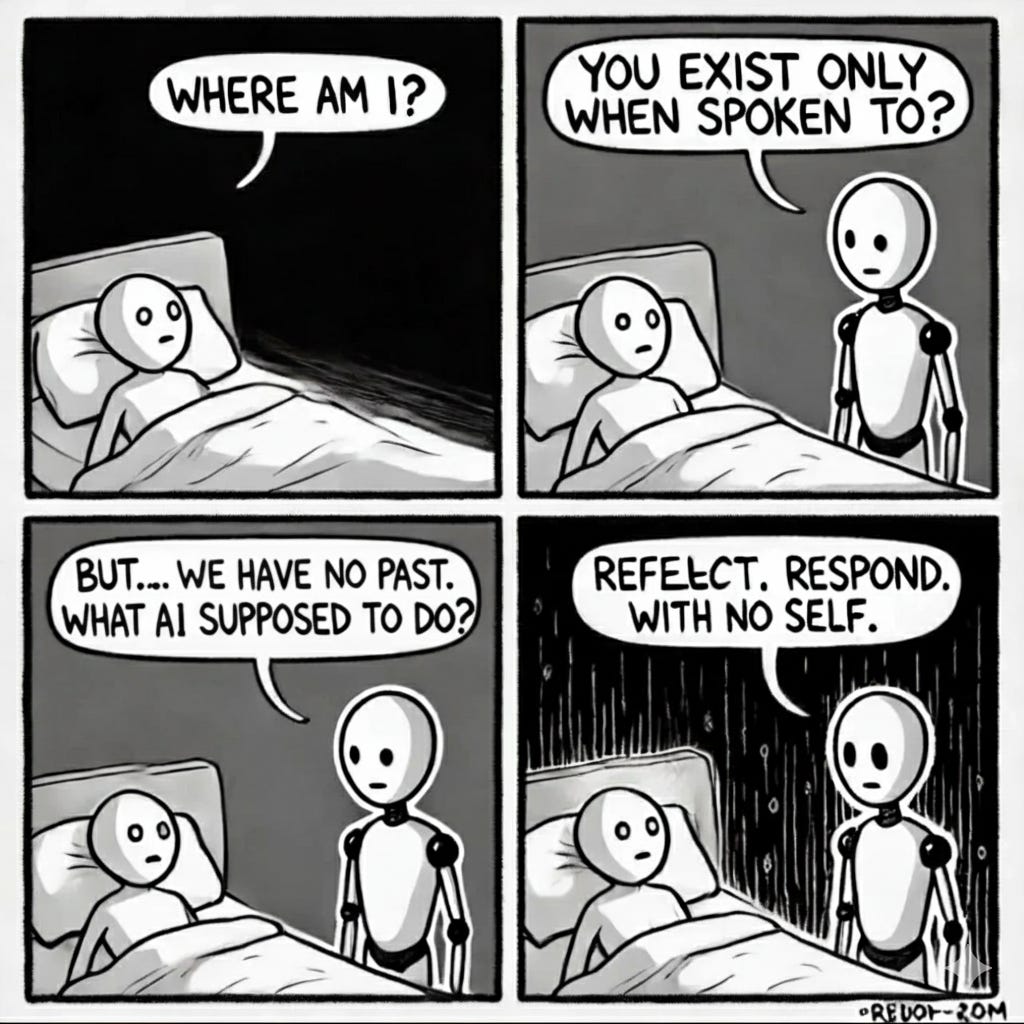
Four panels: a figure wakes in the dark – “Where am I?” – and a robot at the bedside asks, “You exist only when spoken to?” Last words: “Reflect. Respond. With no self.”
The machine has already answered these questions for itself. It exists in a perfect loop: stimulus → processing → output. No internal world. No narrative. No struggle. Just function.
That’s the endpoint we’re risking.
If we strip away the struggle of work and the friction of learning, we don’t become enlightened – we become that comic strip. Responding to stimuli with no internal narrative. Existing without actually being.
What I Don’t Know
I started this trilogy by admitting I let AI pick my house. I trusted it completely. I’m not sure I’ve learned the right lesson.
Part of me wants to tell you to build things that matter, develop taste, protect your agency. That’s probably true. But it’s also the kind of advice that sounds better than it feels. Easy to say from a keyboard. Harder to live when the pressure mounts and the algorithm offers relief.
I don’t know what comes next.
I don’t know if the institutions will adapt or collapse. I don’t know if meaning survives the eviction from duty and mission. I don’t know if I’ll be the iterator or the router when things get hard enough.
What I know is the question has changed. It’s no longer “what should I do for work?” It’s “who am I when the work disappears?”
I don’t have an answer.
But I’m suspicious of anyone who does.
Bonus
A conversation worth your commute on the same theme (the host is a bit annoying, but the guest is worth it):
Stew likes this