

TL;DR: Science can map which brain regions light up when you see red. It cannot explain why seeing red feels like anything at all. That gap – between mechanism and experience – is the biggest unsolved problem in science. And it might mean consciousness isn’t a product of the brain. It might be fundamental.
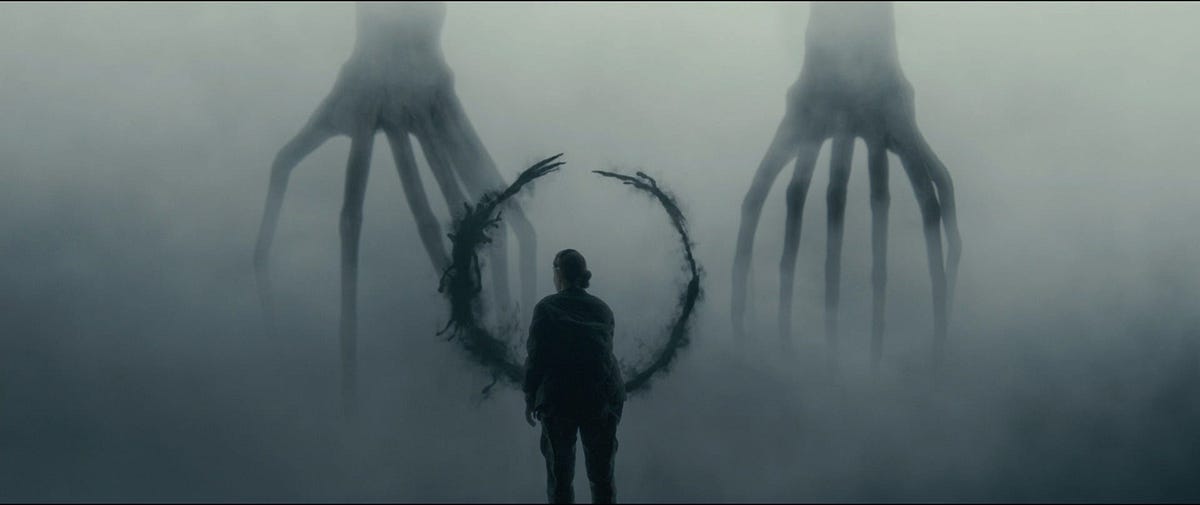
There’s a scene in the movie Arrival that broke something in my brain. Louise Banks, the linguist, has spent months deciphering an alien language. And then it clicks – not just the words, but the structure. The heptapods don’t experience time linearly. Their language has no past or future tense. And by learning to think in their language, Louise starts to see differently.
She begins experiencing her own future.
It’s science fiction. Obviously.
But the idea underneath isn’t: the structure of how you think might determine what you can perceive.
This is the Sapir-Whorf hypothesis taken to its extreme. Language doesn’t just describe reality. It shapes what reality you can access. Every language has concepts that don’t survive translation (trust me, I know). Feelings that exist in one tongue and vanish in another.
What if time is like that? What if linearity is just the language our brains speak – and not the only one available?
The Vocabulary We Forgot
When I was a kid, I could close my eyes and wake up the next day. Instant. No exaggeration.
No sense of duration. No dreams I could remember. Just blink and eight hours had vanished. Like fast-forwarding through time. This happened regularly. Then less. By my teens, almost never. By adulthood, not at all.
I used to think this was just how sleep worked for everyone. Now I wonder if it was something else – a looser grip on linear time that tightens as you age. Children haven’t been formatted for the grid of the calendar yet. Then we’re civilized. We’re taught that “now” is a point on a line, and we lose the ability to drift between frames.
We learn the grammar of linearity and forget the vocabulary of the eternal.
Maybe we’re all born heptapods.
The Gut, Revisited
I’ve argued before that gut feelings aren’t magic – just pattern recognition faster than conscious thought. Sherlock solving the case before writing the report.
I still believe that. But pattern recognition is a rearview mirror. It explains familiar situations, not the moments when your gut seems to know something it couldn’t know.
Confirmation bias? Mostly, probably. But mostly, probably isn’t definitely, always.
You’ve seen the posts. Brain scans with captions like: “WE DO NOT THINK THOUGHTS – WE RECEIVE THEM.” Clocks dissolving into neurons: “INTUITION IS A GLIMPSE OF THE FUTURE YOUR MIND ALREADY REMEMBERS.”
They’re to neuroscience what astrology is to astronomy: same aesthetic, different epistemic universe. Probably nonsense.
But the reason they resonate isn’t because people are gullible. It’s because the official story of how we experience reality is starting to crack.
The question is valid. The cheap answers aren’t.
The Real Weirdness
The scientific establishment – the one that rightly dismisses those posts – is sitting on mysteries just as unsettling. Consciousness isn’t explained by the brain. It’s explained away by it.
David Chalmers (who’s not a mystic, but one of the most respected philosophers of mind alive) calls it the “Hard Problem.”
We can map which brain areas light up when you see red. We cannot explain why any of this is accompanied by experience. The gap is in our framework. Thirty years of neuroscience haven’t made it less mysterious. If anything, the mystery has sharpened.
Then there’s the prediction machine. Karl Friston’s work suggests your brain doesn’t perceive reality – it predicts it. You’re constantly generating a model of what you expect to happen, updating only when surprised. More connections run down from your brain than up from your eyes. Your brain is literally telling your eyes what it expects to see.
You’re not a camera recording the world. You’re a screenwriter rewriting the script in real-time.
And we can turn consciousness off and on without understanding how. Under anesthesia, sensory input still reaches your brain. Sounds still light up your auditory cortex. But the signal doesn’t spread. Your brain stops talking to itself.
Consciousness, it seems, requires integration – not just activity, but connection. Anesthesia doesn’t mute the instruments. It cuts the phone lines between them.
This is mainstream consciousness research. And none of it explains why there’s something it’s like to be you.
Chalmers has spent three decades arguing that consciousness might be fundamental. Not an emergent property of matter, but something basic to reality, like space or time. That’s a serious position from serious people, because the alternative hasn’t gotten any less mysterious despite our best efforts.
The viral posts are wrong on the specifics. But the hunger behind them – the sense that there’s more going on than neurons firing – that hunger is valid.
In Arrival, Louise asks the aliens why they’ve come to Earth. They answer: “Offer weapon.”
The weapon is their language. Because language shapes thought, and thought shapes what you can perceive. The aliens didn’t give humanity a ray gun. They gave us a new way of seeing – a tool for Louise to survive the tragedy of her own life by experiencing it outside the tyranny of sequence.
When I was a child, I could skip eight hours like flipping a page. I don’t know what that was. I don’t know why it stopped. But I suspect we shed capacities as we age that we never knew we had, formatted out of us by clocks and calendars and the grammar of before-and-after.
Maybe the real mystery isn’t what’s hidden in the future. It’s what we lost when we learned to read a clock.
If you enjoyed this, you might like my earlier piece on intuition ⬇️

Fascinating stuff, verging on the surreal and yet... guess what quantum mechanics is hinting at? Yes, your brain just predicted the answer...