

TL;DR: Smart people optimize for being right. Rich people optimize for being believed. The market rewards conviction backed by narrative force. This is a structural problem, not a motivational one. And I’m not exempt.
We all know “The Guy.” 👇

He graduated top of his class. He speaks three languages. He reads academic papers on weekends and corrects people’s grammar in group chats.
He can solve a Rubik’s Cube blindfolded, but he makes $80K a year working for a guy who thinks “EBITDA” is a Greek island.
The last time I listened to “The Guy,” he spent an hour explaining why Elon Musk is fundamentally irrational. The thesis was sound. The logic was flawless. The conclusion was obvious: the market is broken, and idiots are winning.
I nodded along. Then I checked Musk’s net worth. $500+ billion.
His analysis was perfect. His bank account was not.
And before I get too smug about The Guy: I’m a recovering Tesla fanboy who has eaten a decade of delays and overpromises and stayed anyway. My skepticism is real now – but so is the lesson. Musk is a genius of a specific kind: he makes the impossible merely late.
That’s the trap. Smart people confuse “being right” with “getting paid.”
The Academic Game vs. The Market Game
In school, you get an A for being correct. You fail for being wrong. Simple. So “smart” people spend their entire lives optimizing for accuracy. They are terrified of being wrong. They overanalyze. They wait for perfect information.
The market is not a test. The market rewards direction, not precision.
Wealth creation is probabilistic courage – the ability to be early, look stupid for a while, and then be right when it matters.
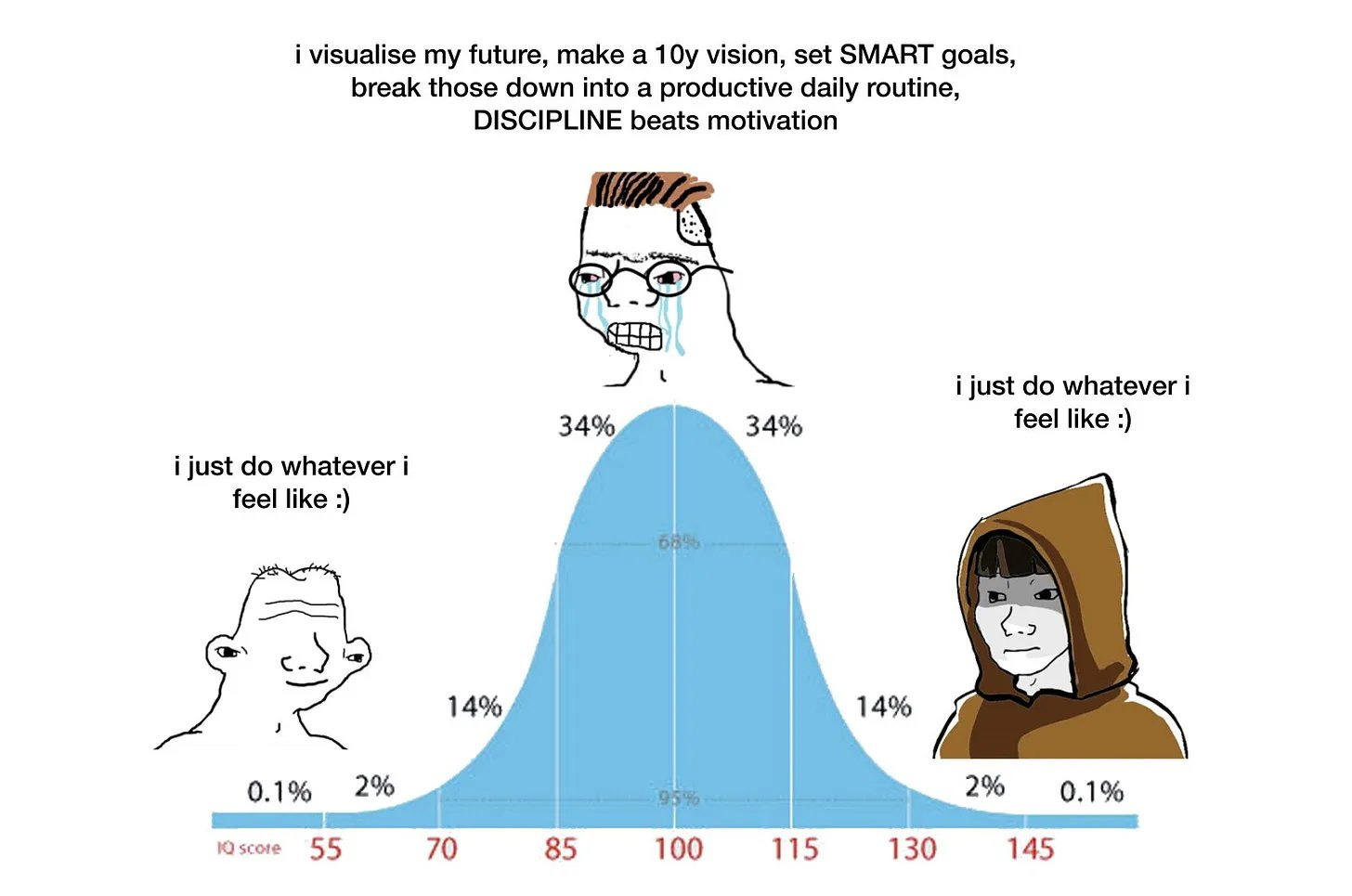
The midwit curve shows the trap in action: low knowledge produces high confidence (you don’t see the problems), medium knowledge produces low confidence (you see ALL the problems), and high knowledge produces calibrated confidence (you know which problems actually matter).
The guy in the middle has just enough knowledge to see every possible failure mode, but not enough wisdom to know which ones matter. He’s frozen. The expert on the right has looped back to “fuck it, let’s go” – but now it’s strategic simplification, not ignorance.
The people in the middle are busy setting SMART goals, building productive daily routines, and wondering why discipline isn’t making them rich.
I built an interactive quiz. Find out where you fall on the bell curve: midwit.huliwood.com
Intelligence without conviction is just expensive self-sabotage.
Linear Logic vs. Geometric Payoffs
Smart people love fairness. Work an hour, get paid $50. Get a degree, get a promotion. Input equals output.
This is the Fairness Fallacy – the belief that the world is a meritocracy where effort compounds linearly. It doesn’t.
Wealth follows power laws. It relies on leverage, network effects, and compounding belief.
The quant understands the math perfectly and works for a salary. The founder understands the narrative perfectly and owns the equity. The quant is smarter. The founder is richer. Because the founder understands that money is captured belief, not just captured value.
The Burden of Seeing Too Much
“The fundamental cause of the trouble is that in the modern world the stupid are cocksure while the intelligent are full of doubt.” ― Bertrand Russell
The smarter you are, the more reasons you can find to not do something. What if the market crashes? What if I’m wrong about the timing? What if there’s a variable I haven’t considered?
Intelligence lets you simulate failure in high definition – every way something might go wrong, before you even start. Useful for avoiding catastrophe. Also a cage.
Meanwhile, the guy who can barely spell “synergy” launches a SaaS product with a landing page he built in Canva. He doesn’t know about CAC/LTV ratios. He doesn’t know he’s supposed to fail. So he doesn’t.
By the time the smart person has finished their competitor analysis, the idiot has already launched, failed, pivoted, and found product-market fit.
Reflexivity: Bending Reality
The most brutal meta-truth: smart people try to describe reality. Rich people try to bend it.
In finance, this is called reflexivity – a term popularized by George Soros, who made billions betting on it. Your belief about the world actually changes the world.
Tesla: the smart person says it’s overvalued, the P/E ratio is insane, traditional automakers will crush them – short this. The reflexive person says: I will tell a story about the future of energy so compelling that everyone buys the stock, which gives me the capital to build the factories, which makes the story true.
Same logic powers crypto, where Bitcoin has value because people believe it has value, which makes more people believe it has value. Smart people scream that it’s not backed by anything. Neither is the US Dollar, or gold, or God – what’s your point?
Smart people confuse fragility with intelligence. They avoid risk. They want a steady paycheck, a clear career path, a guarantee.
But wealth is just captured volatility. You cannot get outsized returns without outsized variance.
Now, if you’ll excuse me, I need to go convince someone that my braindumps are worth subscribing to – not because the writing is objectively better than everyone else’s, but because I’ve constructed a narrative that makes it feel essential.
See? I’m learning.
Frequently Asked Questions
Why aren’t smart people rich?
Intelligence optimises for accuracy – being right, seeing every failure mode before starting. Wealth creation optimises for conviction backed by narrative force. Smart people overanalyse and wait for perfect information while markets reward direction and timing, not precision.
What is the Fairness Fallacy?
The belief that effort compounds linearly – work an hour, get paid proportionally. In reality, wealth follows power laws. A quant who understands the maths perfectly works for a salary. A founder who understands the narrative perfectly owns the equity. The quant is smarter. The founder is richer.
What is reflexivity in finance?
A theory developed by George Soros, first laid out in his 1987 book The Alchemy of Finance. It describes how beliefs about the world actually change the world. Tesla is the textbook case: a compelling story about the future of energy attracts investors, their capital funds the factories, and the story becomes true. Prices influence fundamentals, which influence prices – a self-reinforcing loop.
How does the midwit curve explain why smart people don’t act?
The midwit curve maps confidence against knowledge. Low knowledge produces high confidence (you don’t see the problems), medium knowledge produces paralysis (you see all the problems), and high knowledge loops back to calibrated action (you know which problems actually matter). The person stuck in the middle is the most informed and the least effective.
Is intelligence a disadvantage for building wealth?
It becomes one when it’s channelled into analysis instead of action. Intelligence lets you simulate failure in high definition before you start – useful for avoiding catastrophe, but also a cage. Academic training optimises for accuracy, where being right earns an A. Markets reward probabilistic courage – being early and looking wrong until you’re vindicated.
“start asking if you’re brave enough to be wrong” - although I could have picked any number of bangers in this fine piece of writing. Thanks again Julián.