


Six workers once carried each pensioner. Nowadays? Barely two.
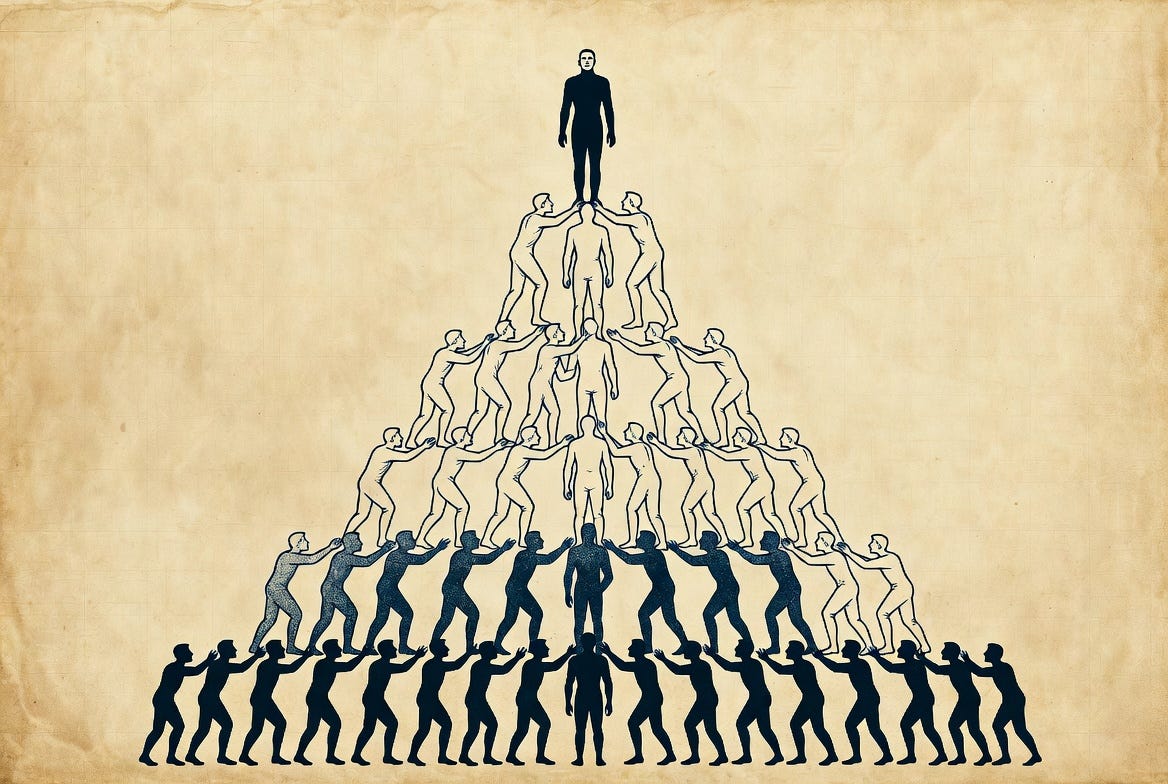
The pension was a brilliant deal, on one condition: that you died roughly on schedule.
You work, you pay in, and when you’re old and worn out, the next batch of workers carries you through the short stretch you have left.
The short stretch was the whole design. It only balances if “retired” means “nearly done”.
And it isn’t a short stretch anymore. People now retire into two decades and change of grandkids and decent knees, and a formula built for a ten-year goodbye is being asked to fund a twenty-year encore.
When the contract was drawn up, six workers stood behind each pensioner; in Germany it’s now about two, sliding toward one and a half. The sum stopped adding up somewhere in the back half of the last century, and nobody updated it.
Fixing the math means telling the people currently being carried that they’ll be carried a little less. Those people vote. Naturally, they vote in growing numbers, in defense of the one large transfer that flows toward them.
The people on the other side of the ledger, funding a deal they’ll grow too old to want reformed, are fewer at the polls and busy with their lives.
Still, in Germany, pay-as-you-go is the only pension design that survived the twentieth century. Funded schemes were wiped out twice – hyperinflation ate the savers’ capital, war finished the rest – while the unfunded contract kept paying, because its collateral was the next generation, and there was always a next generation.
The design still stands. What expired are the two things it took for granted: that you’d die on time, and that the workers keep arriving.
It never collapses, the way a pyramid scheme is supposed to. It just keeps recruiting.
Today’s payers complain about the arrangement right up until the morning they qualify for it, and then they reach for the same shield the last lot was holding.
Nobody is eating the young. The young are simply waiting their turn to be fed, and they’ll vote exactly like everyone before them once they get there.
The contract has one design requirement: never run out of people too young to stop it.
The arithmetic, in years of your life. At the full rate, 18.6% of every working hour goes to the pension – 8.4 years of a 45-year working life. Each year at the average wage buys one Entgeltpunkt; each point pays €42.52 a month for life. Divide what goes in by what comes out and the points cancel: you break even 18.9 years after you start drawing, whatever you earn and however long you paid. Retire at 67 and that is 85.9. A man at 67 is expected to live 16.5 more years, a woman 19.5: he dies 2.4 years before he breaks even, she clears it by about seven months. The deal does not improve with pay or with years served – above the ceiling of €101,400 nothing more is insured and nothing more is earned. Two caveats. The life expectancies are the period table, which Destatis itself calls not a forecast; a cohort table gives someone born in the 1980s more years at 67, enough to turn “dies short” into “roughly breaks even”. And the contribution does not only buy a pension: in 2022, 21% of what the system spent went on disability, survivor and rehabilitation benefits.
Related: Boomerlandia – the angrier version, which this one argues with.

Sources: Demografie-Portal, contributors per pensioner · Eurostat EUROPOP2025 · OECD Pensions at a Glance 2025 · SVBezGrV 2026 · SGB VI §§158, 168 · RWBestV 2026 · Destatis Periodensterbetafel 2023/2025
Corrected 17 September 2026. Two things were wrong. “Across much of Europe it’s now under two” was the German number wearing a European hat – Eurostat puts the EU at about three people of working age per person over 65, and falls to about two by 2050. The sentence now says Germany. And pensioners don’t vote “at the highest rate of any age group”: at the 2025 Bundestagswahl the over-70s turned out at 79.3%, below the national 82.5%. The 50-to-69s did, at 85.5% – which is a worse problem, and a different piece. The clause is gone.
Nothing says “sound financial system” quite like having your actuarial model depend on everyone politely dying on time.
like a drug: “Today’s payers complain about the arrangement right up until the morning they qualify for it, and then they reach for the same shield the last lot was holding.” and it’s a ticking time bomb because the numbers are so out of whack