

TL;DR: Every tech founder is writing about the end of economics – and their solution conveniently requires their product. The real question they won’t answer: who owns the future they’re building?
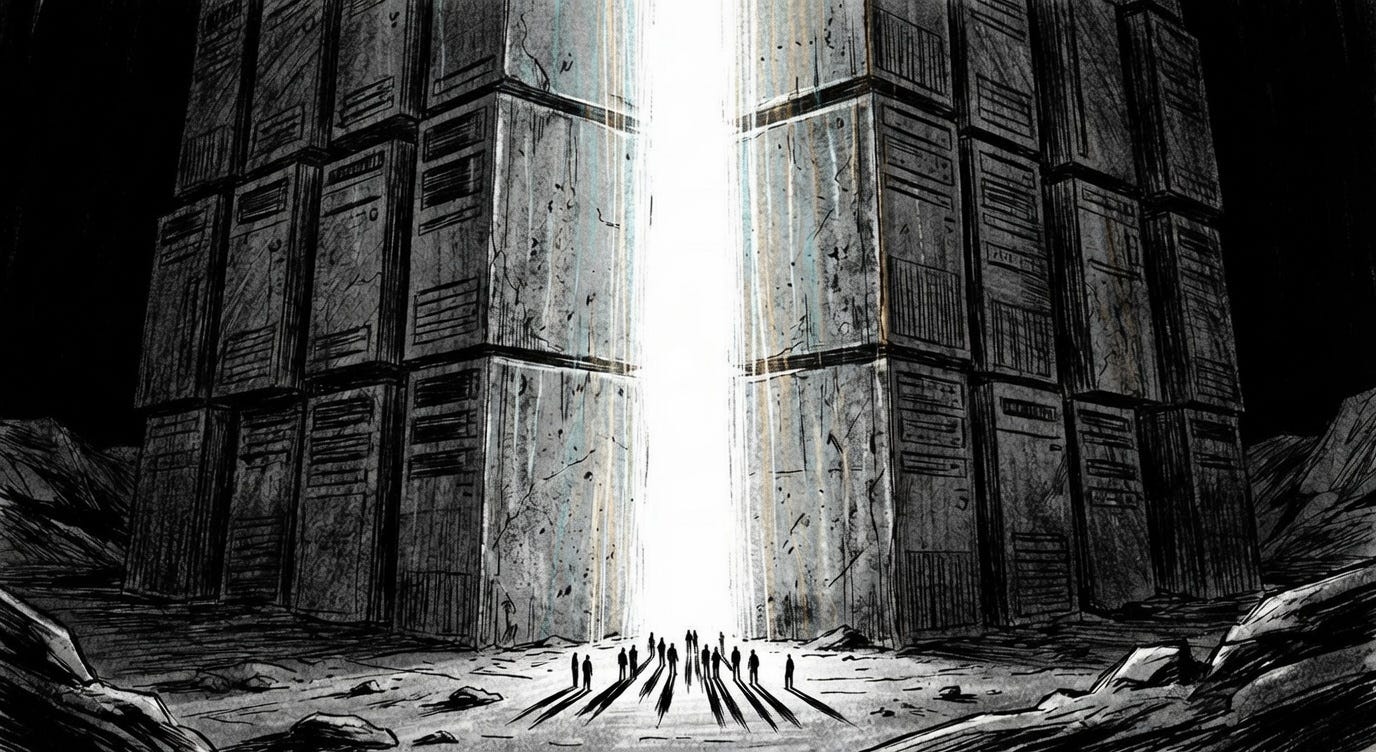
This time last year, I was weeding a field in New Zealand when I first heard a tech billionaire explain why I was about to become economically irrelevant.
Me. Not my job – me. I was pulling invasive plants out of volcanic soil for room and board – the kind of work that makes you receptive to radical ideas about the future of labour.
It was early 2025. Typical British nonchalance from Emad Mostaque, the founder of Stability AI. His company democratized image generation. Later that summer, he published “The Last Economy: A Guide to the Age of Intelligent Economics” – 170+ pages of civilizational prophecy, complete with phase transitions and a thousand-day countdown to economic transformation.
He’s not alone. Altman blogs about UBI and the “Intelligence Age” with OpenAI at the center.
Andreessen’s “Techno-Optimist Manifesto” defends moving fast, written by a man whose firm funds the movers. Balaji’s “Network State” recruits for crypto-sovereign communities he wants to create.
Every tech manifesto diagnoses a civilizational crisis that conveniently requires the author’s product to solve.
The problem is, some of it is insightful.
The Intelligence Inversion
Take Mostaque’s core argument: we’re entering a phase transition where the cost of intelligence drops to near-zero.
Unlike previous transitions, there’s nowhere left to pivot. When machines replace the mind itself, the traditional escape route – retrain, upskill, adapt – stops working.
His distinction between “metabolic” and “non-metabolic” labour is the sharpest framework in the piece. Human workers require food, shelter, rest, healthcare, meaning. AI requires electricity. That’s not a productivity improvement, but a different category of economic existence. You can’t compete on cost with something that doesn’t need to eat.
His thousand-day timeline? Astrology for people who think they’re too smart for astrology. His prescription conveniently involves a crypto-AI token he’s launching. Mostaque’s been right about some things (open-source AI) and catastrophically wrong about others (Stability AI imploded).
But the direction might still be right.
Why the Urgency
Thomas Piketty’s Capital in the Twenty-First Century argued that without aggressive redistribution, inequality spirals indefinitely. The rich save more, earn higher returns, and pull away from everyone else forever.
Most economists disagreed – historically, more hammers make hands more valuable. The system self-corrects. Piketty was wrong about the past.
Trammell and Patel showed why he might be right about the future.
When AI and robotics can do everything humans can, capital and labor become substitutes. More robots don’t make hands more valuable – they make hands redundant. The correction mechanism breaks. The capital share of income rises toward 100%.
Inequality doesn’t self-correct anymore. It compounds.
This is why the manifestos exist. Whoever owns capital when the transition occurs locks in that advantage – potentially for generations. That’s not inevitable. The French aristocracy didn’t see 1789 coming. Wars redistribute. Revolutions redistribute. Coordinated global taxation could redistribute. But absent major shocks or unprecedented policy coordination, the default path is wealth concentration becoming structural rather than cyclical.
The manifestos have intellectual backing. But the academic work owns the nuance.
They’re not just thought leadership. They’re positioning documents for a game of musical chairs where the music is about to stop.
The Kansas City Problem
Trammell and Patel drop a brutal asymmetry on wealth composition.
The richest Americans hold stocks and private equity – assets primed to explode with automation. The bottom 50%? Half their net worth is in real estate, usually the family home.
A house in Kansas City, they note, is capital “almost uniquely ill-suited” to ride an automation leap. Its value hinges on local jobs, commerce, community – the very things hollowed out when intelligence costs less than labor.
Working-class wealth is parked in an asset class that could deflate just as others compound.
Skin in the Game
I should be honest: I’m not a detached observer.
I am irresponsibly long AI infrastructure. HPC data centers, the unsexy plumbing beneath the AI hype train. My bet: we’ll run out of power before we run out of capital. Energy constraints will make companies with cheap electricity contracts the landlords of the new economy.
Reading Mostaque’s manifesto, I recognize my own logic wearing different clothes. His thousand-day window is my reason for concentrating rather than diversifying.
The difference between me and the tech overlords isn’t that I’m more honest. It’s that my bag is smaller.
I have writing to do, a narrative to maintain, a portfolio to justify. The manifesto industrial complex isn’t something I’m observing from outside. I’m a small-time participant. So when I say these manifestos contain real signal wrapped in self-serving packaging, I’m including my own work in that assessment.
The honest position is disclosed partisanship. I have a thesis. I have skin in the game. I have incentives that shape how I interpret information. So does Mostaque. So does Altman. The question isn’t “who can I trust?” It’s “whose incentives do I understand well enough to adjust for?”
My adjustment: equity over real estate. Index funds over nothing. AI-adjacent plays over index funds. Disclosed, not disguised.
The Ownership Question
These manifestos speak fluently of productivity, capabilities, timelines, abundance.
They go quiet on equity, distribution, who gets left holding metabolic bills. The authors sit on the side that benefits from not asking. To discuss distribution is to admit that the “Intelligence Age” might not be a rising tide, but a private yacht.
This time last year I was weeding a field in New Zealand, listening to a tech billionaire explain why I was becoming economically irrelevant. Even if I’d stayed in that field, committed to metabolic labor that AI can’t yet replace, I still wouldn’t own the farm. I’d still be trading hours for dollars while someone else accumulated the capital.
The metabolic vs. non-metabolic distinction is real.
But the deeper distinction is between those who own and those who don’t. That divide exists in the fields and in the data centers. It exists now and it’ll exist after the transition.
The manifestos promise a future of abundance.
They just don’t promise it’ll be your abundance.