

TL;DR: Once a century, the economy changes workers. Coal miners became accountants. Accountants are becoming... obsolete. In their place: AI agents. And just like miners needed housing near coal seams, and accountants needed offices in city centers, AI agents need one thing above all else: electricity.
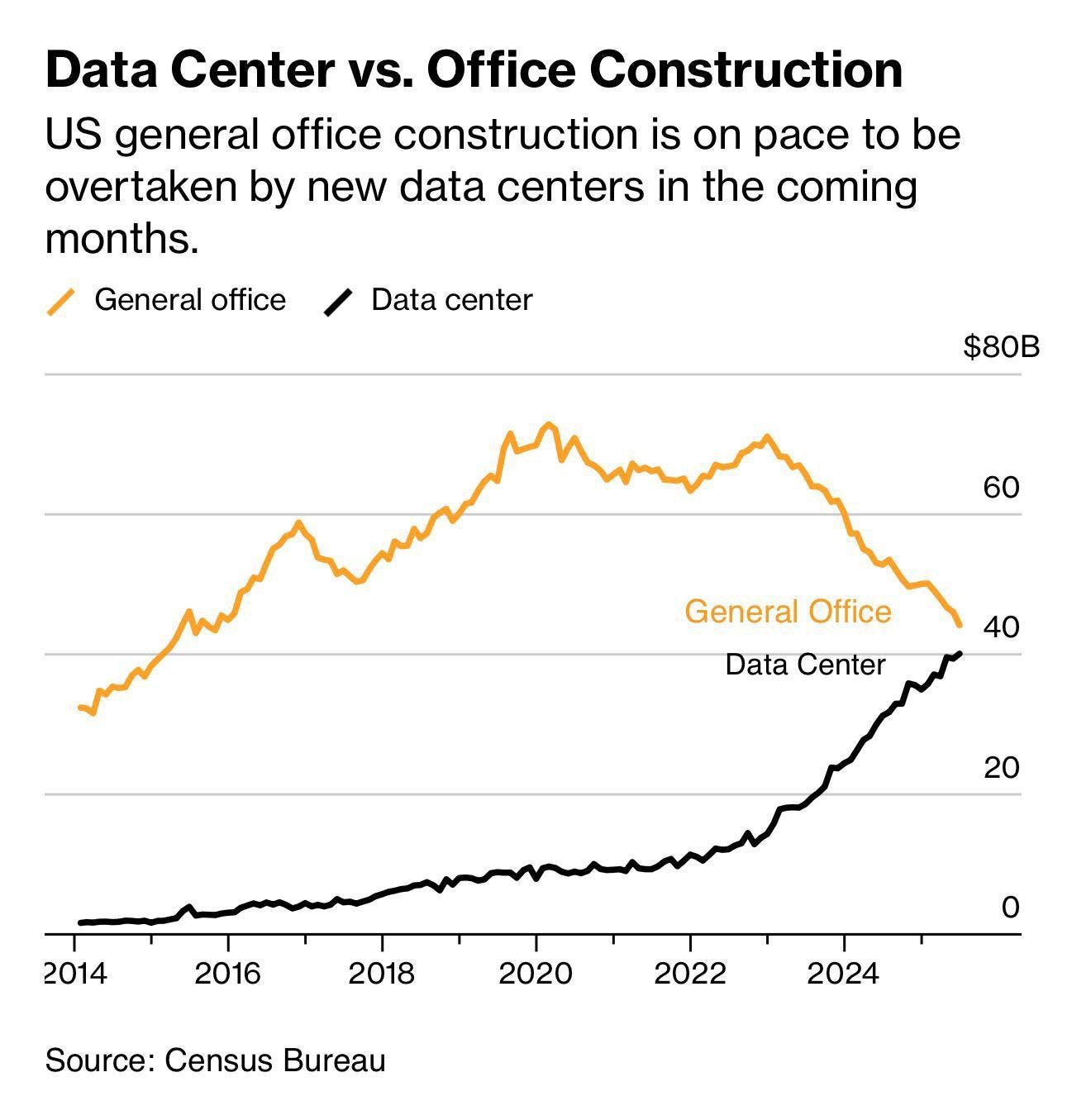
I spent the last few months on a thesis that started with a chart and ended with 44% of my portfolio in companies most people have never heard of.
The chart: for the first time in history, data center construction is overtaking office construction in the US. 2025 is the inflection year. One era ends. Another begins.
Most people saw “cloud computing.” I saw the real estate play nobody recognizes as real estate – except the tenants aren’t humans.
They’re AI agents. And they need housing.
(Whatever marketing genius switched “bots” to “AI agents” deserves a raise.)
The Pattern You’ve Seen Before
Economic transitions follow a pattern. Workers change, resources change, but one thing stays constant: proximity to the critical resource captures value.
1850s: Coal miners needed housing near coal seams. Mine owners got rich.
1950s: Accountants needed offices near city centers. Skyscraper tycoons got rich.
2025: AI agents need data centers near cheap electricity. ??? gets rich.
Fill in the blank.
Coal mines closed. Office buildings replaced them. Now offices are being converted to data centers. Same game, different resource – except this time the workers are digital, and the resource is electrons.
For human workers, factory and housing were separate. You worked at the mine, then went home. For AI agents, the factory is the housing. The data center is both – an AI factory running 24/7. The workers never leave because they are the computation itself.
The “digital labor force”, hard at work.

The Setup Nobody Saw Coming
Remember Bitcoin mining? Those companies everyone laughed at for building warehouses in Texas and Iceland, next to hydroelectric dams, solar farms and geothermal plants?
They had one advantage: cheap electricity. Bitcoin mining is energy arbitrage. Find stranded power – the wind farm that overproduces at night, the dam nobody lives near – and negotiate contracts at $0.02-0.04/kWh.
Then Bitcoin matured. Margins compressed. But something else happened: AI.
Suddenly those same data centers weren’t just useful for Bitcoin. They were perfect for AI training. Same buildings, different tenants.
You can upgrade the computers. You can install new cooling systems. But the grid connection – the multi-year permit to draw hundreds of megawatts – that’s already signed, sealed, and delivered.
They kept the power contract, swapped the hardware, and changed the business model. Bitcoin miners became AI landlords.
You Cannot Print Electrons
In 2025, something shifted. The White House launched two massive initiatives:
Stargate: $500 billion in private investment (OpenAI, SoftBank, Oracle) to build AI data centers by 2029. God emperor Trump stood at the podium next to giga tech bro Sam Altman.
Genesis Mission: A Department of Energy (DoE) program explicitly compared to the Manhattan Project, integrating all 17 National Laboratories into a unified AI platform.
The Silicon Valley barbarians are inside the gate now. David Sacks is AI Czar. The techno-optimists won.
The names aren’t coincidence. The original Manhattan Project built the atomic bomb – and required constructing entire cities, consuming vast electricity, securing scarce uranium. Now we have two new Manhattan Projects. Except this time, the scarce resource isn’t uranium. It’s electricity. And the valuable real estate isn’t in New York – it’s wherever cheap power meets fiber optic cable.

Training frontier models requires gigawatt-scale clusters. Running inference for billions of daily queries requires sustained power. The US grid grows 1-2% annually. AI demand is growing 40-50% annually.
If Microsoft wanted to add 1GW to their Virginia data center in 2024, the utility would say: “Earliest possible: 2028.” Grid infrastructure requires utility interconnection (2-4 year queues), environmental permits (2-3 years), transmission upgrades (3-5 years), substation construction.
Physics doesn’t care about your AI roadmap.
On his first day in office, Trump declared a national energy emergency. The next day, announcing Stargate: “We have to get this stuff built. So they have to produce a lot of electricity…”
The government knows power is the bottleneck. They’re trying to solve it with small modular reactors and fusion research. But even in the best case, that takes 3-5 years. SMRs won’t come online until 2027-2030.
Meanwhile, OpenAI just announced five new data center sites, bringing Stargate to nearly 7 gigawatts of planned capacity. The buildout is happening now.
The companies that already have power – that secured contracts years ago when nobody was competing for it – suddenly have a first-mover advantage nobody can catch.
New entrants face 3-5 year timelines. Permitting, utility queues, NIMBYism – it all adds up. First movers already have power contracts at $0.02-0.04/kWh – half or a third what new entrants would pay. Their infrastructure is built, their grid connections are operational. Everyone else is standing in a queue that stretches to 2028.
You can build a data center in 18 months. You cannot get a grid permit in 18 months. That’s the moat.
The ladder is being pulled up.
The Smart Money
Leopold Aschenbrenner, a former OpenAI researcher, published “Situational Awareness” in June 2024. His thesis: AGI by 2027 is strikingly plausible, driven by compute scaling, algorithmic improvements, and making models more agent-like. We’ll go from “$10 billion compute clusters to $100 billion clusters to trillion-dollar clusters.” American electricity production will need to grow “tens of percent.”
He raised $1.5 billion for an AI infrastructure fund by October. It returned 47% in the first half of 2025. The S&P did 6%.
His largest holdings? Data center infrastructure companies and Bitcoin miners pivoting to AI. Not the AI model builders. Not the application layer. The physical infrastructure – the companies that control energy access to compute.
Demis Hassabis arrives at the same conclusion from the opposite direction. The Google DeepMind CEO has no reason to hype – he has Google’s runway and a Nobel Prize. When he identifies attacks on power grids as AI’s “most obvious vulnerable vector”, and lists “free energy” first in his post-AGI vision, the pattern is clear. The investor and the scientist agree: whoever controls energy controls the AI future.
Whether AGI arrives in 2027 or 2032, the infrastructure has to be built first. I’m betting on the foundation, not the timeline.
Why Efficiency Doesn’t Matter (Jevons Paradox)
The main counterargument: “But AI is getting more efficient! DeepSeek proved you can train models 10x cheaper. Won’t demand collapse?”
No. Jevons Paradox explains why.
When technology gets more efficient, people use more of it, not less. When lightbulbs became 10x more efficient, we didn’t use less electricity – we lit up the night. When cloud computing got cheaper, everyone moved to the cloud. When mobile data got cheaper, everyone started streaming video.
DeepSeek made AI 10x cheaper. That doesn’t mean demand drops 10x. It means AI becomes accessible to 100x more applications: models doing taxes, driving cars, diagnosing diseases, writing code.
The question is whether demand is genuinely insatiable. If AI becomes as ubiquitous as electricity itself, efficiency gains only accelerate adoption.
More efficient models mean more AI factories can run profitably, not fewer.
The Main Risk (Why I Might Be Wrong)
The bear case is simple: efficiency gains outpace demand growth.
Edge-AI is the most plausible threat. What if models get 100x more efficient but applications only grow 10x? Net compute demand declines. The “$100 billion cluster” thesis breaks.
Add to that: Apple’s M-series chips are getting AI accelerators. Qualcomm is building NPUs into every smartphone. If your phone can run GPT-4-level models locally by 2027, cloud inference demand could crater.
Or: Small modular reactors come online faster than expected. Abundant cheap power by 2028-2029. The scarcity thesis breaks. First movers lose their pricing power.
Or: Data centers move to space. 24/7 solar, no cooling costs. Sounds compelling until you remember hardware costs thousands per kilogram to orbit, and latency kills real-time applications. Plus, the timing conveniently aligns with SpaceX’s 2026 IPO. Not saying it won’t happen. Just saying it’s running on “Elon time”.
Or: AGI doesn’t arrive. We hit diminishing returns on scaling. The explosive demand growth never materializes.
These are real risks.
I’m betting against them for two reasons:
Training stays centralized. Even if inference moves to edge, training requires gigawatt-scale clusters. Edge complements data centers – it doesn’t replace them.
Timing. Even if space or SMRs eventually solve scarcity, terrestrial first movers have 5-10 years of runway. That’s enough.
I could be wrong. But I’d rather bet on scarcity while it exists than wait for abundance and miss the window.
How I’m Playing This
Here’s my positioning into 2026:
Core Infrastructure (~44%): IREN 0.00%↑, CIFR 0.00%↑. Bitcoin-to-AI pivot companies. These are the landlords running AI factories. They secured power years ago, and are now renting it to the new AI tenants. IREN is my primary exposure – vertically integrated, underpromise, overdeliver.
Application Layer (~33%): TSLA 0.00%↑ , PLTR 0.00%↑. Tesla is my bet on embodied AI – if robotics scales (FSD + Optimus), it becomes a dominant application layer. AI that moves in the physical world, not just chatbots. Plus, there’s the energy and battery storage optionality for grid stability. Palantir is the other side: the operating system for AI deployment in government and enterprise. If AI agents need a command layer to plug into messy real-world institutions, Palantir is building it.
Diversified Tech Insurance (~11%): QQQ 0.00%↑. The Nasdaq 100 is my “I might be totally wrong” hedge. Liquid, diversified, can redeploy if thesis changes.
Asymmetric Crypto Bet (~11%): If the agent economy emerges, AI agents need programmable money for autonomous transactions. If this doesn’t play out, I lose 11%. If it does, potential 10-50x. Asymmetric.
Cash Buffer: When IREN 0.00%↑ drops 20% on a Tuesday (and it will), I need to be buying, not forced to sell.
The logic: I’m overweight infra (that’s where the moat is), slightly underweight AI applications (commoditizing fast). Money flows to whoever owns the scarce resource.
Exit plan: Start trimming by 2028 regardless of how bullish I feel. The goal isn’t to catch the top – it’s to avoid riding it back down. If I 5x and leave another 5x on the table, I’ll sleep fine.

Most people are looking at the chips.
Look at the power. ⚡️
Disclaimer: Not financial advice. I’m long IREN 0.00%↑, CIFR 0.00%↑, TSLA 0.00%↑, PLTR 0.00%↑, QQQ 0.00%↑, and crypto – so I’m biased. Do your own research. If you think I’m wrong, tell me why in the comments.
On the topic of timelines, check out this fascinating scenario: AI 2027
Here’s an excellent breakdown into IREN by @Agrippa_Inv, if you’re keen.
Related: Am I Early? – the vulnerability of being wrong · Ditch Diworsification – the concentrated investing philosophy behind this bet · Everything Is a Ponzi Scheme – the narrative-driven framework · Money is Stored Time – what these assets represent

Razor-sharp recount of how the historic trends gear up with the current situation. The future is of course unwritten, but there's nothing like having a solid rationale to face it.