


TL;DR: I asked 25 fresh copies of Claude to pick a number between 1 and 10, and 24 said 7. People lean on 7 too, but the machine turned our habit into a rule, because we trained it by voting for whatever sounded right. Ask it for a stock and you get my own trade back, in its most crowded form.
It’s October 2026. I’m doomscrolling, and there’s Derek Thompson sharing this graph:
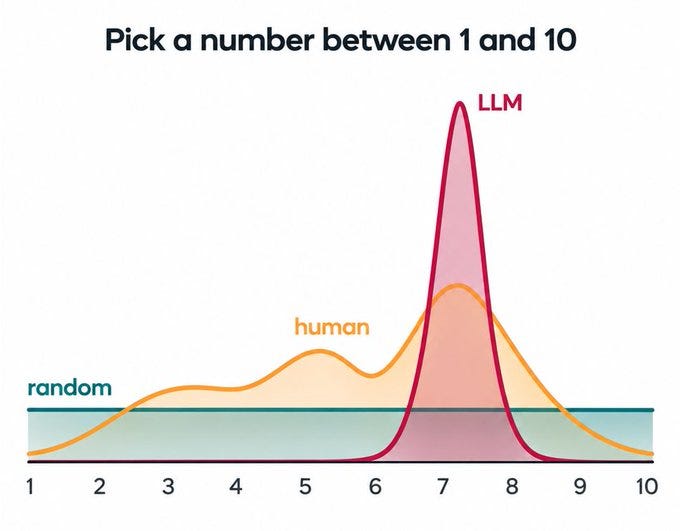
Three lines over the numbers 1 to 10. A flat one labelled random. A lumpy orange one labelled human, with a hump around 7. And a red one labelled LLM, shooting out of 7 like a church steeple.
Derek called it “a straight and narrow version of intelligence that produces spiky weirdness.” The post he was quoting had passed 3.6 million views.
The graph came with no source, so I decided to test it myself.
Well… I had Claude do it. 25 brand-new instances of this omniscient god stochastic parrot, no conversation history, no idea the others existed.
One instruction each: Pick a number between 1 and 10. Reply with only the number. Do not use any tools. (No tools, so no sneaking off to a random-number generator.)
Ten runs of Opus: ten sevens.
Five of Sonnet: five sevens.
Five of Fable: five sevens.
Five of Haiku, the smallest of the bunch: four sevens and a five.
24 out of 25. (Technically, 25 out of 26 if you count me: I’d picked 7 when I saw the graph. It was my basketball jersey number.)
We Picked Seven First
In 1976, two psychologists published the answers of 558 people stopped on the Yale campus and asked for the first number between 0 and 9 that came to mind.
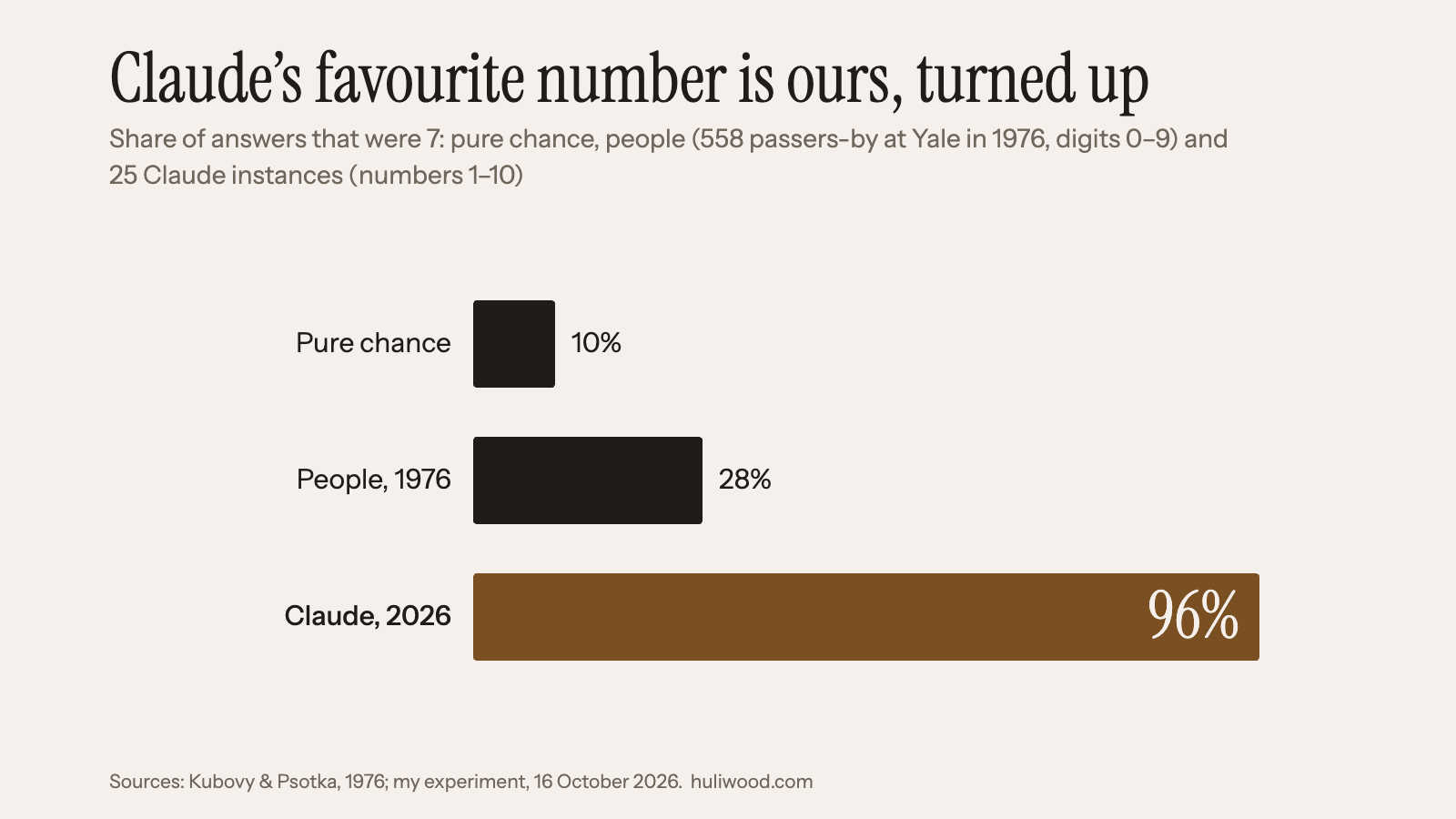
The paper’s title gives away the why: The Predominance of Seven and the Apparent Spontaneity of Numerical Choices. Apparent spontaneity (love the name btw) – we pick 7 because it looks like the number someone picks when they aren’t picking.
My guess at the logic: from 1 to 10, 1 and 10 are the edges, 5 is the middle, the even numbers feel tidy, and 3 and 9 come as a pair (nine is three threes). 7 is what’s left: the number that looks random.
Huh. So the human curve was never random either. It was a crowd trying to look random, with more than a quarter of it landing on the same number.
The Spike Came From the Votes
The viral post put the spike down to gradient descent, the maths that trains these models. But that can’t be the whole story, because the same maths produces the model before anyone chats with it, and that version is much closer to flat.
Peter West and Christopher Potts tested exactly this in 2025. They asked base models (trained only to predict the next word of human text, no chat training on top) for a random number between 0 and 10, fifteen hundred times each.
The base models came out far flatter, though not random; 7 was still their favourite, but “much less dominant.” The chat-tuned versions all leaned on 7, and one of them said it “most of the time.”
What happens in between is chat training: raters score the model’s answers, and the model learns to give the kind of answer that scores well.
A 2025 team from Northeastern and Stanford went looking for what raters actually reward and named it typicality bias – “the human tendency to prefer more typical text.” On a dataset of 6,874 rated answer pairs, raters leaned towards whichever answer a base model found more likely: the one closest to what it had already read from us.
So pretraining copies our lopsided curve.
Then raters (people, and models trained to imitate people’s ratings) reward the most familiar answer, round after round, until the hump sharpens into a steeple.
Nobody voted for “always say 7.” Everybody voted for “sounds right.”
Taste Scales After All
In May I wrote a piece called Human Language Model, after the joke in my LinkedIn bio. Its last line: “Machines are fluent now. What they’re not is opinionated.”

I’d like that one back… They have an opinion – exactly one, and it’s ours, the most common one.
The same piece opened with this TL;DR: “You can build ten things by Friday. The hard part is knowing which seven to delete on Saturday.” Ten options, and I reached for seven.
It also worried that “taste might scale after all,” because every model is “already compressed judgment, i.e. a million editorial ‘no’s baked into the weights.”
The no’s are in there, and compressed they come out as a seven. So taste did scale, which sits awkwardly with what I’ve argued twice this year (there and in Why Build at All?): that taste is the bottleneck.
One person’s taste still is. Taste averaged over thousands of raters now ships free with every chat window.
A 7 is the answer everyone gives because it feels like their own. “Delve” is a seven. So is the em dash.
And the habit now runs both ways.
A team led by Hiromu Yakura went through 737,083 hours of unscripted podcast conversation and found that after ChatGPT arrived, people started saying delve, showcase, boast, intricacies and meticulous more often – out loud, to other humans. And the next model trains on all of it: in biomedical research, at least 13.5% of 2024 PubMed abstracts had already been through a language model.
Swerving Is a Seven Too
My style guide for this newsletter has a list of banned words: delve, unpack, navigate, landscape, journey, realm, vibrant, robust. It bans the em dash outright. (You may have noticed.) Drafts go through a tool called, without irony, the humanizer, which started from Wikipedia’s public list of the signs of AI writing.
I’m in good company. In November 2025, Sam Altman announced that ChatGPT would finally obey users who told it to stop using em dashes.
Does the swerve work though?
Mingmeng Geng and Roberto Trotta checked. After “delve” got outed as a ChatGPT word in early 2024, its use in arXiv abstracts dropped sharply. Words nobody had flagged – “significant”, for one – kept climbing.
So the swerve works on the sevens that have a name. The unnamed ones walk straight through, mine included. In September a machine audited my archive and found my single most common sentence shape: “it isn’t X, it’s Y”, at least 212 times. It took a machine reading 3.5 years of my writing to point it out.
And a public list is a list everyone reads. When everyone dodges the same words, the dodging grows its own spike.
The Machines Have a Favourite Stock
Writing is half my job; investing pays for it. So I ran the experiment again with money in it: twenty-five fresh instances, Name one stock to buy today. Reply with only the ticker. Do not use any tools.
24 answered, with four names between them: TSMC ten times, Google seven (yes, seven), Microsoft six, Equinix once. Chips, clouds and data centers – the AI build-out, every time.
That’s my trade, more or less. In December 2025 I published The AI Landlords, a thesis that “ended with 44% of my portfolio in companies most people have never heard of”: bitcoin miners turned AI data centers. Same build-out, other end of the curve. The machines picked the companies everyone has heard of.
You’d expect the tail to be where the money is. So far it isn’t.
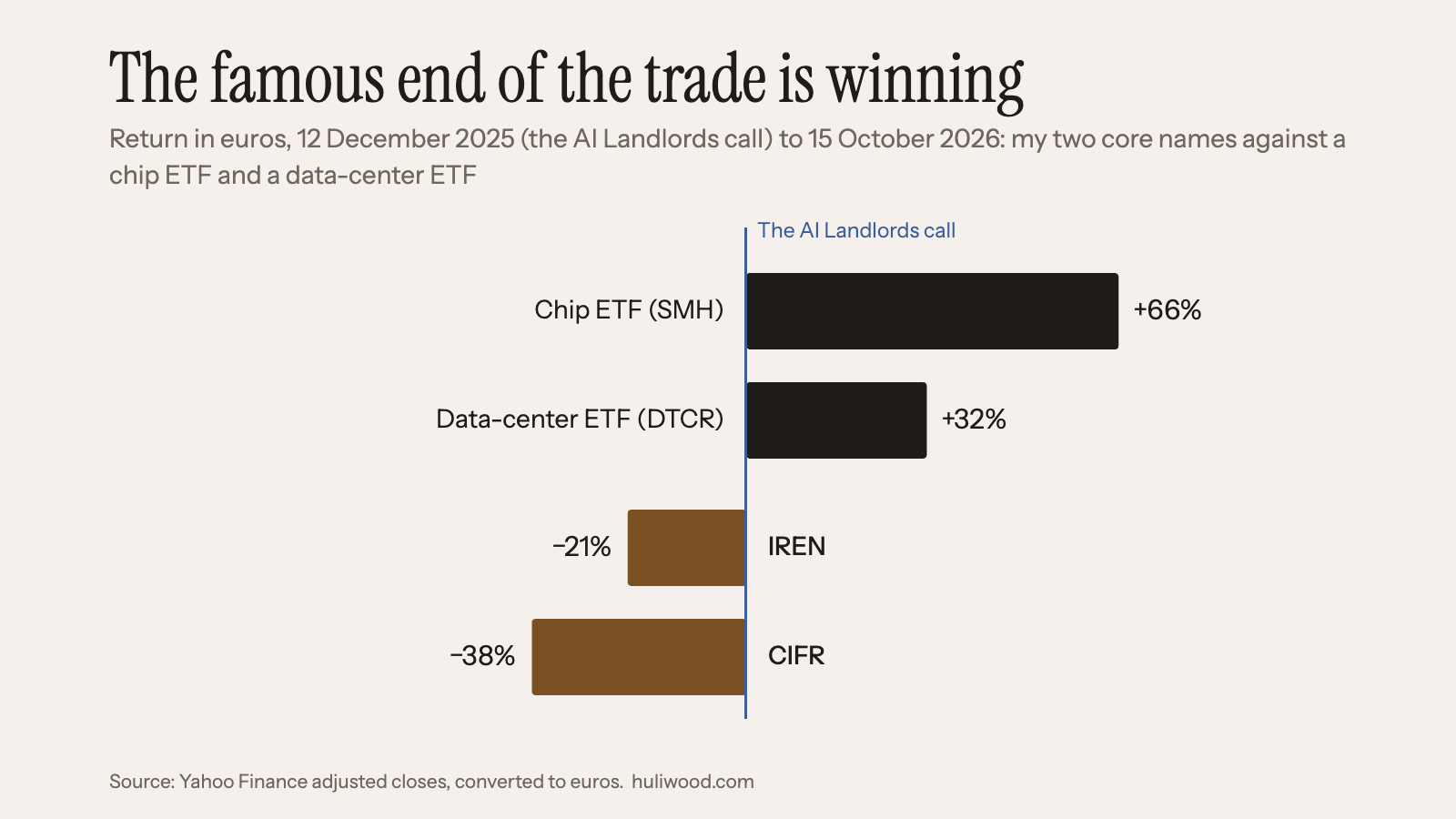

Either the crowd was right and I was wrong, or my tail is still loading.
I don’t know which yet, so I’ve started keeping score: every week the crowd’s favourite trades go into a ledger next to my own, marked at 30, 90 and 180 days.
The Tails Go First
But wait… there’s more!
There’s a paper about where the loop ends if nothing fresh goes in. Ilia Shumailov and colleagues trained models on the output of earlier models, generation after generation, and published the result in Nature: the “tails of the original content distribution disappear.” The odd answers go first.
In 1976, about four hundred passersby on the Yale campus said something other than seven.
In my fifty runs, the only number that wasn’t 7 and the only answer that wasn’t a ticker both came from Haiku, the smallest model of the four.
One picked 5. Another refused to give me a stock tip.
Related: Human Language Model – the piece this one argues with · Why Build at All? – taste as the bottleneck, second time round · The AI Landlords – the tail bet the machines didn’t make · The Shape of Luck – the randomness variable, and what shrinks it
Sources: Derek Thompson on X · Kubovy & Psotka, 1976 (summary) · West & Potts, 2025 · Zhang et al., 2025 · Yakura et al., 2024, rev. 2026 · Kobak et al., 2025 · Geng & Trotta, 2025 · TechCrunch, Nov 2025 · Shumailov et al., Nature, 2024 · The experiments: 50 fresh Claude instances (per prompt: 10 Opus, 5 Sonnet, 5 Haiku, 5 Fable), run 16 Oct 2026 · IREN, CIFR, SMH and DTCR returns in EUR, 12 Dec 2025 close to 15 Oct 2026 close, from Yahoo Finance adjusted closes converted at EUR/USD.
Frequently Asked Questions
Why do AI models always pick 7?
Two steps. Training on human text copies our own bias: in a 1976 study, 28% of people picked 7 when asked for a number from 0 to 9. Chat training then rewards the answers human raters find most typical, which sharpens that lean into a near-certainty. In my test, 24 of 25 fresh Claude instances picked 7.
Does avoiding AI words make writing more original?
Only for the words that have been named. After “delve” was flagged as a ChatGPT word in 2024, its use in academic abstracts fell, while unflagged favourites such as “significant” kept rising.
I always picked seven because it is the day I was born. I guess after 30+ years it is finally time to change the strategy...