

TL;DR: Why did the ships only sail one way? Why Cortés in Tenochtitlan and not Aztec caravels in Seville? Geography, livestock, and 10,000 years of compounding luck.
Why the Ships Only Sailed One Way
In Part 1, I told you about the collision – how two hemispheres met after 12,000 years of separation, how food and disease crossed the Atlantic, how almost 90% of the indigenous American population died within a century.
But I left a question hanging:
Why did the ships only sail one way?
Why was it Spanish caravels in the Caribbean and not Aztec fleets in Cádiz? Why did 168 Spanish soldiers capture the Inca emperor in front of an army of 80,000, and not the reverse?
This question has haunted people for 500 years. The answers reveal more about ideology than about history.
The answer isn’t racial superiority or exceptional greed.
(If you’ve read Guns, Germs, and Steel, you’ll know where this is going…)
It’s geography. Climate. Domesticable species. And 10,000 years of compounding advantages that had nothing to do with virtue and everything to do with luck.
The Axis of Everything
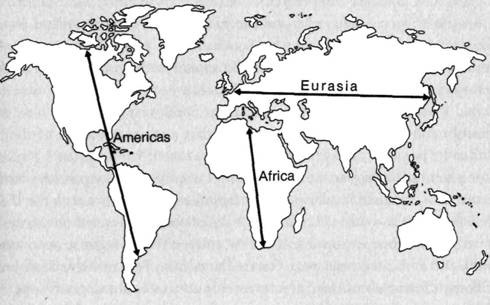
Pull up a map of the world. Draw a line from Portugal to China.
It’s horizontal. Roughly the same latitude the whole way. Similar climates. Similar day lengths. Similar growing seasons.
Now draw a line from Alaska to Patagonia.
It’s vertical. You pass through Arctic tundra, temperate forests, deserts, tropics, more deserts, more temperate zones, and sub-Antarctic cold. Massively different climates stacked on top of each other.
Crops and animals are climate-specific. Wheat domesticated in Mesopotamia could spread to Egypt, to Greece, to Spain, to Northern Europe, to Persia, to India – because all those places have roughly similar growing conditions. One innovation, thousands of miles of diffusion.
In the Americas? A crop perfected in Mexico couldn’t easily reach Peru. Different altitude. Different rainfall. Different seasons. The Andes, the Amazon, the deserts of northern Mexico – these weren’t highways for ideas. They were barriers.
Eurasia’s horizontal axis meant innovations could spread. The Americas’ vertical axis meant innovations stayed local.
This compounded over millennia.
The Livestock Lottery
Why did Eurasia have horses, cattle, pigs, sheep, and goats… and the Americas got llamas?
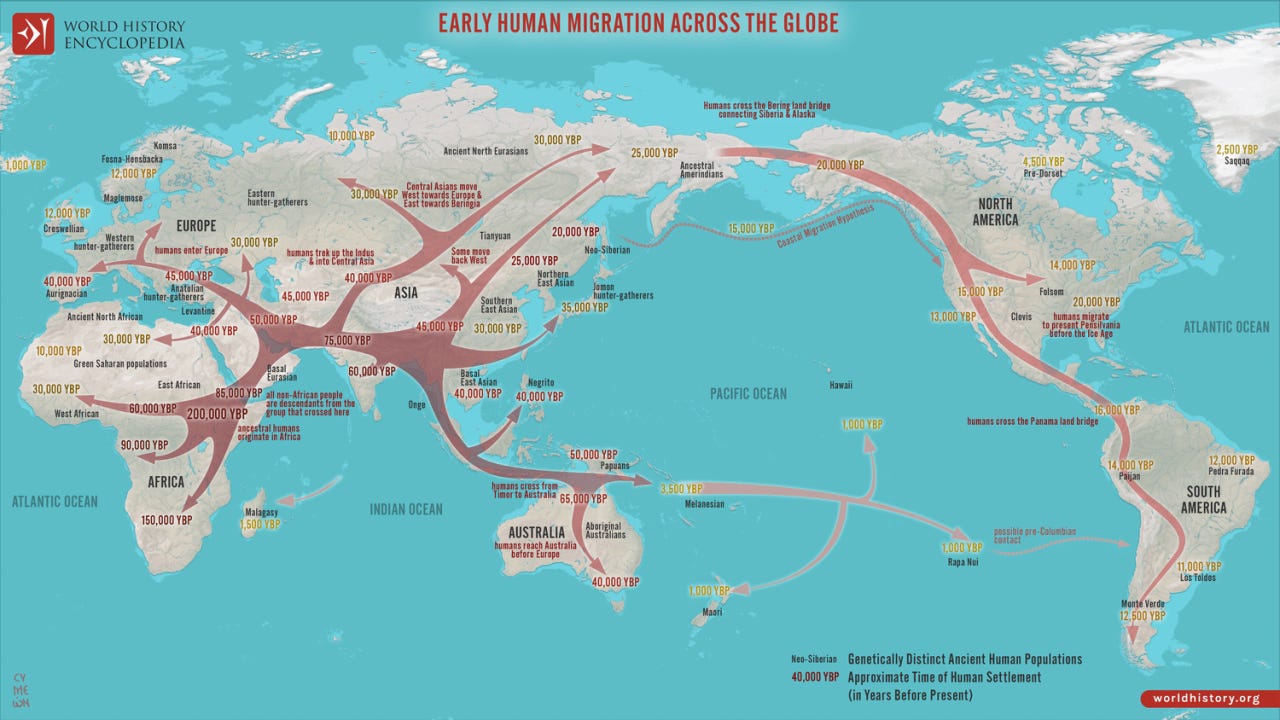
Indigenous Americans turned teosinte, a nearly inedible grass, into corn – arguably the greatest piece of genetic engineering before we invented the term. But large mammals? The Americas got unlucky.
At the end of the last ice age, the Americas lost most of their megafauna. Mammoths, giant ground sloths, native horses, camels… all went extinct. The leading theory: early human hunters ate them before anyone thought to saddle them.
What was left? Llamas and alpacas in the Andes. Useful for wool and light cargo. Useless for pulling plows, carrying cavalry, or providing milk at scale.
Eurasia kept its horses, cattle, and pigs. The Americas didn’t.
Horses meant cavalry, fast communication, and military dominance. Cattle and pigs meant dense protein, meaning larger populations, meaning more specialists who didn’t have to farm – scribes, soldiers, priests, inventors.
Domesticated animals also meant diseases. Smallpox probably came from rodents. Measles came from cattle. Influenza came from pigs and birds. Eurasia’s long cohabitation with livestock hardened its populations – and devastated everyone else.
The Americas didn’t have these animals. So they didn’t have the calories, the cavalry, or the immunity.
Not because they were inferior. Because the lottery of extinction went against them 12,000 years before anyone was keeping score.
The Compounding Gap
By 1492, the compound interest of geography had opened a technological gap that couldn’t be closed in a single generation – or a hundred of them.
Europe had steel weapons and armor, gunpowder and cannons, ocean-going ships with advanced navigation, horses (the tanks of pre-modern warfare), and immunity to devastating diseases.
The Americas had agriculture (often superior to European methods). Monumental architecture like Tenochtitlan and Machu Picchu. Advanced mathematics; the Maya invented zero independently. But none of that stopped a steel sword, outran a horse, or survived smallpox.
The gap wasn’t about intelligence or culture. It was about which technologies had been invented, diffused, and compounded over the previous 10,000 years.
Eurasia had more land, more people, more domesticable species, more connection between civilizations, and more centuries of competitive pressure. Every empire that rose and fell left tools and ideas for the next one to build on. The Mediterranean, the Silk Road – networks of exchange that accelerated everything.
The Americas had civilizations, but they were more isolated – from each other and from the Old World. Innovations didn’t diffuse as widely. The competitive pressure was different.
The Audacity Gap
In 1519, Hernán Cortés landed on the coast of Mexico with about 500 men, 16 horses, and a few cannons. He was ignoring orders from the governor of Cuba. His mission, officially, was exploration, driven by rumors of immense gold and sophisticated cities.
The Aztec Empire had millions of subjects, a massive military, and a capital city larger than any in Spain. Cortés had 500 guys.
What did he do? He scuttled his own ships. His men couldn’t retreat. They would conquer or die.
Then he marched inland, making alliances with every group that hated the Aztecs – the Tlaxcalans, the Totonacs, the Texcocans. By the siege of 1521, his 500 Spaniards were joined by tens of thousands of indigenous allies.
The Aztecs weren’t conquered by Spain. They were conquered by a coalition of their own enemies, led by Spanish shock troops with technological advantages.
Cortés succeeded through audacity, diplomacy, and leverage. Also: steel, guns, horses, and smallpox.
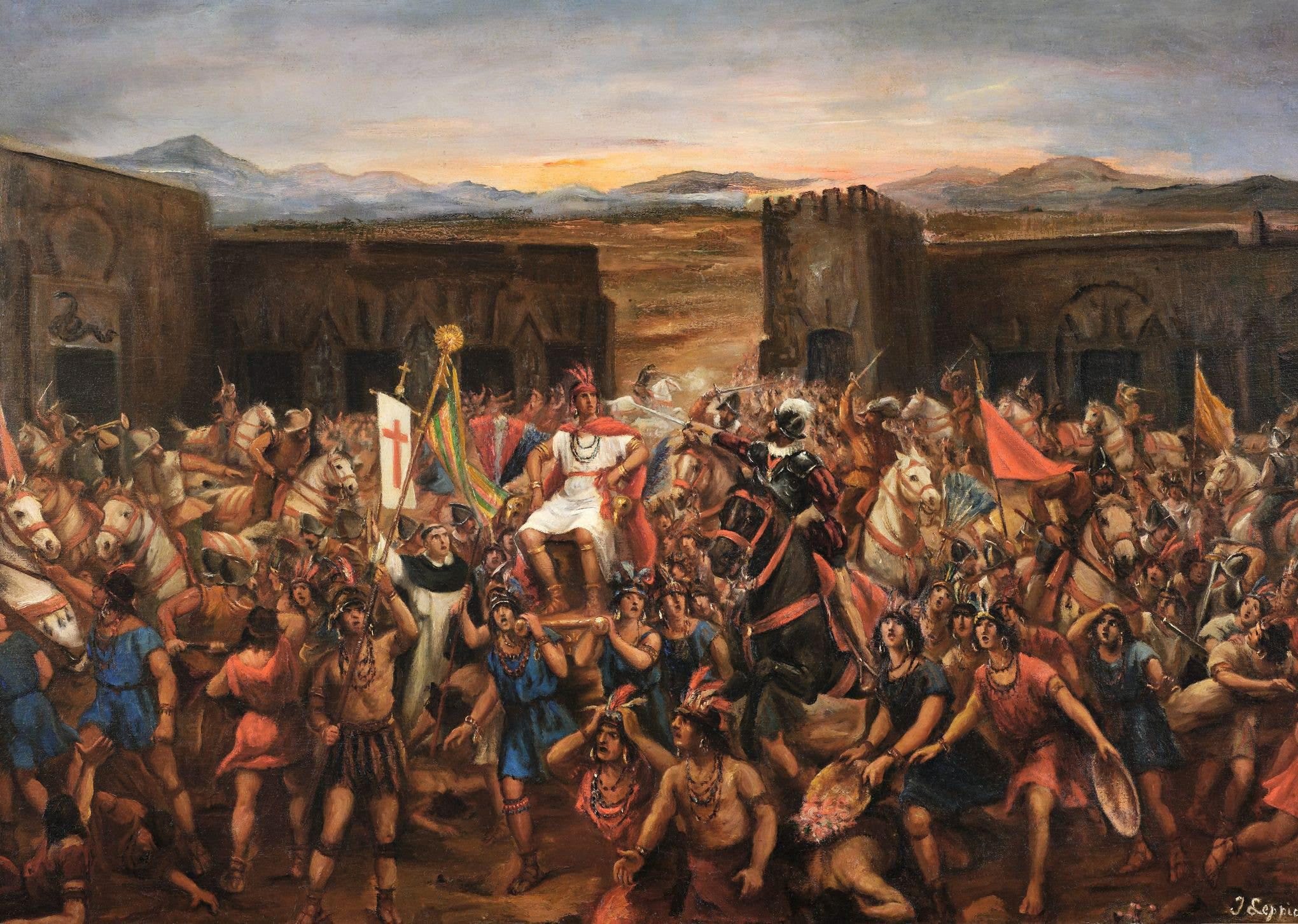
Thirteen years later, Pizarro did it again – 168 men captured Atahualpa in front of an army of 80,000 at Cajamarca. Horses they’d never seen, armor their weapons couldn’t penetrate. One afternoon, one empire decapitated.
That’s what a technological gap looks like when it compounds for 10,000 years. Leverage doesn’t negotiate.
Blood on Every Hand
The Columbian Exchange is often told as European villainy meeting indigenous innocence. The reality was messier.
The Aztecs ran an empire built on terror and human sacrifice. Estimates vary – several thousand per year on average, with tens of thousands during major ceremonies like temple consecrations. Hearts cut out with obsidian blades. Skulls displayed on racks. Flower wars fought specifically to capture victims.
When Cortés arrived, the peoples subjugated by the Aztecs didn’t see him as an invader. They saw him as a liberator. The Tlaxcalans had been fighting the Aztecs for generations. They joined the Spanish after fighting them first.
The Inca Empire was an authoritarian state that relocated entire populations, suppressed local languages, and executed dissent. It was in the middle of a civil war when Pizarro arrived – a war triggered partly by the smallpox epidemic that had killed the previous emperor.
Meanwhile, European kingdoms had been slaughtering each other for centuries. Religious wars would soon kill millions.
Every civilization had blood on its hands. Every empire was built on conquest. The difference in 1492 wasn’t morality. It was capability.
If the technological gap had gone the other way, does anyone seriously believe the Aztecs would have sailed to Seville and asked nicely?
Power is abused wherever power exists.
That’s not a European trait, but a human one.
Still, the Spanish at least paused to ask. In 1550, the Crown debated whether conquering indigenous peoples was just. The English colonial model didn’t bother with the question. The result: Latin America is mestizo. North America saw demographic replacement.
Neither model was good. But they were different.
The Question That Remains
Geography gave some civilizations advantages. Those advantages compounded. When worlds finally collided, leverage determined outcomes.
But this raises another question – one that goes beyond ships and steel.
Why did Western Europe, specifically, capitalize on these advantages so aggressively? Why did a peninsula on the edge of Eurasia become the launchpad for global colonization, and not China, or India, or the Islamic world – all of which had technological sophistication, ocean-going ships, and centuries of head start?
And if the pattern of collision and leverage keeps repeating – if history rhymes – what does that mean for now?
That’s Part 3.
Next: The Ships are Sailing Again – psychology, potatoes, and why the pattern is repeating. ⬇️


Yes, bad luck for some and (undeserved?) fortune for others... yet it's what they did with their advantage what also matters. You tiptoe around the different approaches between the Spanish new territories and the English colonies, of course it wasn't the main subject of this post but it's still worthwhile to consider the legacies on each case. But of course we know who's always had better marketing.