

TL;DR: Before 1492, there were no tomatoes in Italy, no potatoes in Ireland, no chili peppers in Thailand. When two worlds that had developed in isolation for 12,000 years finally collided, one had ships, steel, and smallpox. The other didn’t.
The Golden Apple
You’re in Rome. Sitting at a trattoria with a 4.4-star rating you looked up on Google Maps. You’re watching an old Italian man gesticulate violently at his son about the correct way to prepare sugo al pomodoro. Hands flying. Voice rising. A generational argument about tomato sauce – where food is religion and recipes are scripture.
Then it hits you.
This guy’s ancestors had never seen a tomato.
The pomodoro (“golden apple” in Italian) arrived from Mexico (aka the artist formerly known as Virreinato de Nueva España) sometime in the 16th century. For decades, Europeans thought it was poisonous (it’s in the nightshade family). The tomato didn’t become a staple of Italian cuisine until the 18th century.
The “ancient” tradition this man was defending? Younger than the United States.
You look down at your plate. Pasta al pomodoro. A lie dressed as heritage.
The Menu That Didn’t Exist
Before 1492, there were no potatoes in Ireland.
The Irish Famine that killed a million people and scattered the Irish across the globe was caused by dependence on a Peruvian tuber that had only arrived about 270 years earlier.
There were no chili peppers in Thailand, India, or China – that “authentic” Sichuan heat is Mexican, and every chili-hot Asian dish you’ve ever eaten is a post-Columbian invention.
There was no chocolate in Switzerland; the entire Swiss chocolate industry is built on Mesoamerican cacao beans.
No peanuts in West African stew – the peanut is South American, crossed the Atlantic, became a staple in Africa, then crossed back to America with enslaved Africans.
Every nonna’s “ancient family recipe” is probably younger than the Protestant Reformation.
The Columbian Exchange is the term historians use for the massive, permanent transfer of plants, animals, diseases, people, and ideas between the Americas and the Old World triggered by Columbus’s 1492 voyage. It reshaped every cuisine, economy, and population on Earth – and killed a larger share of humanity than any war in history.
For roughly 12,000 years – from the end of the last ice age until 1492 – the Eastern and Western hemispheres developed in near-total isolation. Same species, same basic cognitive hardware, almost no contact. Two parallel experiments in human civilization, running simultaneously, with no idea the other existed.
Then three leaky Spanish ships bumbled into the Caribbean, looking for India.
The Great Exchange
What followed was the largest biological swap in human history.
Think of it as two continents exchanging care packages (except one contained an apocalypse).
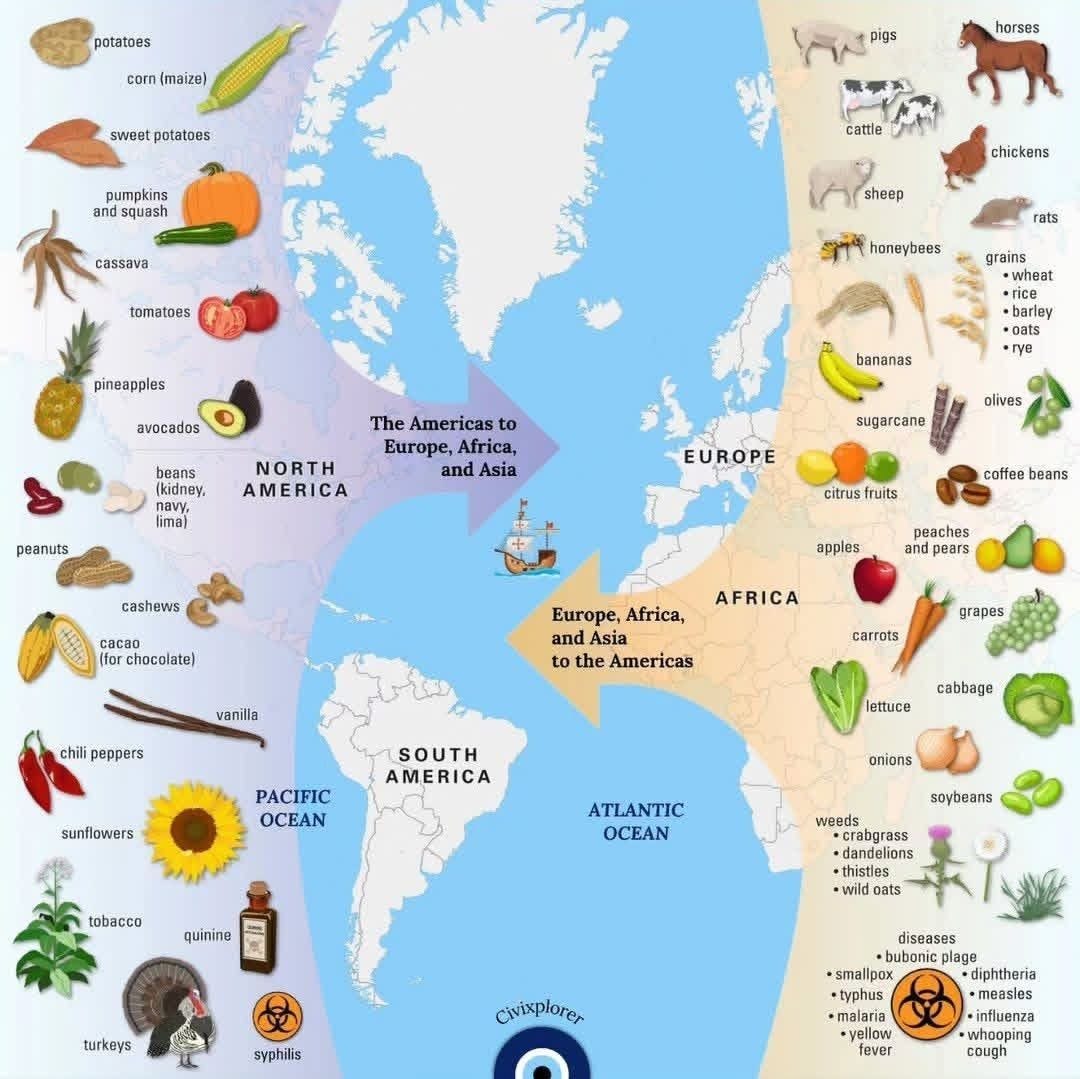
The Americas shipped east: tomatoes, potatoes, corn, cacao, vanilla, chili peppers, peanuts, avocados, squash, tobacco, rubber. For domesticated animals? Turkeys. And llamas.
The Old World shipped west: wheat, rice, sugarcane, coffee, grapes, citrus fruits, apples, bananas, onions, carrots. Horses, cattle, pigs, sheep, goats, chickens. And smallpox, measles, typhus, influenza, bubonic plague, cholera, malaria, yellow fever, whooping cough, diphtheria.
The Americas sent food. The Old World sent livestock, crops – and a pandemic apocalypse.
The Ledger That Doesn’t Balance
Within 100 years of Columbus’s landing, some 50 million indigenous Americans were dead – up to 90% of the population.
The cause wasn’t primarily warfare, though there was plenty of that. It was disease.
For 12,000 years, the populations of Eurasia and Africa had been brewing a biological weapon they didn’t know they carried. Smallpox, measles, influenza – these diseases evolved alongside dense human populations and their domesticated animals.
Europeans had survived countless plagues. The survivors carried immunity. They also carried the pathogens.
The Americas had none of this. No epidemic diseases (with a few exceptions). No herd immunity. No resistance.
When the worlds met, it was a biological massacre.
(The Americas did send syphilis back – the “Great Pox” appeared in Europe in 1495. But it wasn’t remotely a fair trade.)
The Death of Tenochtitlan
In 1519, when Hernán Cortés first laid eyes on Tenochtitlan, it was one of the largest cities on Earth.
Built on an island in Lake Texcoco, connected by causeways, filled with canals, temples, markets, and gardens. Population: somewhere between 200,000 and 300,000 people. As large as Paris. Larger than London. Larger than any city in Spain.
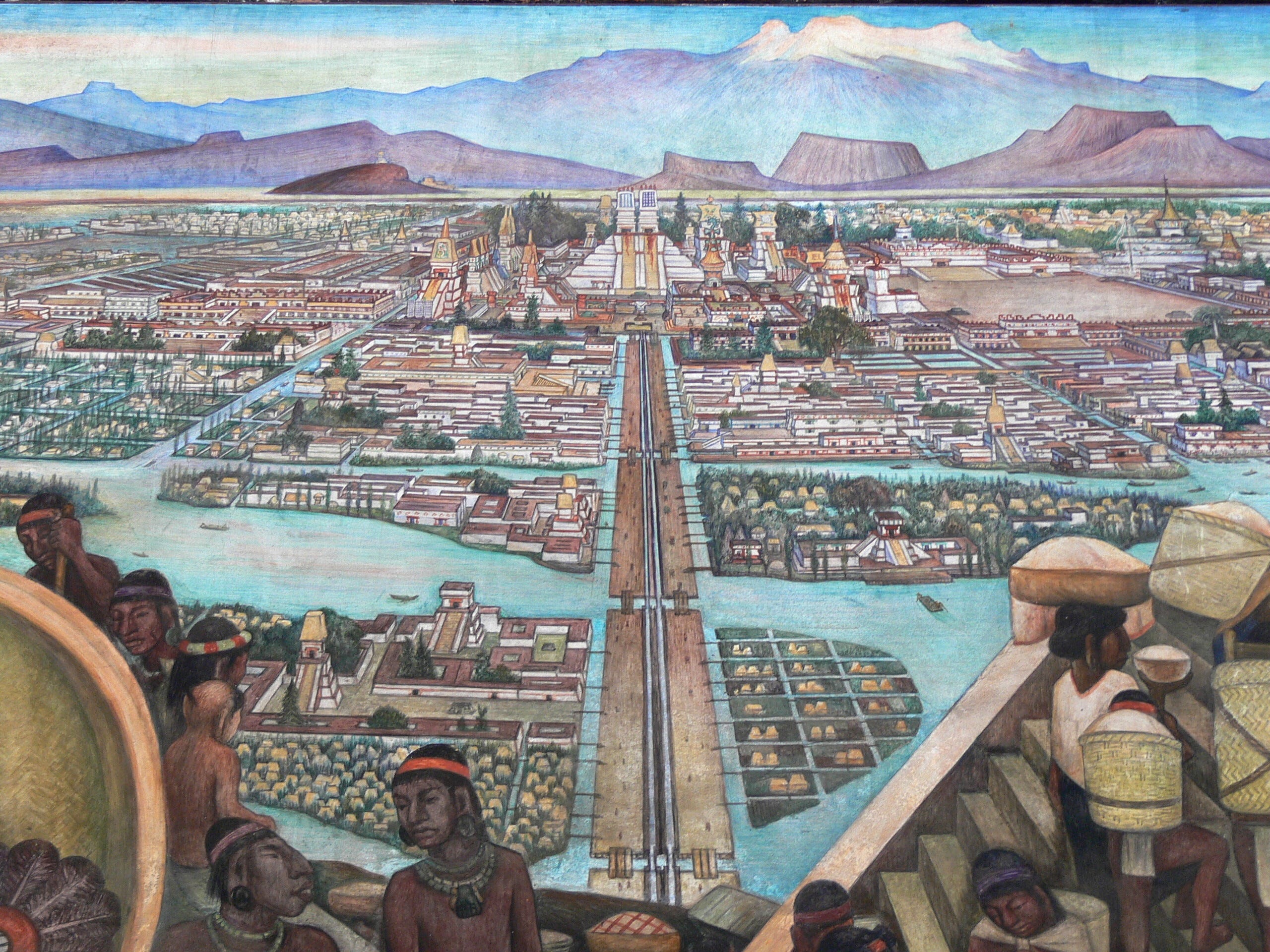
Bernal Díaz del Castillo, one of Cortés’s soldiers, described the moment:
“We were amazed and said that it was like the enchantments they tell of in the legend of Amadis, on account of the great towers and cues [temples] and buildings rising from the water... Some of our soldiers even asked whether the things that we saw were not a dream.”
They thought they were hallucinating. Nothing in Europe compared.
By 1576 – less than 60 years later – the population of central Mexico had collapsed from roughly 25 million to about 1 million. Tenochtitlan, renamed Mexico City, held perhaps 30,000 people.
Smallpox arrived in 1520, brought by a single infected man on a Spanish ship. It swept through the city like fire. The Aztec emperor Cuitláhuac died of it after ruling for only 80 days.
This pattern repeated across the hemisphere.
Hernando de Soto marched through the American Southeast in 1539. He encountered large, complex societies along the Mississippi. When French explorers arrived 150 years later, they found scattered villages and stories of a great plague. De Soto’s expedition may have carried the pathogens that destroyed civilizations he never conquered.
The Inca Empire was in the middle of a civil war when Pizarro arrived – a civil war caused partly by a smallpox epidemic that had killed the emperor and spread chaos through the realm.
The disease outran the conquistadors by years.
Entire cultures vanished before anyone could record their names. Languages. Histories. Technologies. Gone. Not conquered, but erased by microscopic organisms that neither side understood.
The Asymmetry
Why was the exchange so lopsided? Why did Eurasian diseases devastate the Americas, but American diseases barely touched Europe?
The answer comes back to those care package lists. Look at the animals.
Eurasia’s roster: horses, cattle, pigs, sheep, goats, chickens, donkeys, camels.
The Americas? Llamas, alpacas, guinea pigs, turkeys, dogs.
Spot the firepower gap.
Most epidemic diseases – smallpox, measles, influenza – are zoonotic. They started in animals and jumped to humans. They evolved in societies with large domesticated mammals, dense populations, and urban centers.
Eurasia had all three, for thousands of years. The Americas had far fewer domesticable large mammals (most went extinct at the end of the last ice age), smaller and less dense populations, and fewer urban centers.
Europe was a disease factory. The Americas were immunologically naive.
It wasn’t a plan. It was 12,000 years of divergent biological evolution meeting in a single catastrophic moment. But the result was a lopsided apocalypse that shaped everything that came after.
The World We Inherited
The Columbian Exchange didn’t just change what people ate. It changed who lived, who died, and who inherited the Earth.
The population collapse in the Americas opened land for European colonization. The crops that crossed the Atlantic – potatoes, corn, cassava – fueled population explosions in Europe, Africa, and Asia.
The silver mined in Potosí flowed to China, reshaping global trade. The sugar planted in the Caribbean created demand for enslaved African labor, expanding the Atlantic slave trade.
Every major demographic, economic, and political pattern of the last 500 years traces back, in some way, to this collision (which is why I find it so fascinating).
After a trip to México in 2022 – walking through the legacy of mestizaje, standing where Cortés stood – I couldn’t shake one question:
Why did the ships only sail one way?
Also, why was it Columbus stumbling into the Bahamas and not Aztec caravels landing in Seville? And why did Cortés conquer Tenochtitlan and not Moctezuma conquer Madrid?
Next: Haters Gonna Hate, Potatoes Gonna Potate – geography, guns, and the uncomfortable truth about civilizational divergence. ⬇️


Frequently Asked Questions
What is the Columbian Exchange?
The Columbian Exchange is the term for the transfer of plants, animals, diseases, and people between the Americas and Afro-Eurasia after Columbus reached the Caribbean in 1492. The two hemispheres had been biologically cut off from each other for roughly 12,000 years – since the land bridge between Siberia and Alaska disappeared. Once reconnected, crops like potatoes and maize moved east while wheat, horses, and cattle moved west. The disease side was far worse – smallpox, measles, and other Old World pathogens killed an estimated 90% of the Indigenous population of the Americas.
What foods came from the Columbian Exchange?
From the Americas: potatoes, maize (corn), tomatoes, cacao (chocolate), vanilla, peanuts, squash, peppers (including chili), tobacco, rubber, and cassava. From the Old World: wheat, rice, sugarcane, coffee, bananas, citrus fruits, onions, and lettuce. Many of these transplants became so embedded in their new homes that the pre-1492 absence sounds made up – Italian food without tomatoes, Thai cooking without chili, Irish farming without potatoes.
Did Italy have tomatoes before 1492?
No. Tomatoes are native to western South America and did not exist anywhere in Europe, Asia, or Africa before 1492. Spanish explorers brought seeds back in the early 1500s, but Europeans were suspicious – many thought the fruit was poisonous because it belongs to the nightshade family. It took roughly 200 years before tomatoes became a kitchen staple in Italy. The same goes for peppers in India, potatoes in Germany, and peanuts in West Africa – all New World plants that arrived via the Columbian Exchange.
Why did European diseases kill so many Native Americans?
Immunological naivete. The populations of the Americas had been separated from Eurasian disease pools for thousands of years and had no inherited or acquired resistance to smallpox, measles, influenza, typhus, or malaria. In Eurasia, centuries of living with domesticated animals – cattle, pigs, chickens, horses – had created a brutal evolutionary filter: people who survived epidemics passed on partial resistance to their children. The Americas had far fewer domesticated animals and therefore far fewer zoonotic diseases to build resistance against. When contact came, epidemics often raced ahead of the colonisers, collapsing civilisations before Europeans arrived in person.
How many people died from the Columbian Exchange?
Estimates vary, but most historians put Indigenous mortality at roughly 90% of the pre-contact population over the first 100-150 years after 1492. If the pre-contact population of the Americas was around 50-60 million (some estimates run higher), that means tens of millions of deaths – mostly from disease, with warfare, forced labour, and displacement compounding the toll. Some researchers argue the demographic collapse was severe enough to cause a measurable drop in global CO2, as abandoned farmland was reclaimed by forests.
Tomatoes from New Spain, current Mexico.... great recount and beautiful script. You leave us on a cliffhanger... waiting now on tenterhooks.