

TL;DR: Civilization runs on psychoactive substances. Always has. Coffee is the state-sanctioned stimulant of capitalism – we’re all on drugs, we just call this one “productivity.”
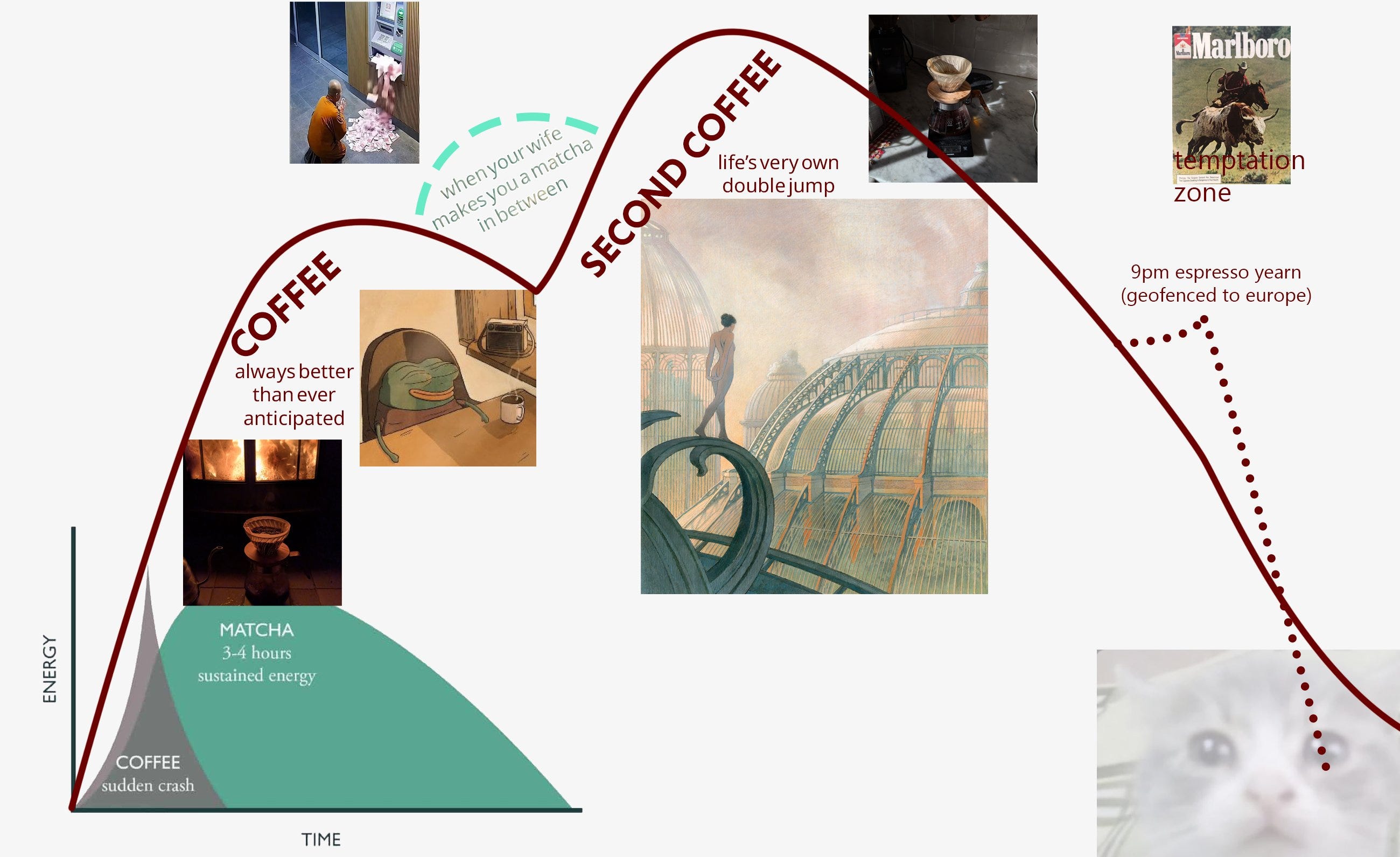
Disclaimer: I’m writing this on my third cup.
My thoughts are sharp, my fingers are twitching, and I have a sudden urge to reorganize my room – while sitting dangerously close to the blast radius of a third-cup gamble that can hit you anywhere, and nowhere is safe. We’ve agreed to call this “being productive.”
But let’s call it what it is: I’m on drugs. Legal ones. Socially encouraged ones. The kind you can expense.
This feeling – caffeinated anxiety masquerading as ambition – is barely 400 years old. Before coffee, nobody felt this way. They felt different things. Mildly buzzed, mostly.
Because they were drunk.
The Great Sobering
We romanticize the past – great thinkers struck by divine inspiration in candlelit studies.
We forget to ask: what was in their cup?
If you lived in Europe before the 1600s, the answer was simple: alcohol. People drank beer, ale, and wine. Morning, noon, and night.
Rich or poor, the average European spent the Middle Ages in a mild, permanent haze. It was a depressant culture – life was slower, reality harsh, vision blurred. Nobody was optimizing anything.
Then, around 1600, a dark bitter sludge arrived from the East. Within decades, Europe sobered up. The fog lifted. And suddenly, everyone had opinions about how to run the world.
We didn’t become smarter. We switched substances.
Every civilization gets the drug it deserves. Medieval Europe got a depressant. Industrial Europe got a stimulant.
The Devil’s Drink
When coffee first arrived in Venice via the Ottoman Empire, the local priesthood panicked. This hot, bitter, black liquid was favored by infidels. Obviously: Satan’s drink.
They petitioned Pope Clement VIII to ban it. But Clement was a man of taste. He requested a sample, took a sip, and allegedly said:
“This Satan’s drink is so delicious that it would be a pity to let the infidels have exclusive use of it.”
He baptized the bean. The Caffeine Age had begun.
Penny Universities
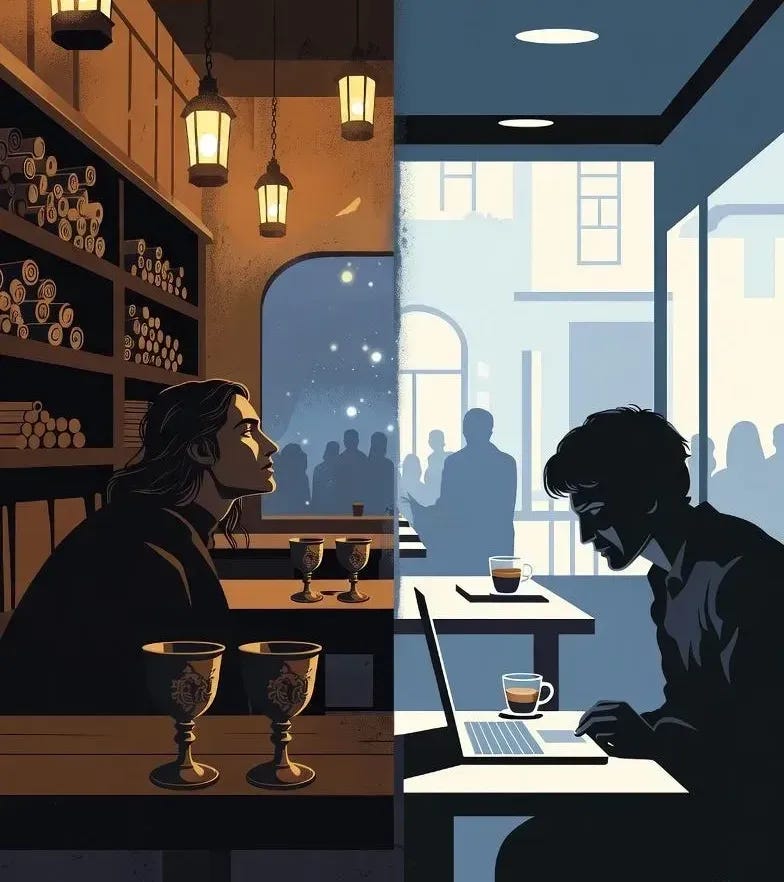
The venue changed everything. The tavern was dark and chaotic – you went there to forget. The coffeehouse was bright and intense – you went there to remember.
For the price of a cup, you could listen to the smartest people in London argue for hours. Coffeehouses became “Penny Universities” – an unregulated, high-speed information exchange where news, rumors, and genius traveled at equal velocity.
Lloyd’s of London started as a coffeehouse where sailors shared shipping news. The Royal Society, where Newton argued physics, was born in Oxford coffeehouses. Voltaire reportedly drank 40 to 50 cups a day (probably exaggeration, possibly a death wish).
The “Age of Reason” coincides exactly with mass adoption of a psychoactive stimulant that promotes linear, analytical thinking. Coincidence is doing a lot of work in that sentence.
We went from “eh, let’s see what happens” to “let’s measure everything, categorize the universe, and overthrow the monarchy.”
The Enlightenment wasn’t divine inspiration, but a continent-wide stimulant binge.
The Trade-Off
We changed how we experience time itself.
Before coffee, time was vague. You worked “from dawn to dusk.” You ate “when hungry.” Appointments were “morning-ish.” The medieval clock had no minute hand – hours were enough.
After coffee, we invented the minute hand. Then the second hand. Then the schedule. Then the 40-hour workweek. Then the pomodoro technique. Caffeine made precision possible, so we demanded precision everywhere.
We traded drunken haze for caffeinated anxiety.
Alcohol lets you tolerate a bad reality. Coffee forces you to notice it – and makes you anxious enough to try fixing it. One keeps you docile. The other keeps you productive.
The Only Legal Speed
Guess which one the economy prefers.
Walk into any café in a major city. Sea of glowing Apple logos. The de facto office for anyone renting a table for the price of a flat white.
We go there to be seen working. We surround ourselves with other caffeinated people to validate our own anxiety. It’s the only public space where staring at a screen for four hours without speaking counts as social activity.
Zoom out: millions of people, voluntarily drugging themselves daily, calling it “morning routine.”
A psychoactive substance so embedded in culture that refusing it is treated as a personality disorder. “I don’t drink coffee” gets the same look as “I don’t own a phone” – somewhere between concern and suspicion.
We’re not more disciplined than our ancestors. We’re not more evolved. We just switched which substance we use to get through the day. They numbed reality with alcohol. We accelerate through it with caffeine.
Neither state is natural. We just prefer the one that builds economies.
Did coffee spark the Renaissance? No. The Renaissance was a wine-drunk dream of beauty.
Coffee sparked the Enlightenment. It gave us science, democracy, and capitalism. It took the human brain, wiped off the beer foam, and overclocked the processor.
I glance at my empty cup. Third one today. I’ve written this post, reorganized my closet, and replied to seventeen messages. I feel sharp. Efficient. Anxious in a way that feels like ambition.
My ancestors were drunk. I’m caffeinated. We’re all on something.
Now, if you’ll excuse me, I need to inzuppare il biscotto nel caffè, as they say in Italy.
Gorlami. ☕️ 🤌
More on clarity: Cold Introspection ⬇️

🤎