


TL;DR: I spent months melting in Southeast Asia and came back with a theory about why cold countries are rich. It’s not what the race science guys think. Put down the calipers.
Imagine you’re standing at the pier waiting to take the ferry somewhere equatorial. Paradise island from a postcard. Just one problem: you’re dripping. Not metaphorically. Sweat pools in places you didn’t know had pores. The humidity reads 94%, which shouldn’t be legal. You only survive by being in water (swimming pool/ocean) or water will come out of you (sweat). Either way, you’re always wet.
Standing there and breathing is sweat-inducing. Now imagine opening a laptop. Important thoughts waiting to be thought. The cursor blinks, patient and judgmental.
Nothing comes.
Your brain has the consistency of pho broth: warm, murky, unable to hold shape. A gecko on the wall, waiting to feast on the mosquitos, makes more progress than you do on this paragraph (always thank your gecko for working hard to keep you mosquito-bite-free, folks).
Months in SEA – Indonesia, Philippines, Vietnam, Singapore, Malaysia – left me with a hypothesis I can’t shake.
Cold climates built the civilizations that currently run the scoreboard. Not through superior genes. But through superior pressure.
Before you reach for your skull-measuring calipers to assess the cranium of a stout Filipino man, hear me out.
(If you don’t know what phrenology is, congratulations. You’ve avoided some dark corners of the internet.)

The Winter Filter
Winter kills the improvident.
If you don’t store grain, you starve. If you don’t cooperate, you freeze. If you eat the seed corn in October, you’re dead by February.
For millennia, seasonal climates ran a brutal filter – not for IQ, but for behaviors: planning, saving, trusting strangers enough to trade with them. The penalty for short-term thinking wasn’t poverty. It was death.
These behaviors became cultures. Cultures that rewarded delayed gratification, property rights, long-term planning. The pressure that built infrastructure also built minds capable of maintaining it.
GDP per capita versus average temperature: the correlation is strong. Temperature alone explains about a quarter of the gap between rich and poor countries. Norway, Sweden, Canada at the top. Chad, Niger, Mali at the bottom. But a quarter isn’t everything.
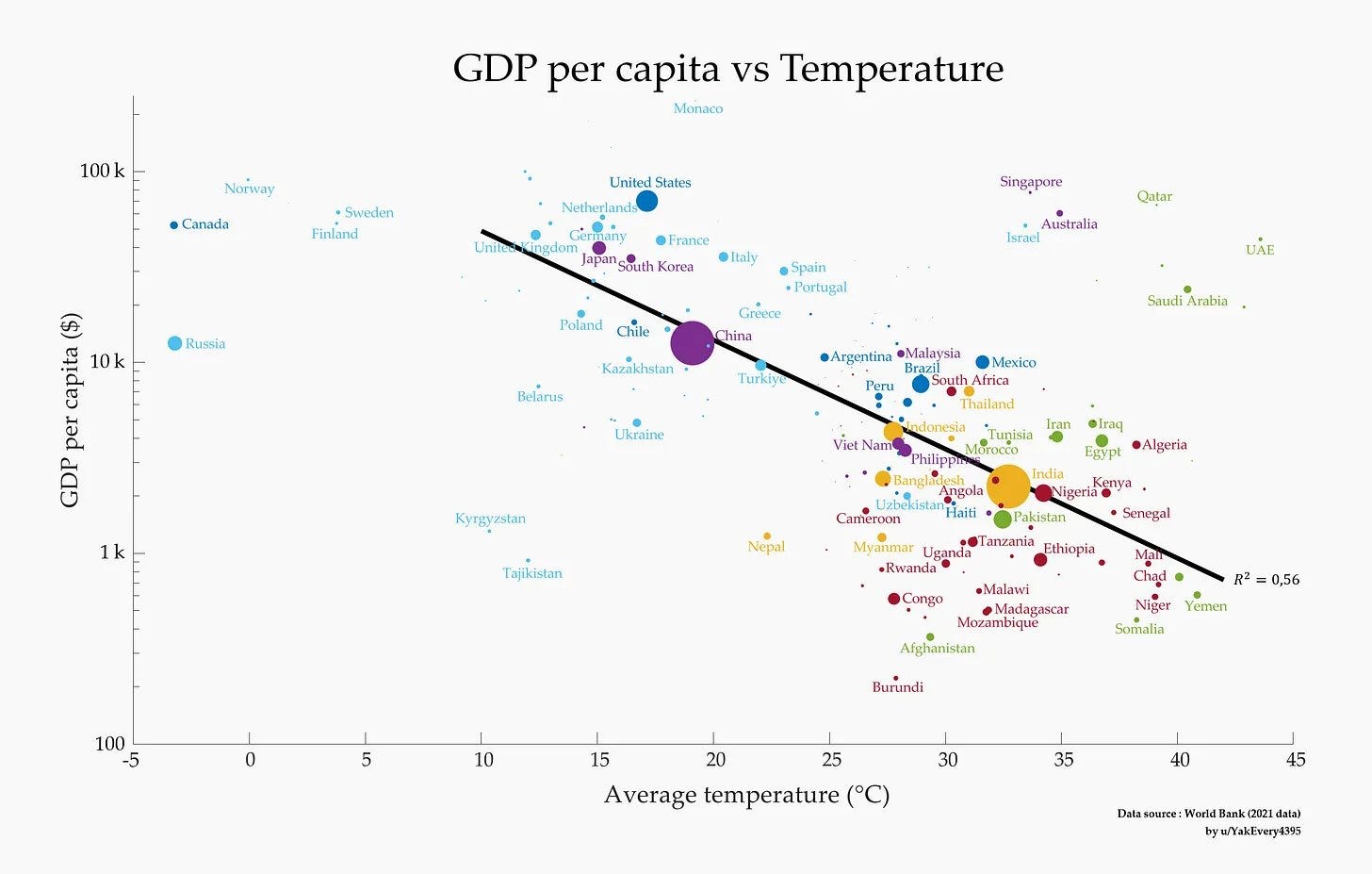
Imperialism and resource extraction shaped the map as much as latitude. And yes, the Nile flooded predictably enough to build pyramids without a single frost. Cold isn’t the only forcing function. It’s a forcing function. One that leaves fingerprints on everything from furniture design to pension systems.
But the trend matters less than the outliers.
Hofstede’s cultural dimensions data found the receipts. The “long-term orientation” score – basically, how much a culture values saving over spending – tends to rise with winter length.
Longer winters, longer time horizons. No surprises there.
The surprise is the outliers. Plot Taiwan, Hong Kong, and Singapore on the scatter and they blow the curve apart – scoring far higher than their latitude has any right to produce. The explanation is almost too clean: tropical countries running on cultural software written in temperate mainland China. The Winter Filter didn’t just shape people. It shaped cultures portable enough to outlast the climate that forged them.
The Hack
Lee Kuan Yew didn’t inherit a cold climate. He inherited a swamp. Malarial, humid, resource-poor. An island the British had written off.
One of his first acts after becoming prime minister in 1959 was installing air conditioning in government buildings – as policy, not luxury. He understood that cognitive work was impossible in tropical heat (not to mention wearing a tie) – Singapore would never compete if its civil servants spent every afternoon in a sweaty daze.
In a 2009 interview, LKY called air conditioning “perhaps one of the signal inventions of history” – one that “changed the nature of civilization by making development possible in the tropics.”
He was right. Singapore now has higher GDP per capita than Britain. The swamp became a financial center. The heat became irrelevant.
Geography isn’t destiny. It’s a constraint. And constraints can be engineered around… if you’re ruthless enough.
The Decay
Now consider the opposite direction.
German trains used to run on time. “Pünktlichkeit” as national religion. Deutsche Bahn is now a punchline: overcrowded, delayed, passengers standing in aisles. The Swiss won’t let late German trains past Basel – afraid the delays are contagious.
What happened? Infrastructure neglect. Political paralysis and short-termism. The very discipline that cold winters supposedly selected for, eroding in a single generation.
Cold isn’t a permanent advantage. It’s a head start you can squander. The institutions that winter built require maintenance. When that slips, the latitude stops mattering. Just ask Russia – brutal winters, dysfunctional institutions.
My German half feels this decay viscerally. No bueno.

This was never really about temperature. It’s about pressure. Cold provided it for millennia. Now we have to build our own.
I didn’t find clarity in paradise. I found it when the humidity broke – when constraint replaced optionality and I could finally sit for hours without my brain wrapped in wet linen.
People who grew up in Saigon or Jakarta are probably laughing. Fair enough. Maybe the Winter Filter just flatters a sweaty Westerner’s own limitations.
And I’m not sure if coming back was choosing the right constraint or just choosing the familiar one.
Where to apply the Winter Filter:

Related: If You’re So Smart, Why Aren’t You Rich? – why being right and getting paid are different games

Frequently Asked Questions
Why are cold countries generally wealthier than tropical ones?
The “Winter Filter” theory holds that seasonal climates imposed survival pressures – store grain or starve, cooperate or freeze – selecting for behaviours like delayed gratification and long-term planning over millennia. These became cultural norms that later supported economic development. GDP per capita correlates strongly with average temperature, though imperialism and resource extraction also shaped the map considerably.
Did cold climates select for higher intelligence?
No. The Winter Filter is a behavioural and cultural argument, not a genetic one. Harsh winters selected for specific habits – saving, planning ahead, cooperating with strangers – that became embedded in cultures and institutions rather than biology. The proof is in the outliers: tropical countries settled by diaspora from temperate mainland China (Taiwan, Hong Kong, Singapore) outperform their latitude on Hofstede’s long-term orientation score by a wide margin.
What did Lee Kuan Yew say about air conditioning and development?
In a 2009 interview with New Perspectives Quarterly, he called air conditioning “perhaps one of the signal inventions of history,” arguing it made development possible in the tropics. One of his first moves after becoming prime minister in 1959 was installing AC in government buildings – not as luxury but as infrastructure for cognitive work. Singapore’s GDP per capita now exceeds Britain’s by roughly 70%.
Is cold climate a permanent economic advantage?
No – cold is a head start you can squander. The institutions winter built require active maintenance. Germany’s rail system, once shorthand for “Pünktlichkeit,” has deteriorated to the point where Swiss Federal Railways terminates late-running Deutsche Bahn services at the border. Russia has brutal winters and dysfunctional institutions. The Winter Filter built the thing, but it doesn’t maintain the thing.
What is Hofstede’s long-term orientation and how does it relate to climate?
It measures how much a culture values saving, persistence, and future planning over immediate consumption. The score tends to rise with winter length – longer winters, longer time horizons. The outliers are telling: East Asian tiger economies score far higher than their tropical latitudes would predict, likely because they inherited cultural software originally shaped in temperate mainland China.
So if I left Madrid summers for Berlin winters... grey means good?