


TL;DR: Last December I called two former Bitcoin miners with big grid connections “AI landlords” and planned for them to be 44% of my portfolio. On 29 October a 145-page essay argued that owning power for AI is a bottleneck: a toll that lasts only until someone builds around it. What separates a landlord from a bottleneck is how long the contracts run, and by that test one of my companies is a landlord and the other isn’t. Since October I’ve kept buying both, most recently on the night the Nasdaq-100 had its worst day since March 2020.

There’s a race on my homepage. I put it there in September: IREN and Cipher, the core of my AI Landlords essay, against the Nasdaq-100, the index most people mean when they say “tech stocks”. It gets redrawn every week, whether I’m winning or not. The idea was simple: intuition should have a scoreboard.
The scoreboard works. It starts at the close on 12 December 2025, the Friday before I made the call. By the close on 6 November, my two landlords had lost 46% in euros, weighted the way I held them at the start. The Nasdaq-100 had gained 13%. I first bought IREN in July 2025, five months before the essay, and Cipher in September. Counted from those first buys, the pair is up about a fifth in euros, a few points behind the Nasdaq-100. The months before I wrote the thesis did all the earning.
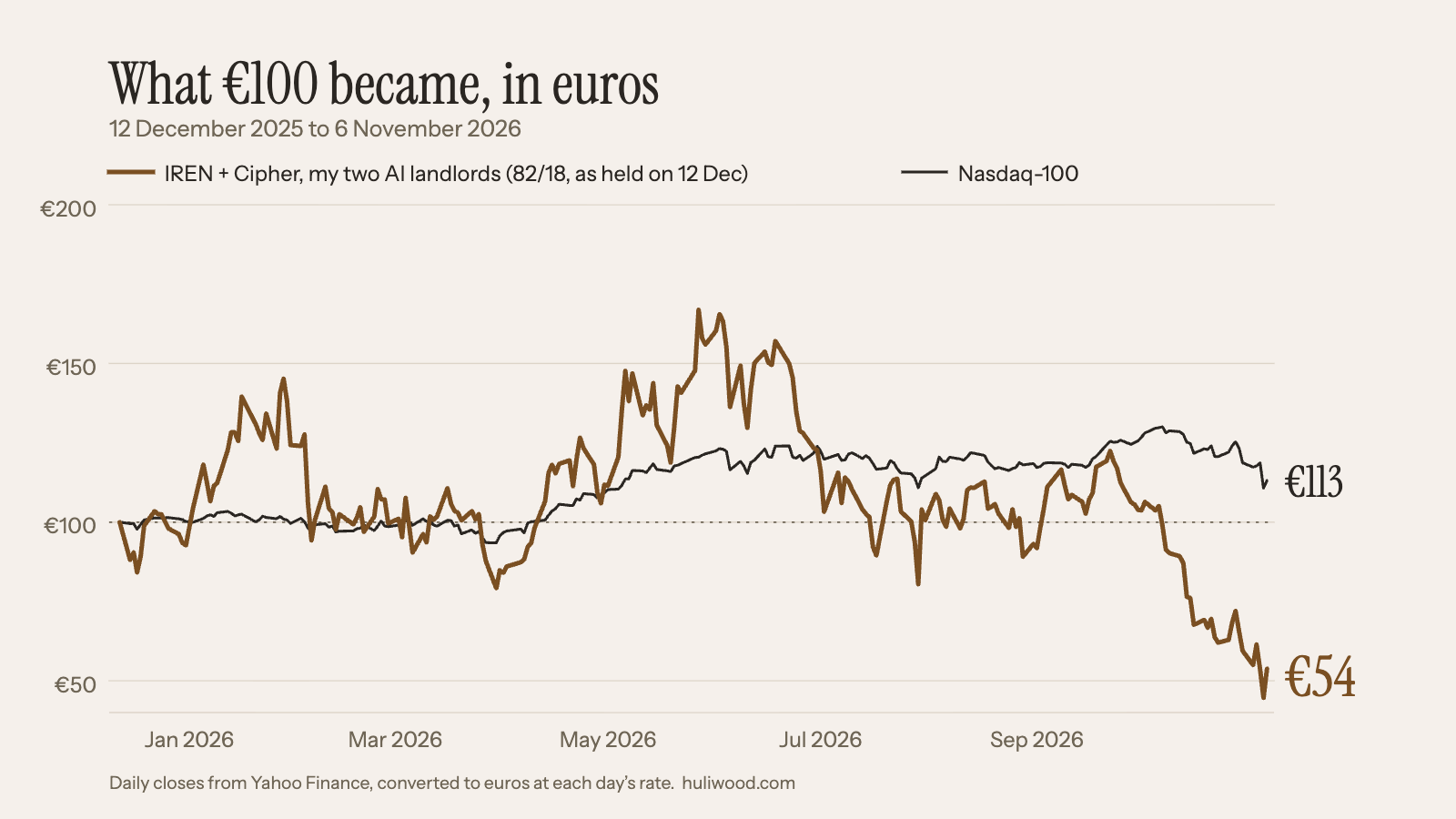
My landlords led for most of the first half of the year. By the end of September the gap was embarrassing, and by the end of October it wasn’t a race any more.
On 29 October, the day Alphabet fell more than 12% on doubts about what its AI spending will earn, IREN and Cipher each lost about 9%. The same day, someone published the clearest case I’ve read for why the gap might never close.
So this piece is me testing my own call against it. I want to work out two things: whether owning power for AI earns a landlord’s rent or a bottleneck’s toll, and which of my two companies is which. Then whether my money agrees.
The essay says power is a toll with an expiry date
The Commanding Heights, by Will Manidis and Joe Roberts, is 145 pages of Lenin, Gutenberg, Standard Oil, the Gospel of Matthew and a man in Bangalore signing off his AI agents’ reports without reading them.
The argument starts with the price of AI. Epoch AI, a research group that tracks it, finds that the cost of reaching a given level of performance falls about 47% a quarter, so whoever sells the answers is in a price war.
The money goes instead to whoever owns the crossings AI has to pass through to reach people’s wallets – the app already on their phone, the way they pay, the license to do the job, the government itself. The authors call these crossings the Commanding Heights, after Lenin, who in 1922 defended letting private trade back into Soviet Russia because the state still held the railways and heavy industry.
Then they draw a line I hadn’t drawn. A Height is a toll that lasts. A bottleneck is a toll that lasts until someone builds around it.
Their example of a bottleneck is my thesis in all but name: the AI Landlords, my bet that whoever already holds scarce grid power collects the rent from AI. A finished data center, fully financed, sits dark because it can’t get connected to the grid, so the owner hands his margin to whoever has the power. They fit my whole essay into one paragraph. Then they keep going: “If power is solved, transmission becomes the crossing. So [the cloud giant] moves power generation on site. Then chips become the crossing.”
(In the chapter on what to buy, the two company names are blacked out, and the site has a form to request a copy. My picks are on my homepage, losing in public. I’m not sure which of us has the better business model.)
The length of the lease decides who’s a landlord
Picture a flat in a city with a housing shortage. You can rent it out on a fifteen-year lease. You lock in today’s high rent, and if the city builds ten thousand new flats next year, your tenant still owes you every month until the lease runs out.
Or you can furnish it and rent it out a few years at a time. You earn more while the shortage lasts. But when it ends, the next tenant pays the new, lower rent – and by then the furniture’s worn out and you’re buying new.
The first is a landlord: the high rent is in writing for 15 years, whenever the shortage ends. The second is the essay’s bottleneck: its rent falls at the first renewal after the shortage ends. What decides which one you are is the contract – how long it runs, and whether the tenant can keep paying. Neither is one of the essay’s Heights (15 years isn’t forever) but only the first outlasts the shortage.
IREN and Cipher both started as Bitcoin miners, which means they spent years securing cheap electricity and the right to draw huge amounts of it from the grid. When AI came along, they kept the grid connections and started switching from mining Bitcoin to serving AI customers. For scale, one megawatt running all year powers about 800 American homes, and these companies deal in hundreds of megawatts at a time.
Cipher is a landlord
Cipher Digital rents out the empty flat: the building and the power. Its tenants bring their own chips.
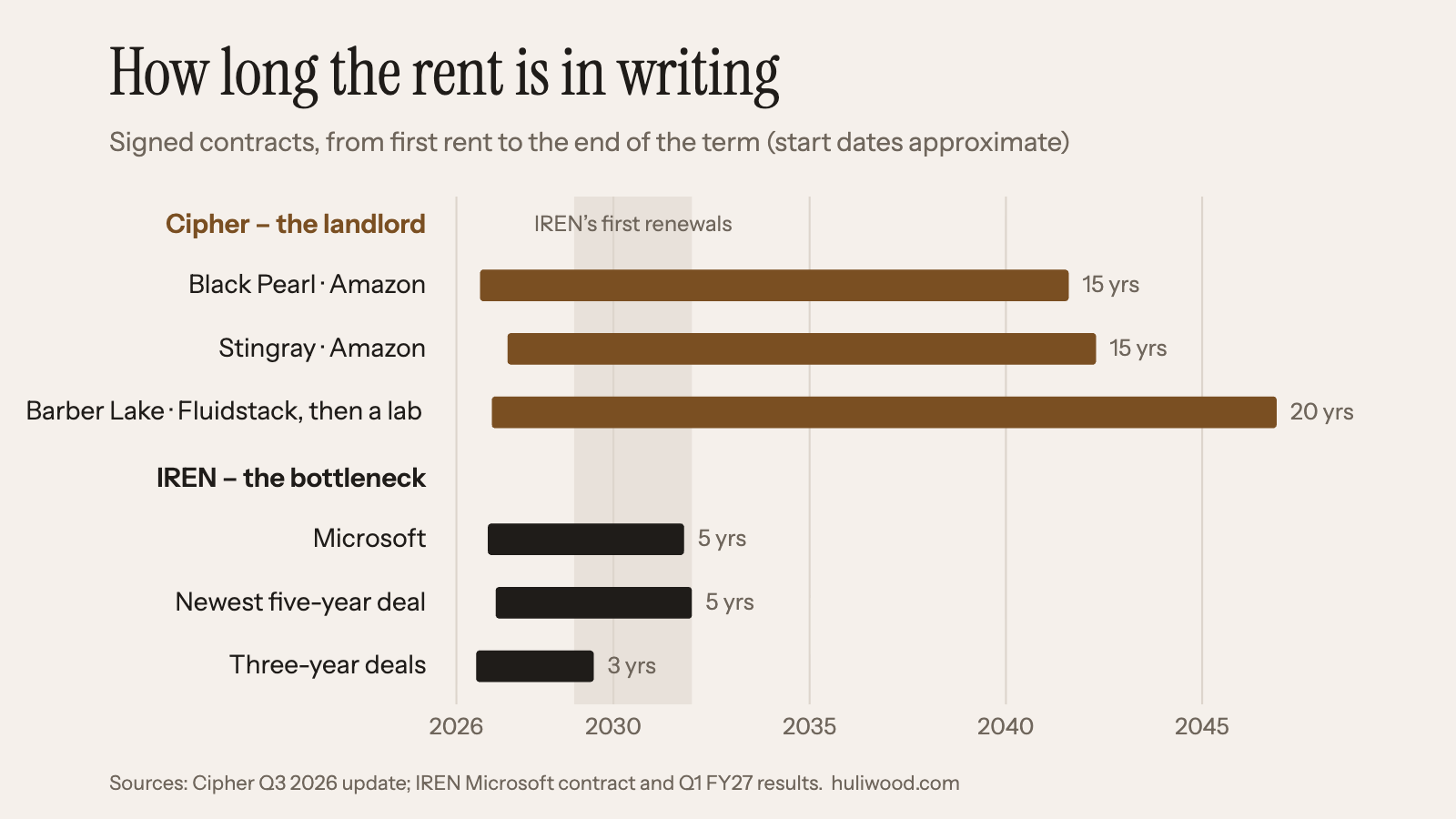
Black Pearl, Texas: about $5.5 billion over 15 years. The tenant is Amazon. Rent on the first phase started in August.
Stingray, Texas: about $2.0 billion over 15 years. Amazon again.
Barber Lake, Texas: about $3.8 billion over ten years with Fluidstack, an AI cloud company, backed in part by Google. In September an unnamed AI lab signed up for the ten years after that, which takes the site past $9 billion over 20 years.
Cipher puts the average length of its leases at 17.3 years. It collects 15 years of rent from Amazon once the buildings switch on, whatever happens to the shortage in between. Barber Lake is less certain: its two tenants, Fluidstack and the unnamed lab, owe more than half of Cipher’s $16.6 billion in signed rent, and Google backs only part of Fluidstack’s share.
Property investors value a rented building by dividing its yearly rent, after running costs, by the return they want. At 8%, every $8 a year is worth $100. On 3 October I had Claude run that sum on Cipher’s three signed leases, after subtracting its debts and the cost of finishing the buildings. At that rate, the leases came to about half the share price. Even at a generous 6.5%, they came to less than three-quarters of it.
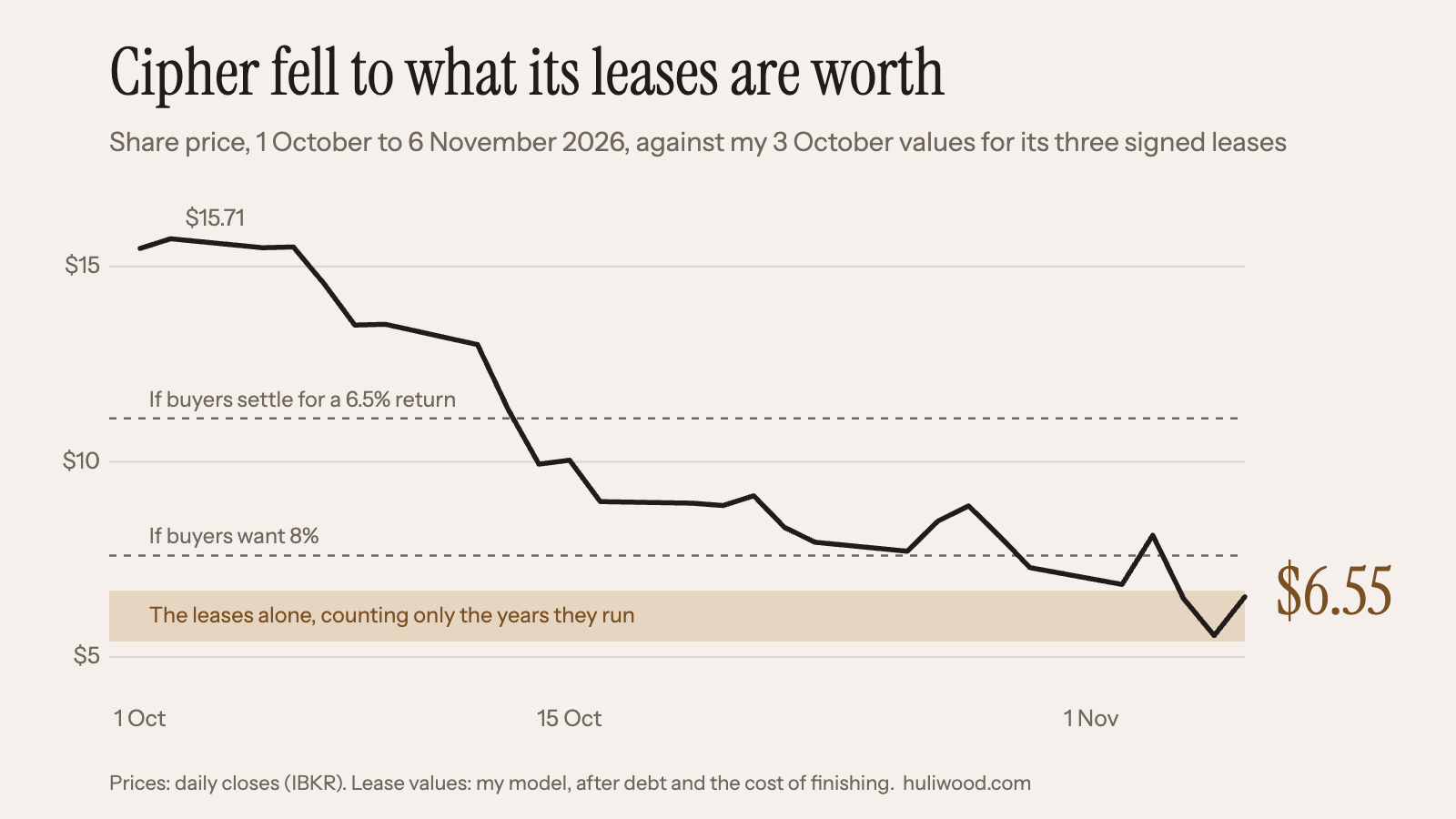
By 6 November the share price had fallen below even the 8% sum, to about what the leases are worth if you count only the years they run. In five weeks, the market went from paying for Cipher’s plans to paying for roughly its signed leases, and next to nothing for the rest of the power Cipher has lined up. And because Cipher built with borrowed money, at today’s price a 10% change in what its leases are worth moves the value of its shares by about 20%, and more as the price falls.
Its costs aren’t all locked in the way its rent is. Amazon pays the overruns above a cap at its two sites, but on 2 November Cipher said Barber Lake now costs it about $13 million per megawatt of computing capacity, against the $9–11 million it first guided. Part of that is extra money it put in to win the longer lease.
IREN is a bottleneck that bought the furniture
IREN, my larger position by far, rents out the furnished flat. It buys the GPUs – the chips that do the AI computing – and rents out their computing power.
Microsoft pays IREN $9.7 billion over five years for 200 megawatts, about $9.7 million per megawatt per year. IREN says its more recent three-year deals price above $20 million per megawatt a year – more than twice what Microsoft pays – and a five-year deal signed after September pays more still. Newer customers also prepay far more of what the chips cost, up to 90% against Microsoft’s 20%, and IREN borrows most of the rest at 6–9%.
On paper IREN has more signed revenue than Cipher: $20.3 billion, about two-thirds of it from investment-grade customers. It just runs for three to five years, not seventeen.
That’s a good business while the shortage lasts.
But by the time those contracts end, newer chips will have overtaken the ones IREN rents out. Every renewal is a new negotiation, at whatever price the market holds that year, and the furniture needs replacing on roughly the same schedule. When the shortage ends, IREN’s rent resets with it.
The case for owning it anyway is timing, and the latest results lean that way. Prices on new deals are still rising, and after the most recent quarter IREN let some capacity on a short-term contract at nearly twice its newest five-year rate – the furnished flat at the top of the market. The same earnings results pushed back the date it expects to reach a $4 billion yearly revenue rate, from the end of the year to January, maybe February 2027. IREN says the recent deals pay for their chips in about two years, and by my count the first contracts come up for renewal around 2029–31, while the shortage should still be running. The danger is the round after that.
To see what the share price pays for, I had Claude run it through my own model, counting only the chips IREN plans to run by the end of 2027 and valuing the rest of its more than 5 gigawatts of secured grid power (enough for over four million homes) at zero.
At $21.64 on 6 November, the chips alone can explain the price if about a third of them rent at the newer rates, and if rents hold when the contracts renew.
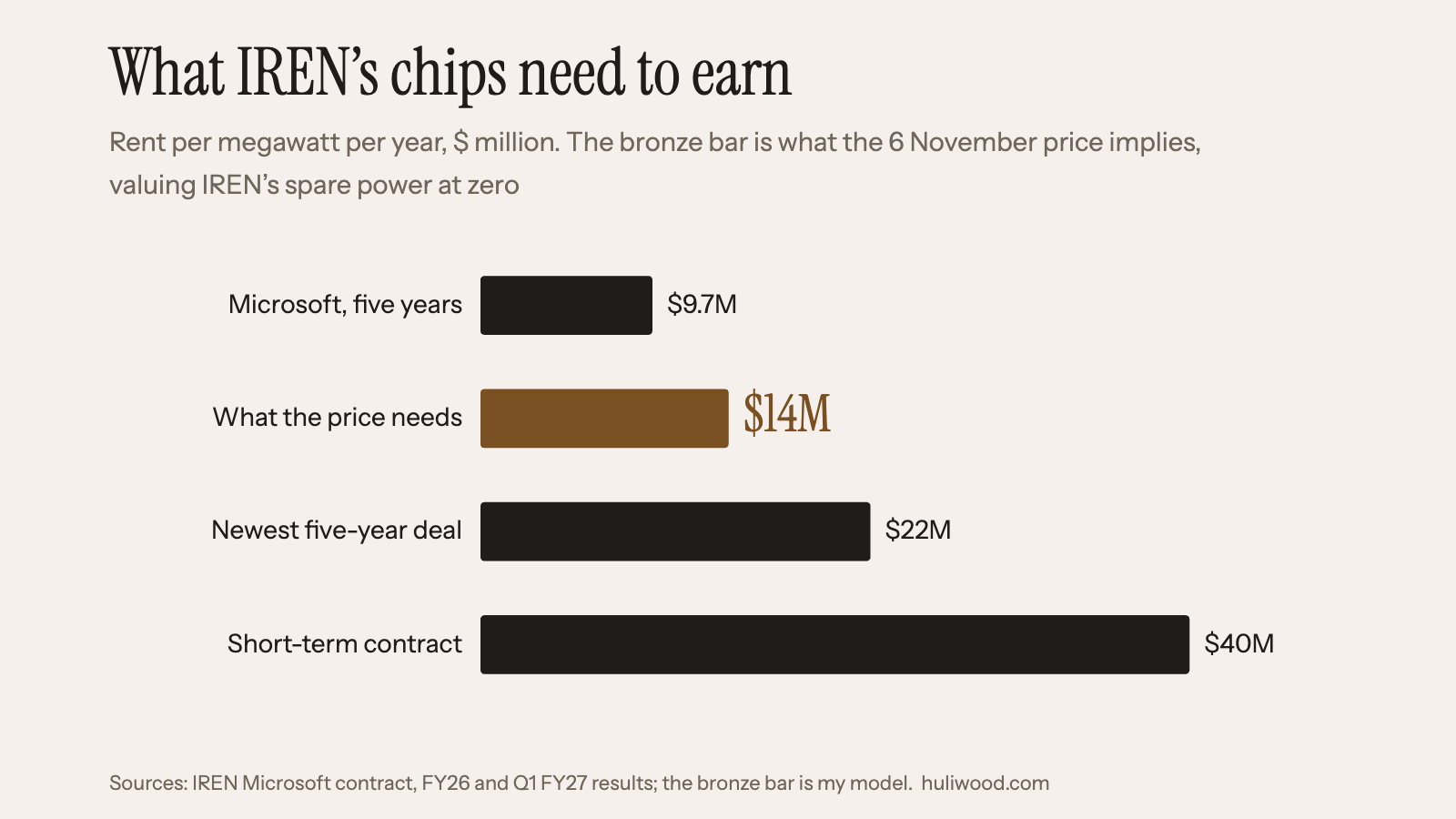
The market doesn’t have to believe in the spare power at all, and the spare power is what I bought IREN for. By my own test, unleased power is a bottleneck at Cipher too, until someone signs a long lease for it.
The shortage looks long
Last December I gave the first movers five to ten years of runway. I named the threats: small nuclear reactors arriving early, AI good enough to run on phones, data centers in space, which I said were running on “Elon time”. I didn’t name the one that’s arriving: big buyers putting their own power plants next to their data centers, so they don’t have to wait for the grid before switching on.
In August, Amazon did what The Commanding Heights describes. It confirmed it had bought GW Ranch, a planned data-center campus in West Texas where the site’s developer is building a gas plant of 35 turbines, about 5 gigawatts, to power the campus directly. That’s the tenant at two of Cipher’s three leased sites, lining up power that doesn’t wait for the grid. Even there, Amazon says it is exploring a link to the grid, so the grid still matters. Cipher is building its own way around the queue too: on 2 November it said it had started building gas pipelines for up to 2.5 gigawatts of its own on-site power.
But the way around the queue has a queue of its own.
Mitsubishi Power now quotes delivery around 2031 for new gas turbines, and GE Vernova has sold slots for 2032, while raising its price per kilowatt by about half. The grid itself is slow: US power plants that came online in 2025 had waited a median of five years for a connection. Meanwhile, almost every data center in the main North American markets is full, and most of what’s being built is rented before it’s finished.
My five to ten years still looks fine. The shortage isn’t what’s wrong with my bet.
Then I reread my own essay, and the bottleneck was in it all along: “I’d rather bet on scarcity while it exists than wait for abundance and miss the window.” Nobody with a fifteen-year lease worries about missing a window.
The market pays for what’s being built, not for the spare power
You’d expect the market to pay extra for scarcity that should last years, or for the landlord’s safety. Instead, both share prices can be explained without the spare power behind them, and I can see four reasons why.
The first is interest rates. 15 years of fixed rent behaves a lot like a bond.
A ten-year US government bond, the usual yardstick for a safe return, pays just under 5%, and in early October it passed 5.3%, the highest since 2002. Next to that, a lease returning 6.5–8% isn’t special any more. That explains why Cipher is priced cautiously, but not why it halved: bonds pay a little less now than they did then.
The second is money. A bottleneck is only worth something to whoever can afford to build on it.
IREN plans to spend about $20 billion this financial year, more than twice what the whole company was worth on the stock market on 6 November. Management’s funding plan leans on loans and customer prepayments, but it doesn’t rule out new shares, and IREN has leaned on them before: in the year to June it raised $4.7 billion by selling new shares, and it has kept selling since.
With the share price at about half its early-October level, every billion it raises that way takes about twice as many new shares, and every existing share owns a smaller slice of the company. For a company that has funded itself this way, the share price is a fuel gauge, not a scoreboard.
The third is Texas. For every toll, the essay asks who else has a say over it, and in Texas the state does. In August the Governor ordered an audit of every data center waiting for a grid connection. ERCOT, which runs the Texas grid, aims to file its report by 10 December, and until then the queue of large data centers, 75 MW and up, is on hold.
Both companies have sites provisionally placed near the front of the queue – IREN’s Sweetwater campus and Cipher’s Colchis – but nobody knows yet which waiting sites will switch on, or when, and a site with no date is hard to price above zero.
And on 3 November the question went national. Data centers, and what they do to power bills, had become a campaign issue, and Democrats won both houses of Congress in the midterms. Two days later the Nasdaq-100 had its worst day since March 2020, on fears that the new Congress would slow the AI buildout. IREN fell 17% that day and Cipher 15%; both won it back the next day, after IREN reported its results.
The fourth is the customers. A shortage only pays while the buyers keep spending, and on 29 October the market doubted they would.
To get paid for scarcity, then, you need long contracts, cheap money, a government that leaves the rent alone and customers who keep spending. Cipher has the contracts. Both have found cheap money of a kind. In October Cipher borrowed $850 million at 0% interest, and IREN’s largest bond pays 1%, far below the 6–9% on its chip loans. Lenders accept so little because they can swap those bonds for shares later, which shrinks everyone else’s slice. Texas gives its first answer in December, Washington when the new Congress sits in January. The customers give theirs every three months, when the big ones report their results.
What I did on the way down
I’d like to report that I followed my own rules in October.
On 17 October I used Claude as my huliwood-hedgefund-manager to establish four trading rules, built on a review of my own record. My sales have mostly been right, my purchases mostly wrong, and the leak is buying because the price fell. One of the rules: every buy needs a reason other than the price.
Two days later I sold my bet on Take-Two, the company behind GTA VI, a month earlier than planned, and put the money into IREN and Cipher, because AI upside beats gaming upside. When my pre-trade check asked for my reason, I confessed to the Claudefather: “Yes this is me trying to time the market.”
Eight days after that I bought more of both; the reason I logged was that it was the “most hated trade on Wall Street right now”. The next day I sold a few small positions that were “not gonna move the needle” and put that money into Cipher, because it was trading inside the range I’d worked out for its leases.
Three rounds of buying in ten days. Each one leaned on the price, and my own system logged every one as a rule break.
November didn’t slow me down.
I added to both on the 2nd and to IREN again on the 3rd. On the 5th, the day of the sell-off, IREN reported its quarter after the close. That evening I sold the last of my Tesla and SpaceX – “rounding errors at their size anyway” – and put the money into IREN.

My reason: the AI infrastructure trade is irrationally panicked, and I’ll rebalance into my other holdings on the way back up. That’s a reason about the price, too.
Six rounds of buying in under three weeks. Last December my plan had IREN and Cipher at 44% of my portfolio. Now they’re most of it. I’ve been riding the elevator down. Let’s see if we take the staircase back up.
So why stay on the elevator? Because I don’t think AI is allowed to slow down. Demand isn’t the problem – the queues for turbines and grid connections run into the 2030s. Financing is shaky, and the market is right to charge for it. As for the midterm panic, the most likely outcome is that Democrats don’t wanna kill AI. They want to tax it. And their demands on the environment, power generation and protecting communities are completely sensible.
Either way, too much now rides on the buildout: a race between Washington and Beijing, an investment boom that accounts for about a third of US growth this year, and progress that is speeding up rather than hitting a wall. On 5 November METR, an independent evaluator given inside access to Anthropic, reported that Anthropic made roughly two years of its usual progress in the past year, most of it probably from using AI to do AI research. It saw no evidence of a bottleneck that would stop this in the next 12 months, though it says it isn’t confident. Andrew Curran, who watches the labs closely, wrote this week that “things changed again in September 2026. We are on a new trajectory.” The AI 2027 scenario, the widely read forecast that AI takes over its own research by late 2027, is very much still in play.
If it plays out, the shortage outlasts every renewal IREN has, and the furnished flat beats the empty one. Faster AI alone doesn’t get me there: models could get cheaper to run faster than demand grows, and scarce power only pays shareholders if the rent covers new chips and new shares. What I’d actually bet on is closer to home: IREN’s newest customers pay more than twice what Microsoft does and prepay half or more of the chips. So I wrote down what would prove me wrong, with dates: Texas’s answer on its waiting data centers by the end of January, IREN’s $4 billion revenue rate by March, and whether new-deal prices keep rising. If those turn, the furnished flat loses, whatever happens to AI. That’s the bet my money is making.
Not financial advice. I own a lot of $IREN and $CIFR. The live score is on huliwood.com.
Related:
The AI Landlords – the December thesis this piece tests
Sources: Manidis & Roberts, The Commanding Heights, Oct 2026 · Epoch AI, The Plunging Price of Thought, Sep 2026 · EIA, household electricity use · Cipher, Black Pearl lease (SEC exhibit) · Cipher, Barber Lake extension, Sep 2026 · Cipher, $850M convertible notes, Oct 2026 (SEC exhibit) · Cipher, Q3 2026 business update, Nov 2026 · Texas Governor’s directive, Aug 2026 · ERCOT, Batch Zero update, Sep 2026 · IREN, Microsoft contract · IREN, FY26 results, Aug 2026 · IREN, Sweetwater in Batch Zero, Sep 2026 · Stocktwits on Cipher’s Batch Zero sites, Sep 2026 · IREN, Q1 FY27 results, Nov 2026 · ENR on GW Ranch, Aug 2026 · Bloomberg on Mitsubishi Power, Oct 2026 · GE Vernova Q3 2026 call · LBNL, Queued Up 2026 · CBRE, North America Data Center Trends H1 2026 · FRED, 10-year Treasury yield · US Treasury, daily yields, Nov 2026 · Yahoo Finance, markets on 29 Oct 2026 · CNN, the 5 Nov sell-off, Nov 2026 · ING, AI’s share of US growth, Aug 2026 · Andrew Curran on X, Nov 2026 · AI 2027 scenario, 2025 · METR, AI R&D acceleration at Anthropic, Nov 2026
Frequently asked questions
What is the difference between an AI landlord and a bottleneck?
The length of the contract. A landlord has rented out its power on long leases, so the rent keeps coming after the shortage ends; a bottleneck sells on short contracts whose prices reset at the first renewal after the shortage ends. The Commanding Heights, a 145-page essay by Will Manidis and Joe Roberts published on 29 October 2026, describes a bottleneck as a toll that lasts until someone builds around it, and uses owning power for AI as its example.
Are IREN and Cipher Digital landlords or bottlenecks?
By the length of their contracts, Cipher Digital (formerly Cipher Mining) is a landlord: it rents out buildings and power for 15 years to Amazon at Black Pearl and Stingray, and for 20 years at Barber Lake, all in Texas, an average of 17.3 years. IREN is a bottleneck: it buys GPUs and rents out computing on three- to five-year contracts, including a $9.7 billion five-year deal with Microsoft. Its $20.3 billion of signed revenue is larger than Cipher’s but runs for far fewer years, so its prices reset at every renewal.
How long will the AI power shortage last?
Huliwood’s December 2025 essay, The AI Landlords, gave the first movers five to ten years of runway, and the evidence in late 2026 still fits: US power plants that came online in 2025 waited a median of five years for a grid connection, Mitsubishi Power quotes gas-turbine delivery around 2031, GE Vernova has sold delivery slots for 2032, and empty data-center space in the main North American markets is at a record-low 1.4%.
Why doesn’t the stock market pay extra for scarce AI power?
This piece finds four reasons, and none of them says power has stopped being scarce. Long fixed rent behaves like a bond, and in early November 2026 ten-year US government bonds paid just under 5%. Building on scarce power takes money: IREN plans to spend about $20 billion in its 2027 financial year. In Texas, the queue of large data centers (75 megawatts and up) is on hold until an audit ordered by the Governor is done; ERCOT aims to file its report by 10 December 2026. After Democrats won both houses of Congress in the 3 November midterms, investors feared Washington would slow the buildout too, and on 5 November the Nasdaq-100 had its worst day since March 2020. And the customers may spend less: on 29 October Alphabet fell more than 12% on doubts about what its AI spending will earn.