


TL;DR: The purchasing power of amazement is collapsing. In eighteen months we went from “impossible” to “huh.” The question I can’t resolve: is that a bug or a feature?
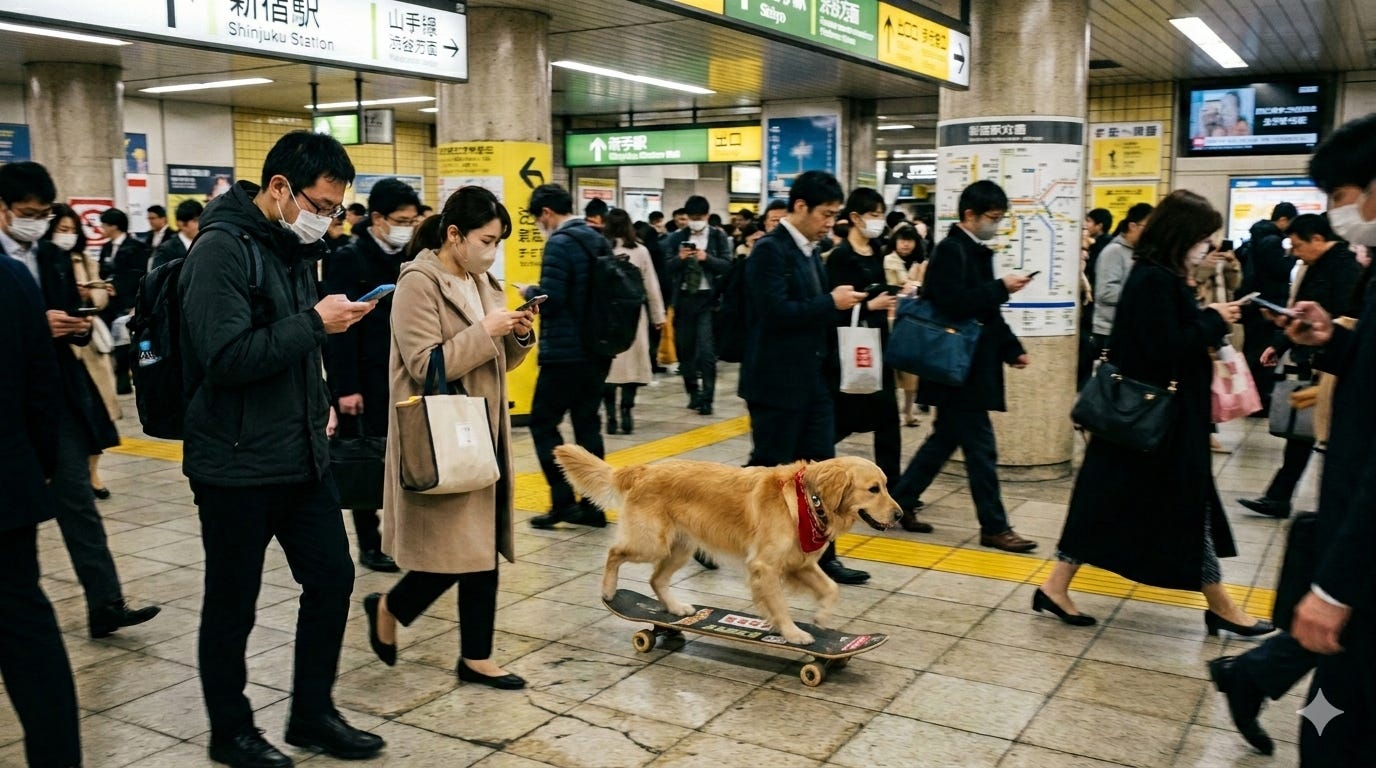
I showed my mom a video last week.
Golden retriever skateboarding through a Tokyo subway, weaving between commuters, fur moving right, physics coherent. Twenty seconds of photorealistic impossible.
– “Ach, wie süß,” she said. How cute. “Where’d you find it?”
– “I typed twelve words into a website. It appeared thirty seconds later. The dog doesn’t exist.”
– “Huh.” She scrolled to the next thing.
We’ve moved from “this is impossible” to “huh” in eighteen months.
I almost did the same thing. Generated that video to test Genie 3. Watched it once, thought “yeah, that’s about right,” moved on.
Didn’t register that I’d conjured photorealistic video from text, something that would’ve been a showstopper eighteen months ago and science fiction a year before that.
I almost shrugged at a miracle.
Miracle Inflation
Miracle inflation: the rate at which the extraordinary becomes ordinary.
I own the stocks. I use the tools. I’ve had the debates with skeptics. None of that means I’m calibrated.
Coding agents that debug themselves.
Voice cloning from three seconds of audio.
Real-time translation that preserves your cadence and stumbles over your idioms.
Every one of these would’ve been the keynote closer at a 2023 tech conference. Now they’re Tuesday.
This AI thing is faster than hedonic adaptation.
Yesterday’s miracle becomes today’s expectation becomes tomorrow’s disappointment. Just a quiet reset of what counts as normal.
Skeptics suffer from it – measuring AI against hype, moving goalposts, perpetually right until they’re not.
But bulls suffer worse, because we should know better. We measure against our own expectations. “Genie 3 is good, but not feature films.” “Claude is smart, but hallucinates.” Technically true. Completely missing the point.
The right baseline is what existed before.
In 2022, if you wanted video of a dog skateboarding through Tokyo, you needed a trained dog, a flight to Tokyo, a film crew, and a VFX team billing six figures over three months. Now you type twelve words.
That’s an extinction event for the old way of making things.
What It Costs
The trendline nobody updates: impossible → hard → expensive → cheap → free → invisible.
Summer 2026, we’re somewhere between cheap and free.
But most people, including most bulls, are anchored to expensive. The gap – between where AI actually sits and where we assume it sits – is where the strategic danger lives.
Normalize miracles and you start planning for linear improvement in a world making nonlinear jumps.
Everyone evaluates AI by what it can’t do. “Still can’t do long-form video.” True – and anchored to last quarter’s version of the trendline.
I’m long the AI Landlords thesis, concentrated in infrastructure, picks and shovels on continued scaling. If progress stalls, I lose real money. If it accelerates, I look like a genius. Maybe I’m pattern-matching miracles because I need them to be miracles.
But I wouldn’t know that, would I?
The Counter-Case
Maybe desensitization is adaptive.
The people who stay perpetually amazed, who stop and gawk at every miracle, they’re not the ones shipping. They’re writing essays about whether the miracle was miraculous enough while a startup in Chy-nah just used a world model to produce a product demo that would’ve cost them $200,000 last year.

My mom said “huh” and scrolled. Maybe the miracle becomes useful precisely when it becomes boring. Maybe awe is the enemy of execution.
There’s a version of this argument where every word I’ve written above is wrong. Not wrong about the technology, but wrong about the correct posture toward it.
The farmer doesn’t write essays about the tractor. He plows the field. The harvest happens every season. Reverence for the tool is a distraction from the work the tool enables.
If that’s true, calibration – what I’ve been arguing for – is just a more intellectual form of gawking.
But I don’t fully buy it. The farmer analogy breaks because tractors improve by the decade. AI improves every two weeks. You can afford to stop marveling at a tool that’s mature. But you can’t afford to stop marveling at one that’s still becoming something else.
Somewhere, someone who said “huh” six months ago and got back to work is compounding while I write about whether the miracle was miraculous enough.

Huh.
Related reading: Observer’s Doom – the cost of watching too closely.

Human condition will dictate the unsatiable expectations for constant wonders... there are only apes behind those veneers.