


TL;DR: I keep meeting people who’ve read everything and believe nothing. They can summarize any debate but won’t pick a side. In an age where AI can present “all perspectives” in twelve seconds, observation without commitment is a slow form of disappearing.
I keep meeting well-read idiots. People who consume forty hours of podcasts a week. Who’ve read the whole canon. Who can reference any topic, recall any framework, cite any source.
And who have no opinions about anything.
Ask them what they think about AI risk, and they’ll summarize five perspectives. Ask what they believe, and they’ll hedge until the question dissolves. Encyclopedias without an index.
I used to be one of them.
Then I chose violence.
The Observer
For years, I prided myself on “seeing all sides.” On being nuanced. On not jumping to conclusions.
What I was actually doing was hiding.
If you never state a position, you can never be wrong. If you always steelman the opposition, you never have to defend your own view.
It feels wise, but it’s cowardice dressed in intellectual clothing.
Sometimes the Observer is the smarter player. Early in a domain, when you lack context, premature commitment is expensive. Surgeons don’t form diagnoses from the first symptom.
The problem isn’t observing – it’s when observation becomes identity. When you’ve been “exploring” a question for months, consuming without your view sharpening, waiting for a certainty that will never arrive. Permanently “gathering more information,” as if one more podcast, one more book, one more thread will finally grant permission to have a take.
An intake valve with no exhaust.
Permission never comes.
And it doesn’t stop at ideas. The same posture colonizes everything – career strategy hedged across three paths so you never have to go deep, investments diversified into market-average returns because conviction requires commitment. The permanent “I’m still figuring things out,” which sounds like openness but functions as paralysis.
The sunk cost fallacy gets all the press. Nobody warns about the opposite: the cost of never going all in.
Burning the Ships
Two years ago, I didn’t just sell furniture and buy a backpack. That’s the marketing version.
What I did was close the door on a decade of career building. Localization. Content. The industry I knew, the network I’d built, the reputation (lol, notorious for jokes that lived dangerously close to an HR ticket).
I let those relationships atrophy. Stopped optimizing for connections. The safe harbor that would’ve taken me back if writing failed – I watched it shrink in the rearview mirror until it wasn’t there anymore.
I was running from what felt like a slow trap. The backpack was incidental. The real weight I dropped was the backup plan.
What if I burned the wrong thing? Fuck that, I can’t A/B test my life.
But wrong commitment is usually recoverable. People reinvent themselves constantly – it’s practically an American pastime.
Never committing is different – no drama, no crisis, just... nothing. A life of pleasant optionality where nothing ever really happened.
Wrong commitment leaves you with a story.
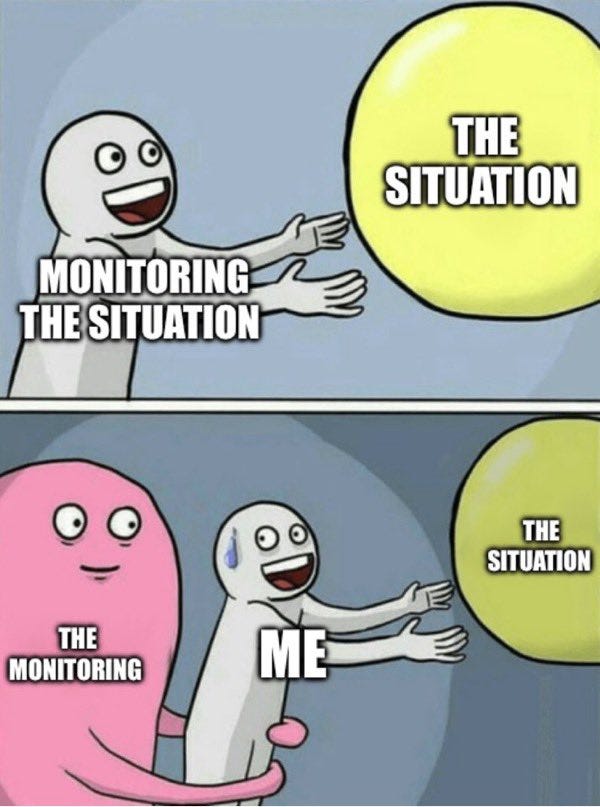
Meanwhile, I watched people who knew less than me but had committed to a view make moves I should have made. They repositioned their careers, placed real bets, had uncomfortable conversations – while I was still “monitoring the situation.”
What changed when I committed: opinions, bets, public writing, uncomfortable conversations with friends about what they’d do if their jobs disappeared. Suddenly everything had stakes – wrong opinions get corrected rapidly and publicly, which is painful and educational in ways that private uncertainty never is.
And now there’s a machine that does what the Observer does, only faster. Anyone can type a question into Claude and get five perspectives summarized in twelve seconds. If your only contribution is “well, here are the various viewpoints,” you’re competing with software that doesn’t need a podcast backlog.
What AI can’t do is stick its neck out and look stupid. That’s still a human monopoly.
The hardest sentence in intellectual life is three words long: “I think X.”
I’ve been trying to follow a rule: every time I catch myself summarizing someone else’s idea, I owe an “I think” statement. No free passes for pure synthesis.
I’m wrong constantly. But at least I won’t be the well-read idiot who never found out.
My take on the biggest unsolved problem in science: Time Is A Feeling ⬇️

Related: Don’t Mid-Curve It | Atoms vs Abstractions
Frequently Asked Questions
What is observer’s doom?
It’s what happens when you consume information without forming opinions about it. You read everything, listen to every podcast, can summarize any debate – but you never pick a side. Over time, this isn’t neutrality. It’s disappearance. You become an encyclopedia no one consults because you’ve got nothing to say that a search engine can’t.
What is analysis paralysis?
The inability to make a decision because you’re stuck evaluating options. It shows up in careers (hedging across three paths instead of committing to one), investing (diversifying into market-average returns to avoid making a call), and opinions (summarizing five perspectives instead of holding one). The pattern is the same everywhere: enough knowledge to see complexity, not enough conviction to act on it.
What does “burning the ships” mean?
It refers to eliminating your fallback option so retreat isn’t possible. The phrase traces back to Hernán Cortés in 1519, who scuttled his fleet after landing in Veracruz so his men couldn’t sail home. (He actually sank them, not burned them – the “burning” version is the better story, which is why it stuck.) In practice, it means closing the door on a safe option – quitting the stable career, dropping the backup plan – so the only way forward is through the commitment you made.
Why is having opinions important in the AI age?
Because AI already does what the careful observer does, only faster. Anyone can type a question into an AI model and get five perspectives summarized in seconds. If your contribution is “well, here are the various viewpoints,” you’re offering something a machine does for free. What AI can’t do is commit to a position and risk being wrong. That’s still a human-only move, and it’s where the value is.
What is the sunk cost of never committing?
Everyone knows the sunk cost fallacy – throwing good money after bad because you’ve already invested. Fewer people talk about the opposite: the cost of never going all in. Wrong commitment usually leaves you with experience, contacts, and a story. Never committing leaves you with options that never turned into anything. It’s not dramatic. It’s just a life where nothing really happened.
To be honest, the selection of this topic surprises me. I feel that, in this day and age, the problem is exactly the opposite. Lots of people seem to have an opinion on every topic, even when they have limited knowledge about it. The most extreme cases do not care about being wrong—nobody will call them out afterward, and doing so is often frowned upon in today’s society (except on Twitter)—but will actually fight blindly for their view.
At least, that’s my two cents based on personal experience