

TL;DR: Geography explains the raw materials of advantage. But why did Western Europe – not China, not the Islamic world – become the launchpad? The answer involves the Catholic Church, potatoes, and a pattern that’s repeating right now.
The Question Geography Can’t Answer
Geography explains why the ships sailed one way. Livestock explains the disease asymmetry. Compounding advantages explain the technological gap.
But that explanation has a hole in it.
By the early 1400s, China had the largest ships in the world. Zheng He’s treasure fleet dwarfed anything Europe could build. The Islamic world had sophisticated mathematics, astronomy, and trade networks spanning continents. India had wealth that Europeans could only dream of.
Why didn’t Chinese caravels colonize Portugal? Why didn’t Ottoman fleets plant flags in the Americas? Why did a small, violent, recently plague-ravaged peninsula on the edge of Eurasia become the launchpad for global domination?
Geography gave Europe raw materials. Something else gave it the will to use them.
The WEIRDest People in the World
WEIRD stands for Western, Educated, Industrialized, Rich, Democratic. Joseph Henrich asked: why did these traits cluster in Western Europe?
I read Henrich’s book in the strangest possible classroom: three weeks volunteering on a family farm in Paraparaumu, New Zealand – feeding sheep, weeding fields, minding a litter of newborn puppies. Doing kin-work for someone else’s family, in other words, while reading about how Europe got rich by escaping exactly that.
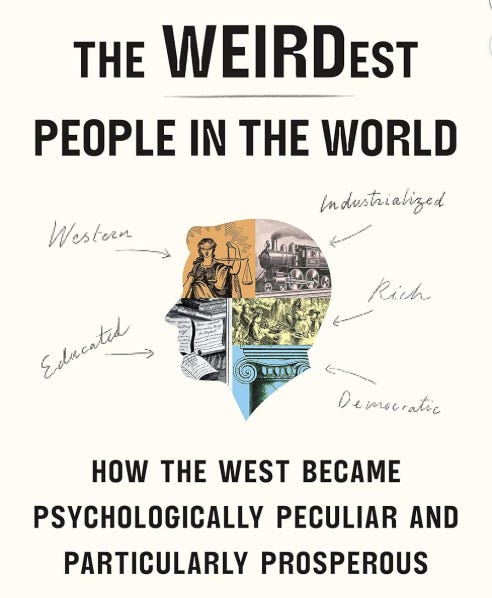
His answer is surprising: the Catholic Church.
Starting around 500 AD, the Western Church began enforcing strict marriage rules. No cousin marriage. No polygamy. No arranged marriages within extended kin groups. These rules were unusual – every other civilization on Earth thought marrying your cousin was just good asset management.
The Church banned all of it. For centuries.
The effect was slow but total. Clan structures broke apart. Extended family networks weakened. What emerged was something new: the nuclear family, individual choice in marriage, loyalty to institutions rather than kin.
By the Age of Exploration, Western Europeans were psychologically unusual. More individualistic than any population on Earth. More willing to trust strangers. More comfortable with impersonal institutions – corporations, joint-stock companies, colonial administrations.
It didn’t make them morally superior. It made them organizationally lethal. The Dutch East India Company was built on contracts between strangers, governed by impersonal rules, scaling across oceans.
China had the ships. The Islamic world had the knowledge. But Western Europe had the organizational software to project power across the globe and outlast any individual.
Geography gave Europe the raw materials. A millennium of cousin-marriage bans gave it the cultural wiring to use them.
I think about this when I look at who’s building AI. Not family businesses. Not kin networks. Corporations of strangers coordinating through impersonal systems, scaling globally. The same organizational software, running on faster hardware.
The Potato’s Revenge
But Europe didn’t simply “win” the Columbian Exchange.
Remember that care package from the Americas? Potatoes, corn, tomatoes, cacao?
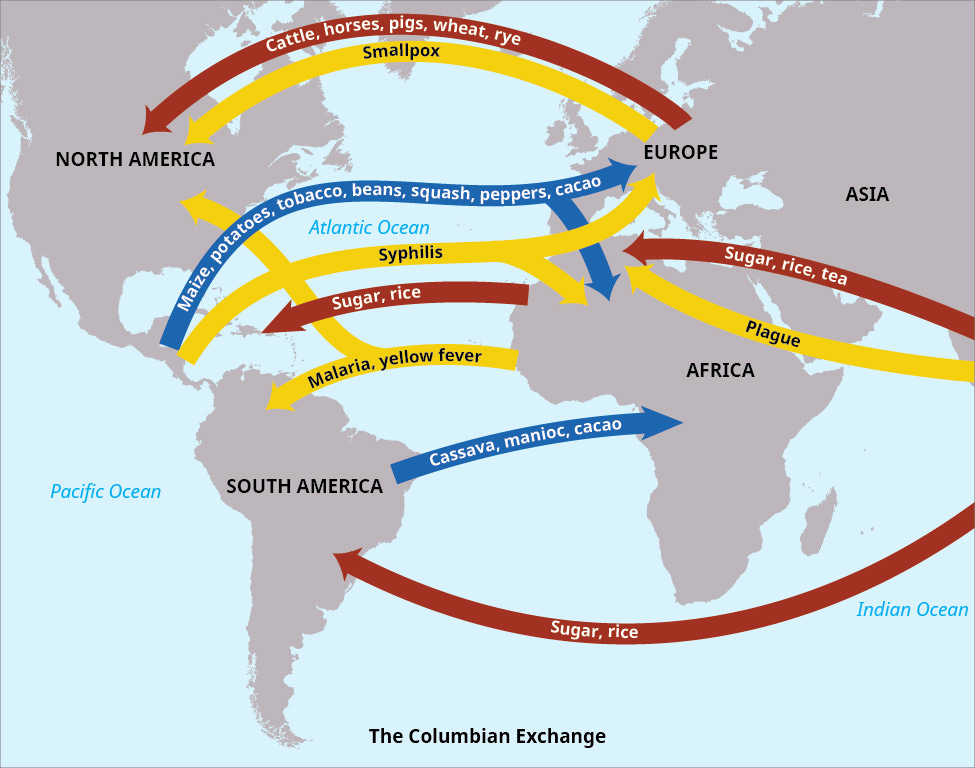
The potato was a miracle.
It could produce more calories per acre than any European grain. It grew in poor soil. It stored well. It was nearly impossible to tax – you can’t see it from the road like a wheat field.
Ireland’s population doubled between 1780 and 1840, fueled almost entirely by this Peruvian tuber. Northern Europe’s population exploded. The Industrial Revolution was powered, in part, by workers fed on American calories.
Then came the revenge.
Phytophthora infestans – potato blight – arrived in Ireland in 1845. Also from the Americas, ironically. Within five years, a million Irish were dead. Another million emigrated.
The potato giveth. The potato taketh away.
The miracle created dependence. The dependence created fragility. And when the system broke, it broke catastrophically – in ways nobody predicted when they were planting the first crop.
History isn’t a morality play. It’s a system of leverage, feedback loops, and unintended consequences that nobody fully controls.
That’s what makes me nervous about what comes next.
The Pattern
When two worlds collide, the one with more leverage doesn’t negotiate. It extracts. It transforms. It leaves the other side wondering what happened.
10,000 years of compounding advantages met 12,000 years of isolation in a single catastrophic afternoon. Nobody planned it. Nobody had to.
The pattern keeps repeating.
Globalization 2.0 was the Industrial Revolution. Steam, coal, telegraphs, railroads. The world shrank again. Populations that hadn’t industrialized found themselves colonized by populations that had.
Globalization 3.0 was the internet. Information moves instantly. Supply chains span continents. Countries that missed the Industrial Revolution leapfrogged with smartphones.
Globalization 4.0 is AI.
The Ships Are Sailing Again
In 1492, the leverage was ships, steel, and smallpox. The people who had them didn’t fully understand what they had. The people who didn’t have them didn’t see it coming until it was too late.
In 2026, the leverage is compute, data, and algorithms.
Who has the ships this time? The companies and countries with massive data centers, cheap electricity, and frontier AI models. A handful of organizations – concentrated in the US and China – control the infrastructure that will reshape every industry and every economy that touches the internet. Which is all of them.
Who’s on the other side? Anyone whose job can be done by a language model and whose skills are suddenly a museum exhibit. If you’re not sure whether that’s you… it might be you.
I’ve placed my bets on the ship-builders. Data centers. Energy infrastructure. The picks and shovels of the AI gold rush. Maybe I’m early. Maybe I’m wrong. Maybe I’m just a guy with a thesis that conveniently matches his positions.
But this is what I keep coming back to:
The Aztecs weren’t stupid. They had mathematics, architecture, agriculture that rivaled or exceeded European methods. But they didn’t have horses, steel, or immunity. The gap was about which capabilities had compounded.
Most people today are still arguing about whether AI can “really” think, whether it’s “just” autocomplete, whether the hype is overblown. Moctezuma’s advisors, the story goes, debated whether the strangers were gods or men. By the time they settled the question, it no longer mattered.
I don’t know if I’m on the right side of this. Nobody does. But I’d rather be wrong about timing than wrong about direction.
The modern trade wars, told through stablecoins and statecraft: Quid Pro Quo

Good triptych of articles; a job well done.... but, a "violent peninsula"? Wow, I'd say no more than the rest of the continent back then. Cheers!
I love this series