


TL;DR: When the hammer swings itself, the economy breaks in both directions. Everyone says Universal Basic Income is the answer. There’s a better answer – and an even better reason it keeps failing.
A Reddit post went viral a few months ago. Someone wrote:
“I genuinely have been trying to understand what is the point of AI taking everything over? … Every job is replaced. … No one can work, therefore, no one has money to buy any of the horse shit temu slop they prime on amazon now. Won’t everything just implode from there?”
Five thousand comments. The top answers were UBI (Universal Basic Income), communism, and “lol we’re fucked.” None of the top answers dug into what actually breaks.
I sold most of my stuff two and a half years ago. Packed a backpack and put the rent money into AI stocks. So when someone argues AI might break classical economics – I’m the case study.
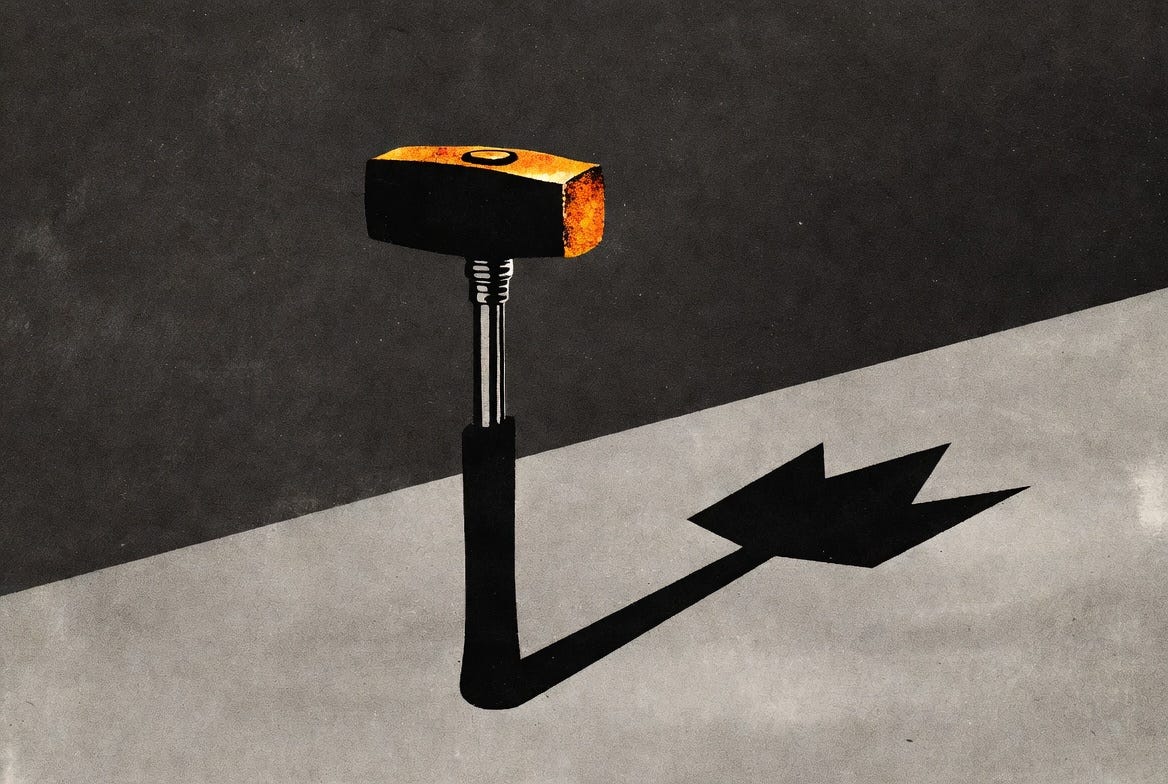
Capitalism runs on one relationship: the worker needs the hammer, the hammer needs the worker.
Codependency since the Industrial Revolution.
Now imagine the hammer swings itself.
Capital no longer needs labour. Labour’s share of income trends toward zero, capital’s toward a hundred. Nobody earns. Nobody buys. Companies lose revenue. And the counterintuitive part: the billionaires drown too. Your expenditure is my revenue is somebody’s salary is your customer base. Break the chain and everyone goes down. Including the people who own the boat.
So people still need income. The question is where it comes from.
The best version of this argument goes something like this:
The answer is not Universal Basic Income. UBI just moves your dependency. Right now you’re wholly dependent on your employer. With UBI, you’re entirely dependent on the government. Same leash, different collar.
The real move: make everyone a collective owner of the productive assets. Sovereign wealth funds, public trusts, DAOs, ESOPs, and schemes where buying from a company progressively earns you equity in it. Instead of wages, dividends. Instead of workers and consumers, owners.
People still have income. They still buy things. The economy doesn’t collapse.
But before you accept the frame, ask what “ownership” has actually meant across human history.
The Hold
Humans can control each other in two ways:
A right to people that gives you access to things. Slavery. You own the person, you take what they produce.
A right to things that gives you a hold on people. Capitalism. You own the farm, the store, the factory. I need food. I need money to get food. I need a job to get money. So I sign an employment contract – and an employment contract is an evolution of the master-servant contract from the industrial era.
The framing changed, but the structure… not so much.
We don’t legally own workers anymore. We control them because we own what they need. The second control scheme, running in 2026, dressed in HR software and quarterly performance reviews.
Collective ownership scrambles this. If everyone holds a piece of the productive assets, you can’t be held hostage by private property rights.
That’s the actual revolution in the framework: it dismantles the hold itself, not just redistributes wealth. That interests me more than the economics.
The Circulation
But every revolution so far has just rotated the names on the door.
The Industrial Revolution didn’t abolish elites. It traded the ones in castles for ones in factories.
The landed nobility fell from power when the economic order that sustained them became obsolete. Nobody defeated them. They just stopped being necessary. Industry created a new way of running an economy, which created a new class of owners to replace the old one. Meanwhile, the peasantry became the working class – a relabeling that left the hierarchy intact.
This has happened before. Hunter-gatherers to agriculture: flat bands became rigid pyramids. Feudalism to mercantilism to industrial capitalism – each revolution breaking the old arrangement and forcing a new one.
Marx saw this.
“No social order ever disappears before all the productive forces for which there is room in it have been developed, and new higher relations of production never appear before the material conditions of their existence have matured in the womb of the old society.”
Marx didn’t live to see electricity scale, but the pattern fits. AI is what industrial technology becomes when the womb finishes gestating.
The question is whether collective ownership is the next stage – or just the next ruling class in a friendlier hat.
The Monday Morning Problem
Even if the ownership model works, it still opens with a question that haunts its own answer: do you wake up on Monday and spend it the way you’d choose if money were no object? Liberation from labour is supposed to fix this.
I’ve been writing about thumos – the Greek word for the spirited part of the soul. The part that needs to strive. The fire that refuses to be managed, even generously. Plato put it in the chest, between reason and appetite. It’s the thing that makes you stand up when sitting down is easier.
Dividends don’t reach the chest.
I’ve been running the experiment myself – sold the stuff, swapped the salary for a portfolio and an essay habit nobody asked for. Technically free.
And yet the first thing I do every Monday is manufacture urgency – deadlines nobody assigned, essays nobody commissioned. The fire needs fuel.
Collective ownership solves the demand problem. But demand was never the hard problem. The hard problem is the dividend hitting your account while nobody needs you for anything.
History’s leisure classes are a mixed record – a handful of Medicis bankrolling Botticelli, far more Versailles courtiers dying of boredom and intrigue.
The forcing function of labour is coercive, yes. But it also gives you somewhere to be on Monday and someone to complain about on Friday. Remove it without replacing what it was doing and the check lands in a vacuum.
I wrote in The Job of the Future that when machines do everything perfectly, the only job left is being imperfectly human. That was 2024. The question still stands. But I think it’s sharper now. Ownership doesn’t just need to solve the economic problem – it needs to answer a question that economics was never designed to ask: what are people for?
Most people never have to ask it. The answer comes pre-installed – you’re born somewhere, into something, and the something needs doing.
The answer used to be obvious. You were for working.
When that’s gone, every philosophy that ever hand-waved about “meaning” and “purpose” suddenly has a deadline.
The hammer swings itself. That might be coming.
Collective ownership is better than UBI, and both are better than the dark path: a neo-nobility with neural implants and compound interest, a neo-peasantry with dividend checks and Netflix. The medieval hierarchy, except this time the nobility really are superhuman and they’ve got the receipts.
We already ran the governance experiment once. It was called pensions. US public pension funds were fully funded in 2000. By 2022, they were $1.26 trillion underwater.
The design said “collective ownership.” The execution said “committee of politicians with four-year attention spans.”
Norway’s sovereign wealth fund passed $2 trillion by running the same model with competent administration across decades – but Norway works because Norway works. Small, cohesive, oil-funded. Try exporting that.
You know where I’m positioned.
The other hard problem is who governs the owners.
Related reading:
The Race Condition – two AI futures and where I’m positioned

The AI Landlords – who captures the value when production is free

The Job of the Future – what work means when machines do it better
