

TL;DR: Europe’s pension systems were designed when workers died at 67. Now they retire at about 64 and live to 85. The pyramid has inverted, and the young are funding a contract they’ll never benefit from. Saturn is eating his children, literally.
Last Xmas I Gave You My Unsolicited Rant
I spent Christmas in Spain. Think hors d’oeuvres, jamón platters, turrón/cava and we all know him, we all love him: drunk uncle (let’s call him Tío Pepe). It didn’t take long for him to launch into his annual sermon about “la juventud de hoy.”
Kids these days. Don’t want to work. Too comfortable.
Tío Pepe is 63. He retired at 59 on a full pension. He bought his apartment in 1987 for €25,000. It’s worth €380,000 now. He’s never refreshed a job portal, never been ghosted by a recruiter, never been told his application was rejected because they found someone with ten years of experience willing to work for entry-level pay.

I smiled, poured more wine, and let it go.
Arguing with a man who bought his economic security for the price of a used car isn’t a debate. It’s archaeology.
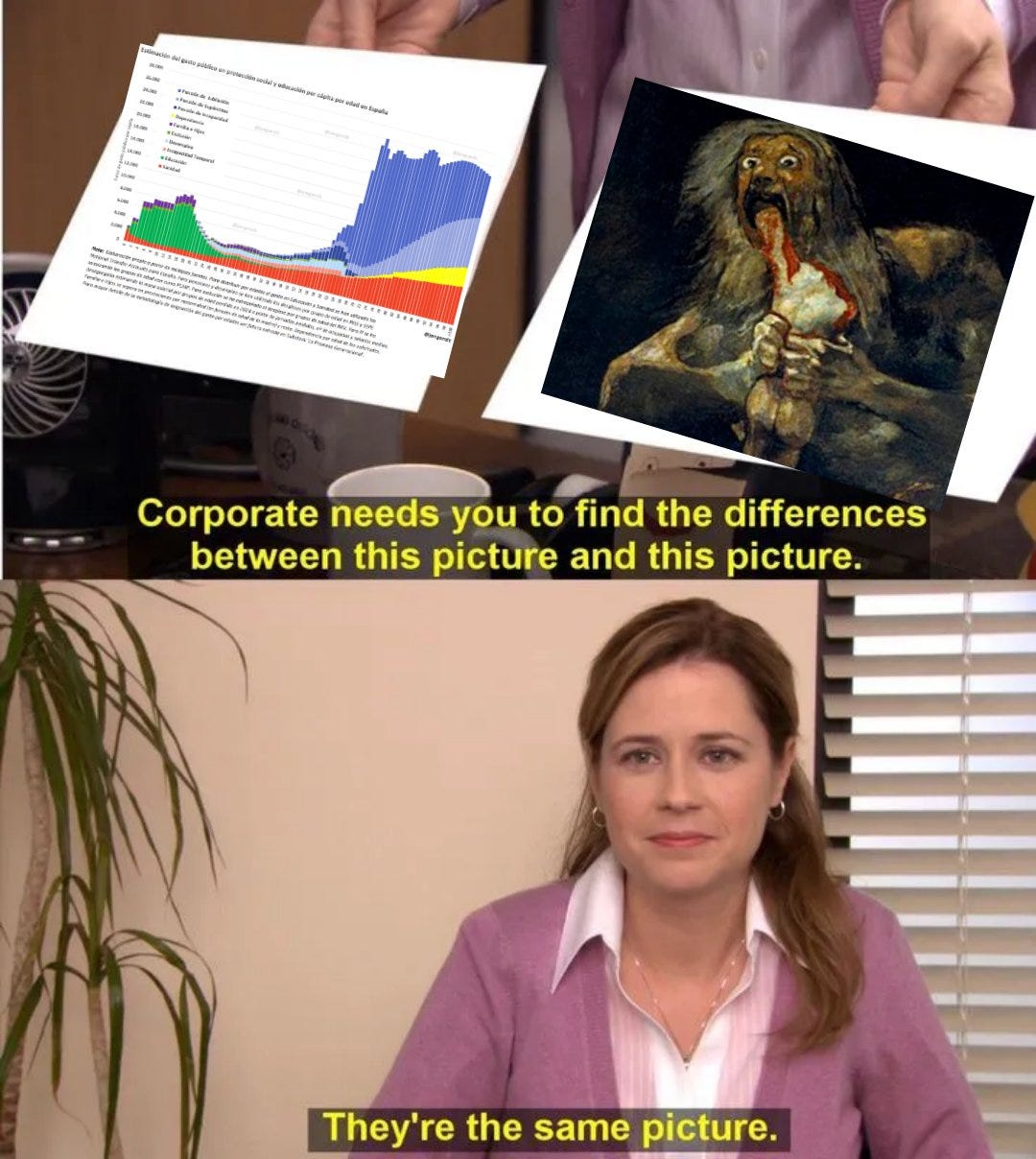
Speaking of fun, this reminded me of a chart: Spanish public spending by age.
Someone put it next to Goya’s Saturn Devouring His Son.
They’re the same picture.
The Demographic Ponzi
I’ve written before about how markets are Ponzi schemes – confidence games that work as long as new money flows in. The European pension system runs on the same logic, except the “investors” aren’t recruited. They’re born.
For decades, this worked. Wide base of workers, narrow apex of retirees. Many paying in, few drawing out.
That pyramid looks more and more like a mushroom every year. Exhibit A:
Spain, for instance, is heading toward a 1:1 ratio – one worker funding one retiree. The fertility rate has collapsed to 1.10 children per woman, second-lowest in the EU behind Malta. The workers aren’t being born. But the retirees keep retiring (which is why Spain is fueling GDP with immigration, but that’s a separate story).
In 2025, Spanish pensions rose 2.8%, indexed to inflation. Starting salaries for young employees? Flat.
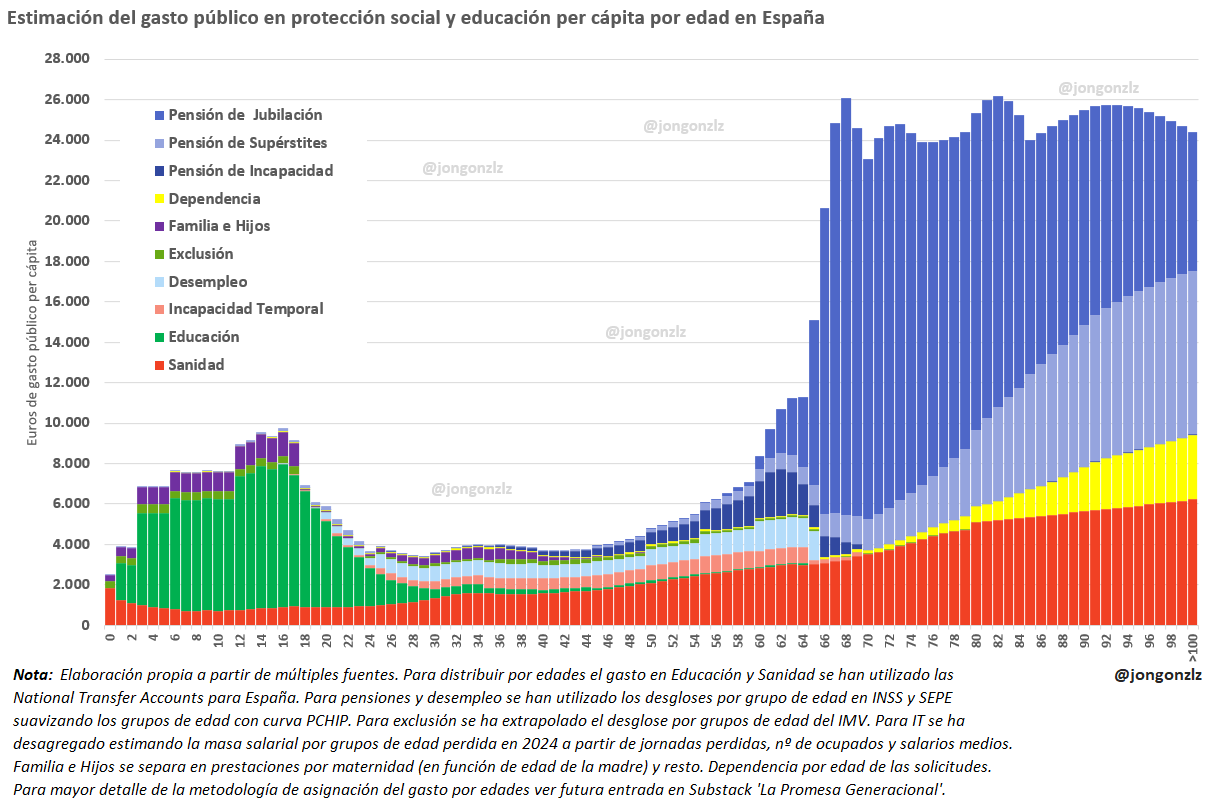
We’re protecting the past from inflation while letting the future rot. I call this the elephant chart. Once you see it, you can’t unsee it:
Spanish public spending by age. The blue tsunami on the right? Pensions:
Madafaking Bismarck
Spain is just further along the curve.
Germany’s pension system was designed by Bismarck in 1889 and rebuilt as pay-as-you-go – the Umlageverfahren – in 1957. It assumed workers would die shortly after retirement, not live another 25 years. It assumed population growth, not collapse. It assumed the future would always have more workers than the past had retirees.
Every assumption was wrong.
Germany is heading toward 1.5 workers per retiree, Italy is worse, and France set Paris on fire over raising the retirement age by two years. The pay-as-you-go system is designed for a demographic reality that no longer exists.
And here’s the thing I have to admit: the generation that built these systems probably did so in good faith. Bismarck wasn’t scheming to bankrupt millennials. The assumptions were reasonable at the time. But a system designed with good intentions and wrong assumptions still produces the same extraction as one designed with bad intentions. The downstream doesn’t care about the upstream’s motives.
The Silver Vote
Why doesn’t anyone fix this?
Because 10 million pensioners vote in Spain alone. They vote in every election, like their lives depend on it – because economically, their lives do depend on it.
The young? Busy. Disillusioned. Abroad.
A politician who proposes pension reform loses the next election. So no one proposes it. The budget becomes a funnel: taxes flow in from the young, transfers flow out to the old. Everyone knows the young will never see the same return.
The dead hand of the past has a vote in Spain – and it’s not letting go.
The Drawbridge
Extraction turns predatory at the housing level.
Nearly 90% of Spaniards over 65 own their homes outright. Most bought when housing was a fraction of its current cost relative to wages.
Today, renting an average 80 m² flat takes 47% of the average gross salary (Fotocasa/InfoJobs) – up from 40% in 2019. In Madrid, it’s 71%. Not a mortgage – rent. The money flows directly from productive worker to asset-holding pensioner.
Your grandmother’s apartment cost three years of salary in 1978. Today it would cost twenty – if you could get a mortgage. Which you can’t, because you don’t have a permanent contract. Because companies don’t give permanent contracts to people under 35.
The property ladder isn’t a ladder anymore. It’s a drawbridge. And the people who crossed pulled it up behind them.
The social contract used to mean: you work, you save, you build equity, you retire on what you built.
The intergenerational contract meant each generation left the next one better off.
Both contracts have been voided. The young just weren’t consulted on the terms.
Economist @JesusFerna7026 ran the numbers: over a lifetime, the average Spaniard takes out about €21,000 more than they pay in. The gap is borrowed, and the young inherit the bill. A wealth transfer with no return address.
The cruelest part? They still give the advice. “Just save more. Just work harder. Just be patient.” As if the game hasn’t changed. As if they didn’t change it.
The Three Exits
When a system extracts without offering a path forward, you exit.
You can’t afford kids when you’re funding someone else’s retirement. So you don’t have them. The pyramid shrinks further – the demographic Ponzi eating its own seed corn.
I know many Spaniards in Berlin with degrees on top of degrees. All left for the same reason: in Germany, they’re workers. In Spain, they’re ATMs. But Germans are leaving too – for Switzerland, for the US, for anywhere the tax wedge doesn’t eat half their salary before they see it. The brain drain is European.
And then there’s the shadow economy – 20-25% of Spain’s GDP. When the system treats you as a resource to extract, you go underground. Cash. Crypto. Anything that doesn’t pass through the tax authorities on its way to the pension fund.
The system won’t save you. The question is which exit you’re taking.
The Quiet Part Out Loud
Here’s what no one says publicly:
The system isn’t broken. It’s working exactly as designed – for the people who designed it.
Pensions get protected because pensioners vote. Housing stays expensive because homeowners vote. Labor markets stay rigid because insiders vote.
The young don’t vote enough, don’t own property, don’t have permanent contracts, don’t have lobby groups. So the young get extracted from.
Democracy working as intended: the majority gets what the majority wants. They don’t call it the tyranny of the majority for nothing (democracy truly is the worst system, except for all the others).
Saturn ain’t devouring me, son.
Sources: Eurostat, EU fertility rate 2024 · Eurostat EUROPOP2025 population projections · OECD Pensions at a Glance 2025
If Europe is eating its young, where should they go? Green Pastures ⬇️

More on the midwit trap: Don’t Mid-Curve It ⬇️

En román paladino:


El primer vídeo profundiza en los datos económicos reales que sustentan la brecha entre las pensiones crecientes y los salarios estancados… el otro va de monos.
insightful review with a somber perspective on the looming future. One issue at play is the young don't vote because they don't really have whom to: the alternative to conservative sameness can't be illiterate saviors chiming on proven failed doctrines (same dogs with SAME COLLARS, and then they wonder...).Maybe if the cowardness and hypocrisy would recede... yeah, sure.
I am not crying, you are crying (in the pillow)