


TL;DR: Prompt engineering is the skeuomorphism of AI. Skeu-what? I guess you’ll have to read on. Spoiler: my best outputs come from my laziest inputs.
When the iPhone launched, the Notes app looked like a yellow legal pad.
Designers call that skeuomorphism – dressing new technology in old technology’s clothes until the new medium finds its own language.
That’s what we’ve been doing with prompts.


Everyone’s selling courses on how to write better queries.
Role + Task + Tone + Format + Audience. AIDA frameworks for ChatGPT. “Act as a senior marketing strategist with 10 years of experience.”
It works. The way knowing how to Google “best Italian restaurant near me” works.
But while the prompt engineering discourse was busy monetizing itself, the models learned who you are.
Memory, persistent context, MCP connectors, custom skills…
The entire “craft the perfect prompt” formula exists to compensate for one thing – the model not knowing what you want or how you work.
Once it does? That formula is overhead.
The Laziest Inputs
My own workflow is infused with AI in every layer. Scheduled tasks for research, custom voice skills, image gen, a humanizer, SEO, persistent memory across sessions… the list goes on.
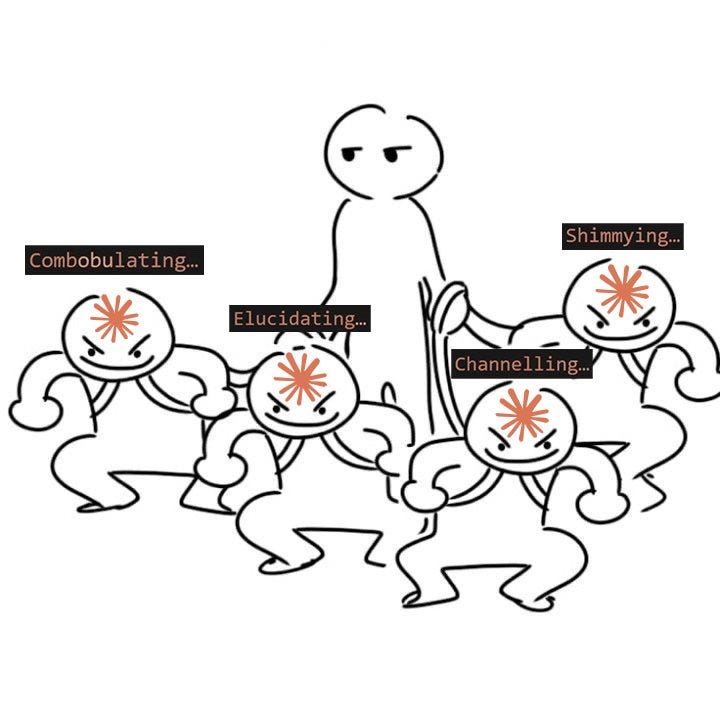
And with that, I’ve noticed that my best outputs come from my laziest inputs.
“Here’s a screenshot, do the thing.”
“What do you reckon?”
“Make it sharper.”
That’s the prompt. That’s all of it. No role assignment. No elaborate frameworks. Nada.
It works because the context is already loaded. The model knows my voice, my audience, my patterns (and anti-patterns).
I built that system once. Now I just talk to it.
Last week I pasted a rough braindump and typed “punch this up, it’s mid.” It came back with my sentence rhythms, my callbacks, my usual tricks – better than a version I’d have spent an hour polishing myself. The prompt was five words. The context was months of accumulated memory.
Last month the input was one sentence of plain speech – “make the archive less formulaic, keep the scaffolding” – and the system came back having read the whole archive.
And increasingly, not even typing. Voice mode made this obvious. Nobody speaks in structured prompts. You don’t say “Act as a senior editor, tone: conversational, audience: 25-40 year old knowledge workers” out loud.
You say “uh, you know that thing we did last week with the – no wait, not that one, the other draft – yeah, make it more like that but less... you know what I mean.”
And somehow it does.
All the messy, nonlinear ways humans actually think (the rambling, the circling, the mid-sentence course corrections) turn out to be better instructions than the five-part framework ever was.
A structured prompt strips out hesitation, emphasis, tangents – exactly the signals that tell the model what you actually care about.
Voice puts them back in. And a screenshot carries more information than any text prompt ever could – layout, tone, structure, intent, communicated simultaneously.
A text prompt replicating that would be 500 words and still miss half the picture.
Anthropic’s Boris Cherny, who built Claude Code, made a similar point on Lenny’s Podcast:
“Almost always you get better results if you just give the model tools. You give it a goal and you let it figure it out.”
What Replaces Prompt Engineering?
Context engineering.
Building the persistent memory, skills, and environmental knowledge that make individual prompts irrelevant.
Less “asking the model” and more interior design. You’re arranging the room before the conversation starts.
Prompting isn’t dying just yet, though.
The simple stuff got swallowed by one-click tools. The complex stuff turned out to be architecture, not copywriting. And the “ten prompting frameworks” crowd is caught in between, selling solutions to a problem that’s disappearing.
The best AI users I know write worse prompts than beginners. They just built better systems around the model.
So, prompt engineering is the skeuomorphism of AI. It was the right skill for 2023. The yellow legal pad was the right metaphor for a touchscreen – until it wasn’t.
It’s not my idea. Karpathy and Lütke baptized it context engineering a year ago.


One objection, though:
My lazy inputs only work because they’re secretly not lazy – “punch this up, it’s mid” is riding on months of loaded context, the exact craft the beginner still needs.
Tell a newcomer to just talk to the model and they’ll get slop. The room isn’t furnished yet, and the frameworks I’m dismissing are the furniture.
So maybe I didn’t kill prompt engineering. Maybe I just buried it deep enough to feel above it.
Whatever, mate…
I just call it working.
I really like the "interior design" analogy. It captures something I've noticed myself: as the models improve, I spend less time polishing prompts and much more time making sure the AI has the right context, memory and constraints. The prompt increasingly feels like the last 5% of the work rather than the first 95%.