
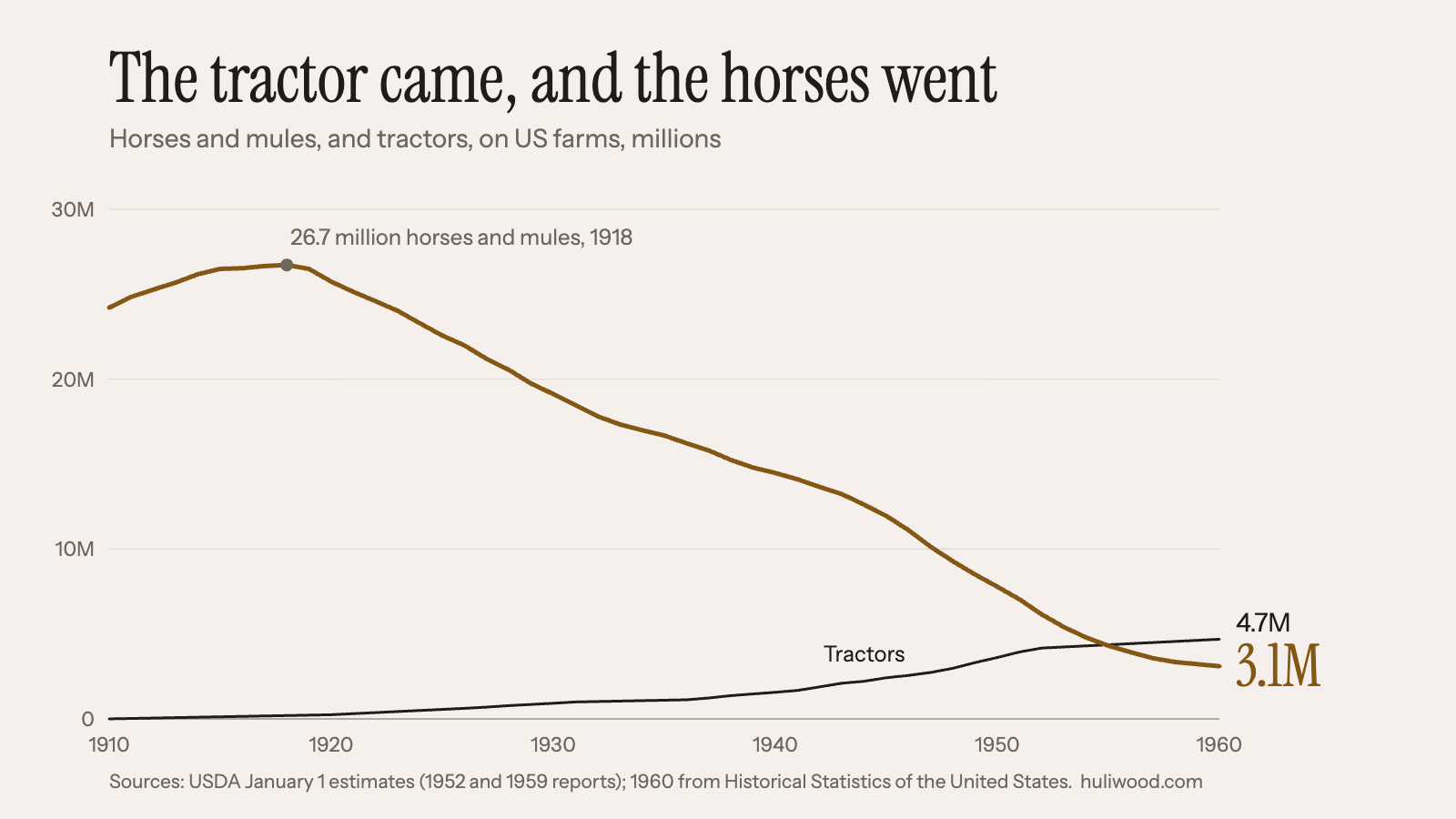
There were twenty-some million working horses in America when the tractor showed up.
By 1960, nearly nine in ten were gone.
Nobody retrained them. (They also didn’t automatically make horse sausage out of them, I’d hope.) There was no program, no transition fund, no “new kinds of horse work” waiting on the other side. The economist Wassily Leontief pointed at them in 1983 and said, politely, that we were next.
I think about the horses more than I’d like, because there’s a feeling going around right now that millions of people have and can’t name. Something between anxiety and grief, aimed at nothing specific. Just a sense that the ground rules changed and nobody sent the memo.
The old contract – work hard, things improve – rested on a fact: the powerful needed the powerless, as workers, as soldiers, as customers. Every social contract in history, including the cruel ones, ran on that mutual dependency. The lord fed the serf for the same reason the farmer fed the horse: out of need.
The engines didn’t negotiate with the horses. They made them unnecessary, and nobody had to ask how to share the field anymore.
The tractor replaced the horse but still needed someone in the seat. The machines arriving now are the first technology that doesn’t need a rider – which puts us where the horses were, in an economy still built on the idea that it needs riders.
Maybe it lands differently this time; people, unlike horses, occasionally vote, and I’ve written elsewhere about who ends up holding the reins.
But the dread is millions of people doing the arithmetic before their economists finish the paper.
Related: The Last Leash – who holds the reins when nobody needs a rider.

Sources: US horse & mule population (USDA, 1840–1924) · Yale Energy History, horse and mule statistics · Leontief, National Perspective (National Academy of Engineering, 1983) · Historical Statistics of the United States, horses and mules on farms, 1867–1960
Discussion about this post