


London, 1685. You can practically smell it in the Thames air.
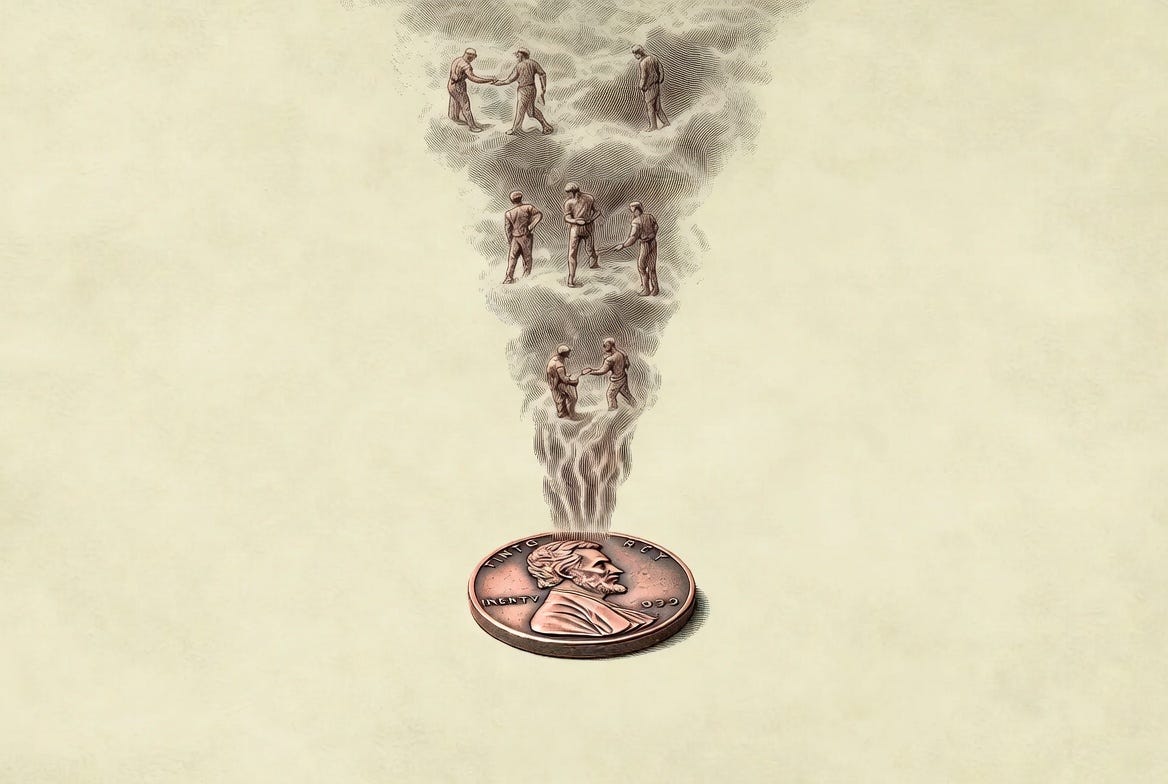
For a penny you got a seat, a dish of coffee, and several hours of the sharpest minds alive arguing in one loud room, sober.
The coffeehouses were later dubbed “Penny Universities”, and the name was only half a joke.
Lloyd’s of London began as one. Fellows of the Royal Society adopted another as their annex. Traders, pamphleteers, scientists, and cranks, all for the price of a cup.
We usually hand the Enlightenment to the coffee, the swap from a half-drunk Europe to a caffeinated one. But the harder drug was the room.
What the coffeehouse did that the tavern couldn’t was force an idea to survive other people’s faces. You showed up. You sat down. You said your piece to someone who could see you, push back, and remember tomorrow that you’d been an idiot.
An argument cost you something.
A reputation was a thing you carried in and out the door.
The Penny University priced an idea by whether it held up in a room full of people who’d watched you make it.
That’s the part we demolished.
We kept the stimulant and scaled it to infinity, a coffee on every corner and a feed in every pocket, and we threw out the room.
The comment section is a coffeehouse with the bodies removed: the talk without the table, the take without the tab. Reach went up a millionfold. Accountability went to zero.
The room itself survived, by the way. I’m a paying member – a specialty coffee victim, 5 € a flat white, and the fiver works exactly like the penny did: it’s a filter with a doorway.
Except the penny let in anyone sober enough to argue – traders, cranks, people wrong in interesting ways – and the flat white lets in people exactly like me. Twenty of us, laptops open, silently arguing about oat milk.
Related: From Buzzed to Wired – the stimulant half of the story.

Sources: Royal Society, founding history · Lloyd’s of London, coffee and commerce
The modern day's Penny University is Twitter: a room where everyone has a microphone, everything is recorded forever, and yet, nobody is responsible for anything they said five minutes ago.