

TL;DR: 91.4% of your worries will never happen. You’ll suffer anyway. That’s the tax – and you’re paying it on futures that never arrive.
Months of YouTube mid-roll BetterHelp ads finally got to me. I had one of those online therapy calls. The first 2 weeks are free, right? My assigned therapist: Michael. Nice guy.
First thing he asked me was to take a Big Five personality test.
I scored 0 in neuroticism.

He opened the next session by saying he’d never seen anyone score that low. (congratulations? or red flag?)
So maybe I’m uniquely qualified to write about worry. Or maybe I’m a tourist in territory I don’t understand. Probably both.
But even I know the feeling of spiraling. Not often. But enough. Late night. The ceiling. The cascade. The disaster simulations your brain runs without your permission.
By morning, the thing you were worried about still hasn’t happened. Probably never will. But you’ve already paid the price.
The Liar in Your Head
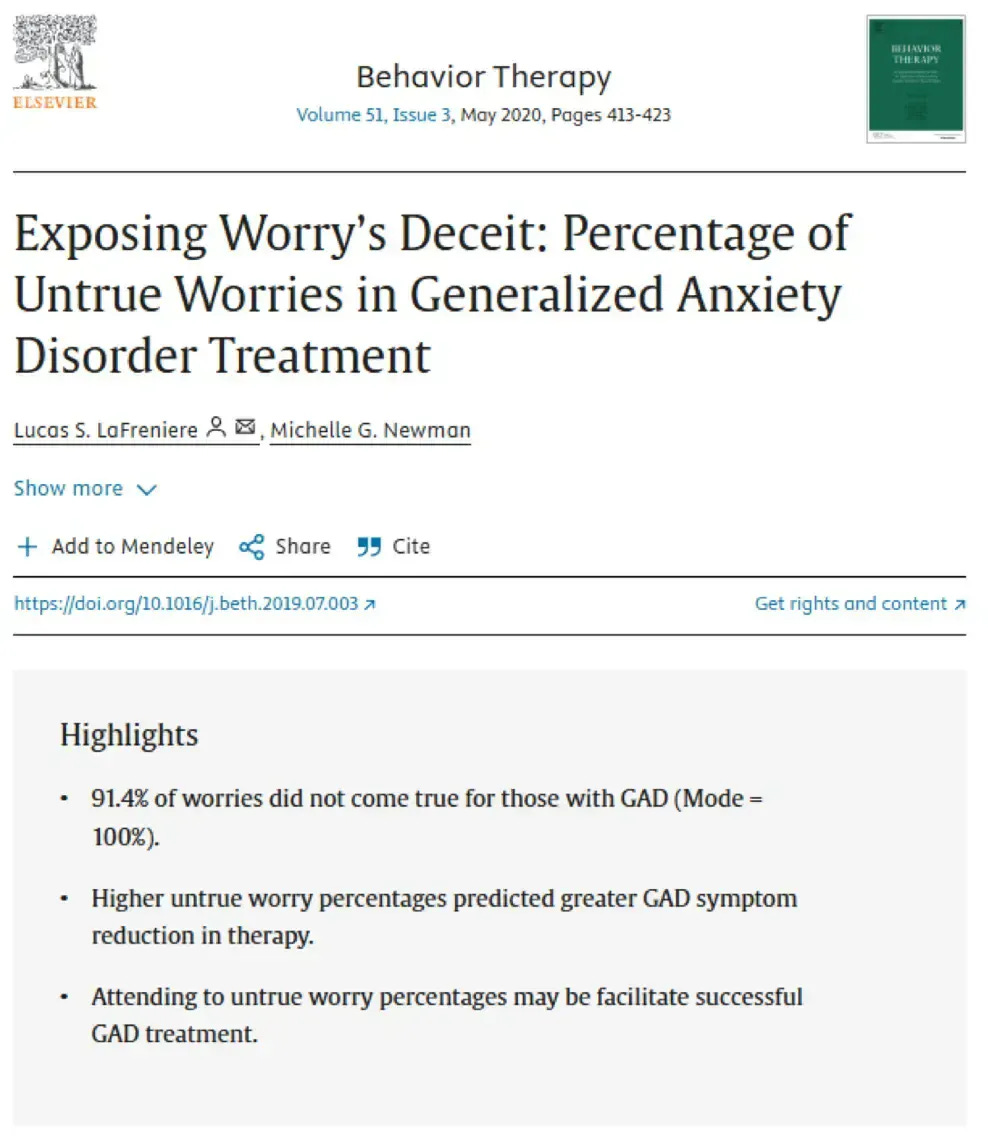
Your brain has a 91.4% false positive rate on worry.
That’s from a 2019 study in Behavior Therapy tracking people with Generalized Anxiety Disorder – professional worriers. They logged their fears, then tracked what actually happened.
Nine out of ten worries were false alarms. For many participants, not a single worry materialized.
Think about that. The presentation that would end your career. The lump that was definitely cancer. The text you sent that ruined everything. The conversation you rehearsed forty times. None of it happened.
Your brain speaks in the voice of reason, dressed in the language of prudence. “I’m just being realistic,” it says. “Better safe than sorry.”
But your worry generator has a 91% false positive rate.
If it were a smoke detector, you’d replace it.
The Double Tax
Okay, so the worries aren’t real. Cold comfort. The suffering is real anyway.
A 2010 Harvard study tracked 2,250 people via an iPhone app, pinging them randomly throughout the day: What are you doing? What are you thinking? How happy are you?
The finding: a wandering mind is an unhappy mind.
People’s minds wandered 47% of the time – nearly half their waking lives spent somewhere other than the present moment. And when the mind wandered, happiness dropped. Regardless of what they were actually doing.
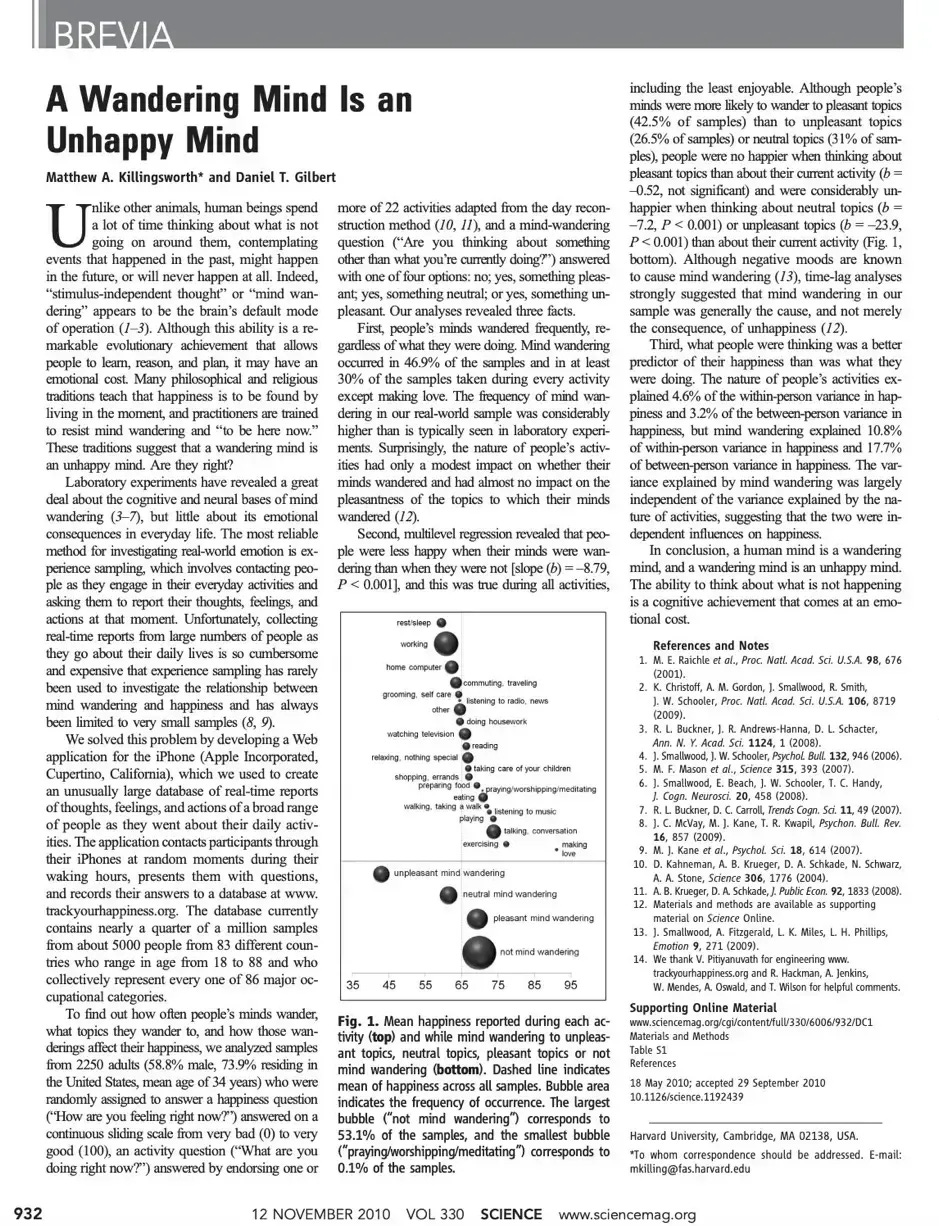
It’s a bit hard to tell from the chart, so here’s the summary:
Making love: highest happiness, lowest mind-wandering. Commuting: miserable – not because of traffic, but because your mind is elsewhere. The activity mattered less than whether you were actually there for it.
The cruelest insight? Even wandering to pleasant fantasies didn’t boost happiness. Presence beats even pleasant absence.
That’s the double tax: You suffer imagining a future that won’t happen (91% of the time). And you miss the present that’s actually fine (47% of your life).
Being wrong is one thing. Being wrong and miserable? That’s the real tax.
It’s A Trap
The cruel joke: trying to stop makes it worse.
Psychologists call it “ironic process theory.” When you try not to think about something, you first have to identify what you’re avoiding – which means thinking about it. The golfer who tells himself “don’t hit it in the water” has already programmed his attention toward the hazard.
Try not to think of a polar bear.

Why are we like this? Evolution.
The brain that assumed every rustle was a threat survived. The relaxed one got eaten. We’re running survival software in a world that no longer requires it. The rustle is just wind, or a Slack notification, or your own thoughts eating themselves.
The trifecta is complete: Your worries are probably false. The worrying makes you miserable. And trying to stop worrying makes you worry more.
The Ancients Knew
Two thousand years ago, Seneca wrote:
“We suffer more often in imagination than in reality.”1
No iPhone app. No peer review. No sample size of 2,250. Just a guy paying attention to his own mind.
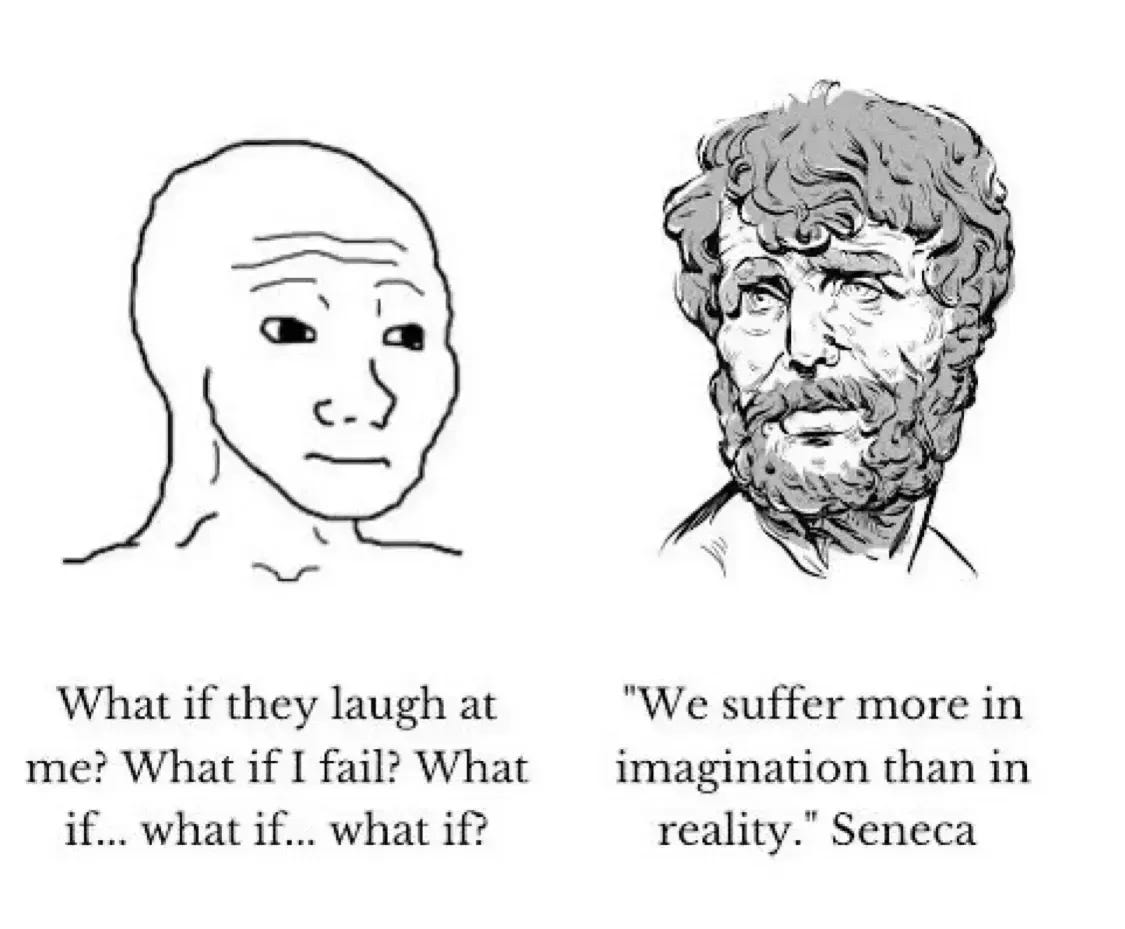
He nailed the 91% stat in ancient Latin:
“How often has the unexpected happened! How often has the expected never come to pass!”
The Stoics weren’t optimists. They didn’t say “don’t worry, it’ll be fine.” They had a practice called premeditatio malorum – imagining the worst deliberately, briefly, in daylight. Not to spiral, but to inoculate.
The difference between their method and your spiraling brain? They chose the when, the what, and the duration.
Controlled burn vs. wildfire.
The Other Side
Two years ago I could have worried I’d never find the courage to quit my job and travel the world. I could have worried we’d run out of money in Australia. That I’d come home with no prospects.
Some of those thoughts crossed my mind. But I didn’t let them set up camp. And here I am – alive, fine, writing to you from the other side of all those hypothetical disasters.
The fears that feel so urgent, so certain, so real – they evaporate without a trace. Nine times out of ten.
Maybe that’s what 0 neuroticism actually means: not fearlessness, just a shorter memory for false alarms.
More on thinking clearly: Trust Your Gut | The Information Mirage | Don’t Mid-Curve It
Frequently Asked Questions
What does “the 91% lie” mean?
It comes from a 2019 study in Behavior Therapy by LaFreniere and Newman, which found that 91.4% of worries never came true. Participants tracked their worries over 10 days and compared predictions against outcomes. Nearly all of it was fiction the brain wrote and then believed. The “lie” is that worry feels like preparation when it’s actually just running expensive simulations of things that probably won’t happen.
What is the worry false positive rate?
91.4%, according to the LaFreniere and Newman study. Of the remaining 8.6% that did come true, a significant portion turned out better than expected. So the rate of worries that came true and were as bad as predicted is even lower than 8.6%. Your threat-detection system is firing almost constantly, on almost nothing.
Is worry the same as mind-wandering?
They overlap but aren’t identical. Killingsworth and Gilbert’s 2010 Harvard study, published in Science, found that people’s minds wander about 47% of waking hours – and that mind-wandering made people less happy regardless of what they were doing. Even pleasant daydreams didn’t boost happiness. Worry is a specific flavour of mind-wandering: future-focused and threat-oriented, running on the same hardware but pointed at worst-case scenarios on repeat.
What is ironic process theory?
Daniel Wegner’s finding that trying not to think about something makes you think about it more. His classic experiment told people not to think about a white bear – and they thought about it roughly once per minute. The harder you suppress a thought, the more your brain monitors for it, which keeps surfacing the very thing you’re avoiding. That’s why “just stop worrying” backfires. The instruction to stop creates the surveillance that keeps the thought alive.
What did the Stoics say about worry?
Seneca wrote in Letters to Lucilius (Letter 13, around 65 AD) that we suffer more often in imagination than in reality. But the Stoics didn’t recommend ignoring fear. They practised premeditatio malorum – deliberately visualising the worst case in a controlled way, then asking “and then what?” The difference is structure. Worry loops without resolution. Premeditation walks through the scenario to its end, and usually the end is survivable, which is the whole point of the exercise.
BONUS:
Check out Joseph Everett (WIL)’s video on this:
Seneca. Letters from a Stoic, Letter 13: “On Groundless Fears.” ~65 AD
I agree with the 91.4.% of your posting, but in the spirit of critical judgement I'd plant the seed of doubt: what if some of those worries that didn't happen did not happen because worrying about them in time gave us the solution?