

TL;DR: Three researchers mapped all of science into a single network. They laid it on a sphere. Turns out, it has no center. I went looking for the missing discipline that connects all others and found seven candidates, each partially right, none complete. And the questions are more interesting than any single answer.
In 2006, Kevin Boyack, Dick Klavans and Brad Paley did something nobody had attempted at scale: they mapped all of science.
An empirical map. 800,000 papers sorted into 776 scientific paradigms based on how often they cited each other. Physics drifted toward mathematics. Biology toward chemistry. Psychology toward neuroscience. The layout was computed into place.
The result looked like a galaxy. Dense islands connected by faint filaments, separated by dark voids of mutual indifference.
Organic chemistry and political science are practically on different planets – and judging by the citation data, they prefer it that way.
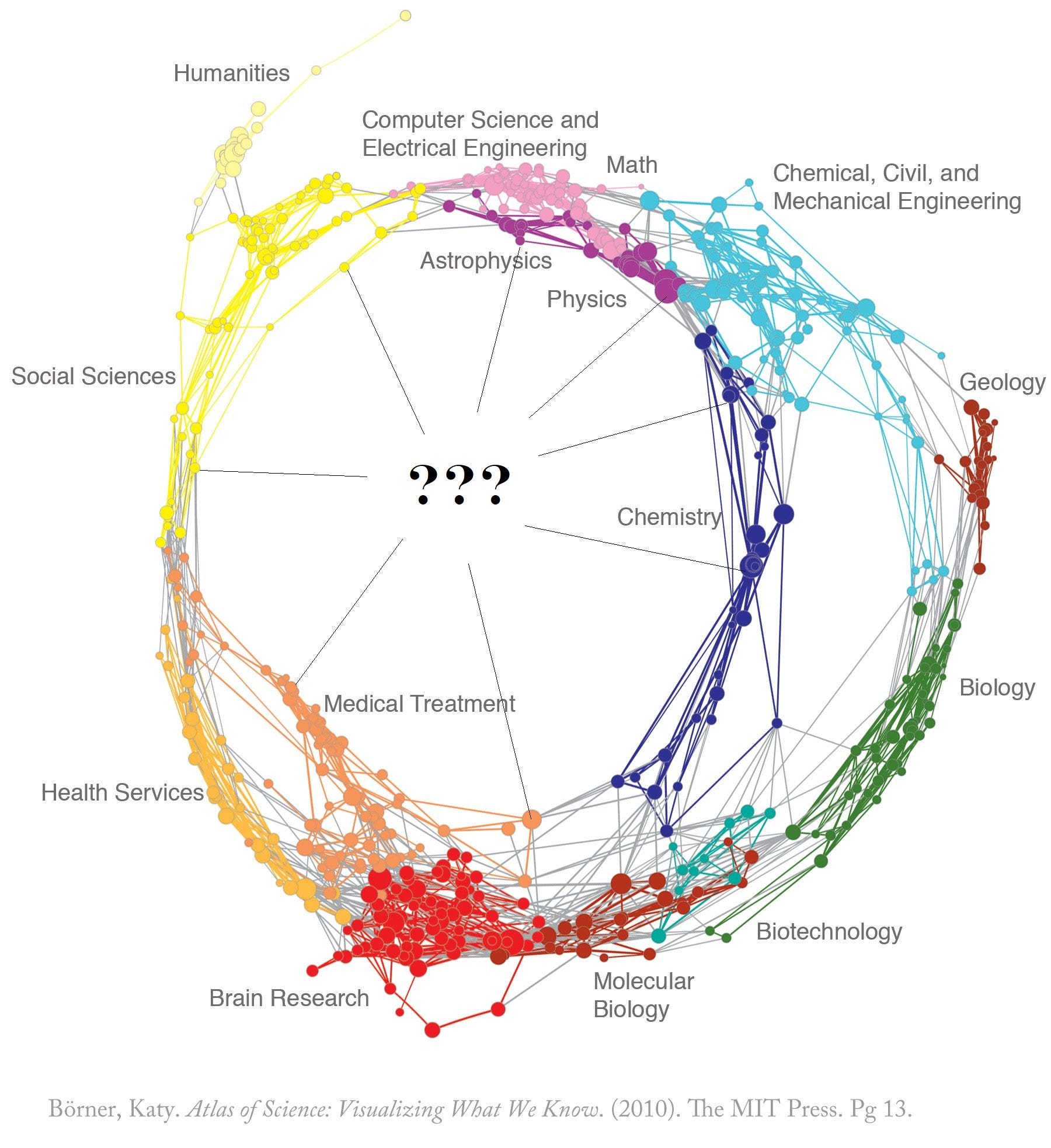
When the team later analyzed 20 different maps of science to find the consensus structure, the answer was a circle.
Mathematics at the top, then clockwise through physics, chemistry, earth sciences, biology, medicine, psychology, humanities, social sciences, computer science – and back to mathematics, closing the loop. They laid the full map on a sphere. No north pole. No south pole. No capital.
I stared at this map for quite some time. The clusters are obvious. But what pulled my eye was the center. Or rather, the absence of one. On a sphere, there is no center. Every point is as central as every other.
The map of all human knowledge doesn’t have a capital.
Which lands a little close to home.
After all, I’m writing a newsletter whose entire premise is that the connections between things are more interesting than the things themselves.
Finance one week, philosophy the next, travel, AI, history, always betting that the thread running through them matters.
If knowledge has no center, then either I’m onto something or I’ve been writing elaborate footnotes to nothing. (Which is fine by me, actually).
So: is there a missing discipline, a meta-science, that would sit at the center if we could identify it? A secret grammar that all the other sciences are conjugating without knowing it?
Let’s look for candidates.
1. Mathematics
The obvious first nominee.
Mathematics is the language every hard science eventually speaks when it gets serious. Physics runs on differential equations. Chemistry runs on quantum mechanics, which runs on linear algebra. Even biology (that holdout of messy, wet contingency) now runs on statistical models and genomic computation.
In 1960, Eugene Wigner wrote a paper called “The Unreasonable Effectiveness of Mathematics in the Natural Sciences.”
His argument: mathematical structures invented for purely abstract reasons keep turning out to describe physical reality with eerie precision.
Complex numbers, a curiosity, turned out essential for quantum mechanics. Non-Euclidean geometry, a thought experiment, became the backbone of general relativity. Wigner called it “a wonderful gift which we neither understand nor deserve.”
So: mathematics as the missing link? Ask a mathematician and they’ll say yes before you finish the question.
To me, it’s the grammar, not the meaning. You can model a neuron firing without touching what it feels like to be conscious.
Math is silent on love, politics, what to have for lunch. The most powerful tool science has ever produced, and it covers maybe a third of the territory.
A hammer connects with a lot of nails. That doesn’t make it the center of carpentry.
2. Philosophy
Before the sciences existed, philosophy was the science.
Aristotle didn’t have departments. He just thought about everything, and the distinctions came later.
Philosophy asks the questions every other discipline assumes it can skip.
What counts as evidence?
What are the limits of knowledge?
When physicists argue about quantum interpretation, they’re doing philosophy whether they like it or not. When neuroscientists say consciousness is “just” brain activity, the “just” is doing philosophical work they haven’t paid for.
But philosophy got colonized by its own offspring. Physics left home. Chemistry left. Psychology left. Linguistics left. Each took its questions and slammed the door. What remained was philosophy-of-X, tethered to the disciplines it was supposed to ground.
The queen of the sciences became a court advisor to each departing kingdom, and the advisors don’t talk to each other much these days.
Philosophy still asks the best questions.
But asking good questions and unifying the answers are different jobs, and nobody hires the same person for both.
3. Information Theory
In 1948, Claude Shannon (our fav AI overlord’s namesake) published “A Mathematical Theory of Communication” and accidentally laid the groundwork for the modern world.
He showed that information could be quantified and transmitted with mathematical precision, regardless of whether it was music, text, images, or stock prices.
The content didn’t matter. The math was the same.
John Archibald Wheeler (the physicist who popularized the term “black hole”) took Shannon’s insight and drove it off a cliff. His slogan: it from bit.
Which goes something like this…
Reality isn’t made of matter. It’s made of information. Every particle, every field, even spacetime: all derived from binary choices at the bottom. Matter is what information looks like when you zoom out.
I remember the first time I heard this claim… a religious experience of sorts.
The whole universe explained in three words. DNA is information. Markets are information. Music, language, consciousness, all information. If reality is computation all the way down, then information theory is the missing link. The substrate beneath every substrate.
That feeling lasted about a week.
Because: information about what? Shannon’s theory is deliberately blind to content. A bit is a bit whether it encodes a love letter or a death sentence. That’s the theory’s power, and its ceiling.
A framework that treats everything identically can’t explain why anything is different.
Information theory is the skeleton. But nobody falls in love with a skeleton.
4. Complexity Science
Forty years on, the Santa Fe Institute still can’t tell you why ant colonies and neural networks share the same dynamics. Not for lack of looking.
They started in 1984 – a group of scientists, many from Los Alamos – on a premise that sounded either brilliant or naive: the most interesting questions in science live between the disciplines, not inside them.
Markets crash like ecosystems collapse. Brains organize like ant colonies. Cities grow like organisms. The founders bet these weren’t just metaphors – that genuine mathematical patterns recur across wildly different systems.
Emergence. Feedback loops. Power laws that appear in earthquakes and stock crashes and epidemics, over and over, as if nature has a favorite trick.
Murray Gell-Mann recruited scientists from a dozen fields. Many responded the same way: “I’ve been waiting for this all my life.” (Which is what people say right before they join a cult or a startup.)
The connections are real. Naming the pattern isn’t the same as explaining it, and whether ant colonies and neural networks share a cause or only a shape is, all these years later, still an open question.
5. Consciousness
Still with me? Conscious enough to not have fallen asleep quite yet, I presume.
Here’s where the list breaks.
Every previous candidate is a tool, a framework, a method. Something you point at the world.
Consciousness is the thing doing the pointing. You can’t remove it from the experiment.
Every map was drawn by someone. The observer is always in the room, sitting in a chair nobody put on the diagram.
David Chalmers called the core puzzle “the hard problem”: not how the brain processes information (that’s the easy problem), but why processing gives rise to subjective experience at all.
Why does it feel like something to see red?
Why isn’t everything just computation in the dark?
Math can’t account for the mathematician. Information theory says nothing about who’s receiving the signal. Complexity science can’t explain how a hundred billion neurons become someone who wonders about emergence.
Every other candidate on this list has consciousness as its blind spot.
Which makes consciousness either the deepest answer or the deepest dodge.
The telescope pointed at its own lens, unable to confirm what it sees.
6. Artificial Intelligence
Feed a large language model every paper on Boyack’s map and it finds connections no individual human could hold in their head.
The immunology paper and the materials science paper and the economics paper, read at once. The Santa Fe Institute’s dream, running at inhuman speed. This is our moment’s nominee – and it doesn’t even claim to be the missing link. Only the translator.
Which would be enough, if translation were understanding.
AI reflects the structure of the knowledge it ingested, including the biases, the blind spots, the gaps.
If the map of science has no center, training an AI on the map doesn’t conjure one.
A GPS knows every route in the city. Ask it what the city means and it’ll reroute you to the nearest specialty coffee shop (obviously).
7. God
I hesitated before writing this section, which is probably a sign it belongs here.
Every culture in recorded history has named something that unifies all experience. A logos. A Tao. A Brahman. An unmoved mover.
The specifics vary too wildly to all be right… but the impulse is identical: there must be something holding everything together. The sciences are fragments of one truth. The right angle would reveal the whole.
Don’t think of it as a theological argument. It’s more an anthropological observation.
The desire for a unifying principle is structurally identical to the oldest religious impulse humans have.
We keep looking for the center because we feel, at some level, that one should exist.
The Enlightenment called it Reason. The 20th century called it Information. We’re calling it Intelligence. The impulse predates all of them.
Which doesn’t mean it’s wrong. Maybe something real keeps getting renamed in whatever vocabulary the era trusts most.
The Map Has No Capital
Kevin Boyack, the one who built the map, was very amused by the comments.


People saw the network and immediately started arguing about what belongs in the center. Physicists said physics. Mathematicians said math. Everyone projected their own discipline into the gap.
But the map is built from citation data. Not from theory or philosophy, not from anyone’s sense of what the center should be.
And the answer is: nothing.
The consensus structure is a circle. The full map sits on a sphere. There is no center – it’s topology, stupid.
Every candidate I collected: math, philosophy, information, complexity, consciousness, AI, God… each illuminates something the others miss. And each one has a blind spot the next candidate exists to fill.
Seven serious answers, each partially right, none complete.
Call it the Projection Problem: the map has no center, but the viewer can’t help inventing one.
Each era picks the missing link that matches its highest value.
The Enlightenment, drunk on Newton, said mathematics.
The mid-20th century, drunk on Shannon and Turing, said information.
The late 20th, watching markets and ecosystems behave as complex systems, said complexity.
Our century, watching AI eat everything in sight, says intelligence. And underneath all of them, the oldest candidate just waits.
Now… if you held a gun to my head, I’d say consciousness.
I can’t defend it 100%, of course, but it’s the only candidate that can’t be removed from the experiment.
You can do science without math (people did, for millennia). You can’t do science without an observer. The telescope can’t observe itself, but it’s the only one looking.
Then again, that’s exactly the Projection Problem at work. I pick consciousness because I’m more humanist than scientist – someone whose entire craft is about subjective experience.
A physicist would pick math. An engineer would pick complexity. A theologian would pick God.
The map doesn’t have a center because knowledge doesn’t have a center.
It has a reader. And the reader keeps trying to stand in the middle.