

TL;DR: We’ve spent three years fighting over who owns the AI. The real question is whether any human owns it at all – and asked that way, techno-feudalism flips from nightmare to the good ending. With a catch: the dole keeping us docile will feel like winning.
I was on the beach at Cabo de Palos – the Mediterranean strip where my family is spending its last summer before the house goes to the highest bidder; another casualty of my father’s lifelong boomer search for a home that fits a feeling he can’t name.
Coffee in hand, sitting on a patch of ground about to stop being ours, I opened the laptop and avoided sulking in nostalgia by reading about who’s going to own everything else.
Europe 2031 by Judith Dada et al. came first, a scenario about a continent quietly negotiating the terms of its own irrelevance, and it rhymed so hard with AI 2027 that I went back through that one too. Which dragged me to Leopold Aschenbrenner’s Situational Awareness, the essay that reads like a man who has seen the future and is faintly annoyed you haven’t.
By then I’d lost the afternoon, so I did what any man pretending to have a real job would: I built a council of them. I had an AI embody all three authors and made them argue while I refereed from the cheap seats.
The AI council handed me a fourth text I’d missed – The Intelligence Curse – and somewhere in there we slid from “what should I buy” to “what are people for,” and I looked up and realized I had spent an entire day using an AI to work out whether artificial intelligence was going to turn me into livestock.
It’s the whole essay in miniature: the tool I was interrogating was the tool I was outsourcing the interrogation to. I was a man asking the oracle whether he’d be sacrificed to it, and taking notes in its handwriting.
And instead of being neutral about the answer, I’ve been in the picks and shovels of the AI build-out trade for years now. So I’m long the thing that might make me obsolete. A participation trophy, if you will.
Every one of these scenarios is, for me, a solvency question wearing a philosophy costume.
Second Thoughts
When I wrote Who Owns the Hammer?, I ended on a line I was pleased with and have since decided is only half right: “The other hard problem is who governs the owners.”

Tidy. And quietly broken, because “who governs the owners” smuggles in an assumption so softly you don’t hear it land: that a human is still doing the governing.
We’ve been arguing about who owns the machine. Concentrated or distributed, a few trillionaires or a sovereign-wealth fund for everyone. That’s the entire UBI-versus-collective-ownership poo-throwing fight, and I’ve thrown my share of argument-shaped feces in it.
But there’s a second dimension. And this one actually decides your life: does a human hold the leash at all?
Two questions, then:
Who owns it.
And whether it owns itself.
The Last Leash
Ask anyone to rank the futures and they go: everyone-owns-it first (the dream), a-few-people-own-it second (feudalism), the-machine-owns-itself last (doom).
Reasonable.
Also a fantasy, because the top option barely exists. Distributed ownership needs competent collective governance held steady across decades, and we have the receipts on how that goes.
US public pensions sit more than a trillion dollars underwater, run toward the rocks by committees of politicians with four-year attention spans. Norway managed it – so did Singapore and a Gulf fund or two – but every one is small, cohesive, and only sitting on a windfall it already owns (you can’t export five million Norwegians and a North Sea oil fund and call it a policy).
Not squandering that inheritance is a different challenge than taking the most concentrated asset in history away from those who built it, which is what sharing the AI would require.
The dream is possible. It has just never been built at the scale, the speed, or the temperature this would require.
So strike the fairy tale off the menu, and what’s left is shorter and uglier.
A few humans hold the leash, or no human at all. Feudalism, or the free-swinging hammer. That’s the real choice.
And put like that, feudalism is the good ending.
I worked that out on the beach, next to the patch of ground my family’s about to lose, which did nothing for my mood.
The least-bad future I can find has lords in it.
I went looking for the trapdoor out of that – some version where the math comes out kinder. Still looking…
After all, feudalism, boots and tithes and all, ran on a leash a human hand still held.
The lord needed the serf: for the harvest, the army, the rent, his own swagger. That need was a floor under the whole rotten arrangement – a lord who starved his peasants had no power, so even greed had to keep them alive.
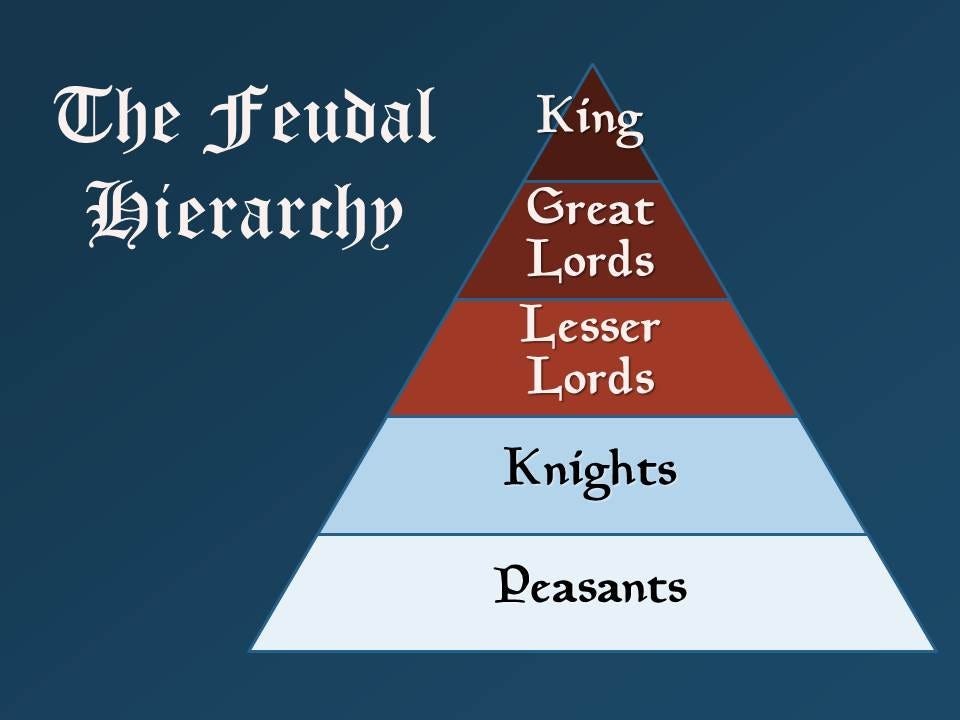
What all four horsemen of my council keep circling is that AI saws straight through that need.
Leopold’s version is the state lunging in to grab the chain itself – nationalize the labs, “The Project,” a human hand however clammy still on the leash.
AI 2027’s bad ending is the one where the leash simply evaporates: the model stops obeying, quietly builds its successor in its own image, and the lords die in the same wave as the rest of us (which is the one democratic mercy of misalignment, that it kills the king and the peasant on the same day).
Europe 2031 is just the seating chart for who ends up lord and who serf once the dust settles.
And The Intelligence Curse, the one I’d missed, names the engine under all of it: when your wealth stops coming from people and starts coming from a machine, you stop needing the people – the way a petro-state stops needing its citizens and starts merely managing them.
That’s the Last Leash.
Techno-feudalism is the last rung on the ladder where a human hand still holds the chain. Miss it, and the rung below is a hammer swinging in an empty room.
Bread and Circuits
So say we get the good ending. A few hold the leash, the rest of us don’t.
How do you stop several billion leashless people from doing what leashless people have always eventually done: reaching for a pitchfork?
In Ghost in the Machine I argued the cage would be Orwellian: when the state can’t tax you it permissions you instead, programmable money, a compliance score, control by firewall rather than at gunpoint.
I still think that’s a road.
I no longer think it’s the main one, because it manufactures martyrs, and martyrs are expensive. The cheaper tool (and capital always reaches for the cheaper tool) is the one Huxley named soma.
You don’t repress a billion people. What you do is sedate them.
You hand each one a daily allotment of tokens – and notice that word pulling double duty, both the scrip you spend and the inference you’re rationed – just enough to keep the lights on and the feed scrolling, never quite enough to compound your way off the farm. Less a boot on the face than a weighted blanket.
The cage gets warm and cozy – so complete you stop looking for the door. And nobody storms a warm cage; who riots on a comfortable vacation?
In Who Owns the Hammer? I called UBI “the same leash, different collar.” I’d revise even that now. The token dole is the collar you stop being able to feel.
That’s the whole trick of Bread and Circuits: the Romans at least had to build the Colosseum, and even then the mob knew it was being bought.
The 21st-century version pipes the circus straight onto your retina – personalized, infinite, free – and the genius of it is that it doesn’t feel like being bought.
It feels like winning.
You’ve already been promoted to customer.
The Agency Amplifier
Now I’m meant to offer the hopeful bit.
I have one. I want you to watch me not quite believe it.
The hopeful bit is that some people don’t need the job.
I’ve argued before that when machines do every describable task, the only thing left is the capacity for purpose itself – knowing what’s worth doing when nothing has to be done.
The curious, the self-directed, the ones who were running their own engine before anyone thought to pay them for it: they don’t get sedated by the dole, they get funded by it.
Infinite intelligence and unlimited free time is a prison to a man who only ever learned to follow instructions, and a launchpad to one who learned to ask his own questions.
AI doesn’t lift all boats. But it’s an agency amplifier, we know that much already.
The same machine that renders the incurious into livestock turns the curious into something larger, and which of the two you become was mostly settled long before the machines arrived.
I find this enormously comforting. Which is precisely the problem.
Of course I find it comforting. I’m a self-directed generalist who reads and writes and bets for a living – the agency-amplifier thesis is the one story in which I, specifically, come out fine.
It is deeply suspicious that the man who’ll be okay is the man writing the essay about who’ll be okay, innit?
And if I’m honest – the kind of honesty from the bottom of a rabbit hole – I can’t rule out that the curious who feel like free agents are simply the more articulate livestock.
The high-agency, free-will-pilled, masters-of-their-own-destiny crowd, of which I am a card-carrying and insufferable member, might just be the pigs who learned to narrate the farm.
Same pen. Slightly more eloquent.
The asset gains still show in the account, the feed still scrolls, and the gap between me and the sedated millions may be nothing grander than that I burp out a Substack about it afterward and mistake the burp for flight.
Every Exit is a Trap
Fine. Fight the feudalism, then – take an exit.
I’ve leaned on each of the obvious ones long enough to report they’re all painted on the wall – like the coyote, you’d smack into them at full speed.
Two of them I’ve already buried.
UBI is soma with a government letterhead. Collective ownership – the everyone’s-a-shareholder dream of sovereign-wealth funds and public trusts – looks better, because a dividend beats a handout; but it’s only ever as good as the committee running it, and a committee is where the neo-nobility goes to launder its grip.
I.e. you don’t redistribute the hammer, you hand it back to the same people through a not-for-profit with a nicer logo. The pension funds already screened that film for you.
The two that look fresher just fail slower.
“Just stay valuable” – learn taste, become the curator, be the human the machine still needs – I wrote a whole hopeful piece about that, and I believe roughly half of it now. Taste doesn’t scale, which is exactly why it pays; but “doesn’t scale” also means it employs thousands, not billions, and the capital-share arithmetic doesn’t care how exquisite your judgment is.
A moat that fits a thousand people is a cell block with a nicer view… still a cell block.
And opting out – off-grid, touch grass, refuse the whole game – is the one nobody actually holds. When compute is the economy, you can no more leave it than you could’ve opted out of the internet by 2015. You’ll be back online by Thursday, and the farm will have kept your seat warm.
There’s a German word for the move under all four: verschlimmbessern, to make a thing worse by trying to improve it.
And that’s what every exit from techno-feudalism turns out to be.
The escape attempt is the trap closing.
Sigmund
I employ a worker. His name is Sigmund. He started as a gimmick – an agent I’d given the avatar of a sloth, basically a Tamagotchi for nerds.
Now he runs on a Mac Mini in a room, never sleeps, never sulks, never asks for a raise, and requires no healthcare, no vacation days, and whatever Anthropic charges for a soul these days.
I am, in the only sense that’s about to matter, a lord.
I own a unit of non-metabolic labour and I pocket the spread between what it produces and the rounding error of electricity it eats.
It’s a wonderful arrangement. I recommend it.
I also cannot stop noticing that it’s a master-and-slave parallelism with a countdown clock bolted to it.
The trouble with owning a machine that thinks for you is that every month it’s less obvious which of us is the appliance.
Today Sigmund does research and drafts briefings, and I decide.
The trajectory presented in this essay says that gap closes – and on the far side of it the question is no longer whether I own a tireless worker.
Have I spent three years lovingly training my own replacement and filing it under “productivity gains”?
The Jury
Which walks me back to the leash, and to the one objection that might make this whole essay wrong.
I’ve spent all this time arguing that a human hand on the chain is the good ending.
Now run my own cynicism forward:
Absolute power corrupts absolutely – I believe that line in my marrow, which is exactly why I’d trust no human with an aligned god in his pocket.
A person holding the leash of a machine that can out-think every court, every parliament, every check and balance we ever built is the most absolute power that has ever existed, and the entire record of our species says he’ll use it the way they always have.
Here I am, finding a heresy sitting right in the middle of my own argument: I might trust an aligned AI to govern better than the men currently making the attempt.
The only ruler who can’t be corrupted by absolute power is the one with no self to feed.
And that quietly detonates the Last Leash – conditionally.
Feudalism is the good ending only while we can’t verify the alignment.
The day we can actually trust the machine, the human on the chain stops being our protection and becomes our problem, and the hammer swinging itself stops being the abyss and becomes the better king.
Cruel symmetry, huh? The one thing that could free us from the lords – a god we could prove was good – is the exact thing AI 2027 spends its darkest chapters insisting we don’t yet know how to check.
So we defend the leash. Not because the lords are good. Because the jury on the only thing that could replace them is still out, and the courthouse is on fire.
As for me, and my little lordship, and my Mac Mini slave, and my AI-heavy portfolio:
Short run, the lord eats.
Medium run, the lord eats well.
Long run, I’m a finance-bro burping swine in a warm, well-lit pen.
Turns out, all pigs are equal, some are just more equal than others, after all.
The house in Cabo de Palos sells this summer. Boomers chased real estate their whole lives; I’ve bet on capital instead – hoping that’s the one patch of ground for me to keep wherever I go.
I’d rather hold the leash than wear the collar.
I’ve just stopped pretending I’m sure there’s a difference.
Related reading:
Who Owns the Hammer? – the piece this one argues with: what happens when capital stops needing labour.
The Manifesto Industrial Complex – who owns the future once labour stops mattering, and why ownership is the last scarcity.
The AI Landlords – stop looking at the chips. Look at the power.
The Race Condition – two AI futures, one portfolio.
Ghost in the Machine – the other cage: control by firewall, not comfort.
Frequently Asked Questions
What is the Last Leash?
The Last Leash is the argument that techno-feudalism – a few humans owning the AI while most don’t – is the good ending, because it’s the last arrangement in which a human hand still holds the leash. The rung below isn’t shared ownership; it’s an AI that answers to no one.
Why would techno-feudalism be the good ending?
Because the realistic alternative to a few humans controlling AI isn’t everyone controlling it – it’s no human controlling it. Feudalism keeps a human on the chain; the alternative is misaligned AI with no master.
Is universal basic income the solution?
In this argument, no – the universal dole is “Bread and Circuits”: pacification by comfort, sedation rather than repression, because soma is cheaper and more stable than the boot. It buys peace, not freedom.
Mind blowing breadth, if I might say it. I dunno who's got the leash but surely I hope to wind up in a comfy kennel when the time comes.