


TL;DR: I had a machine read every essay on this site and tell me what I’ve been writing about. The answer took one sentence: “everything you value is something else, stored”. A flattering worldview, right up until you notice the one thing that can’t be stored is the thing everything else is priced in.
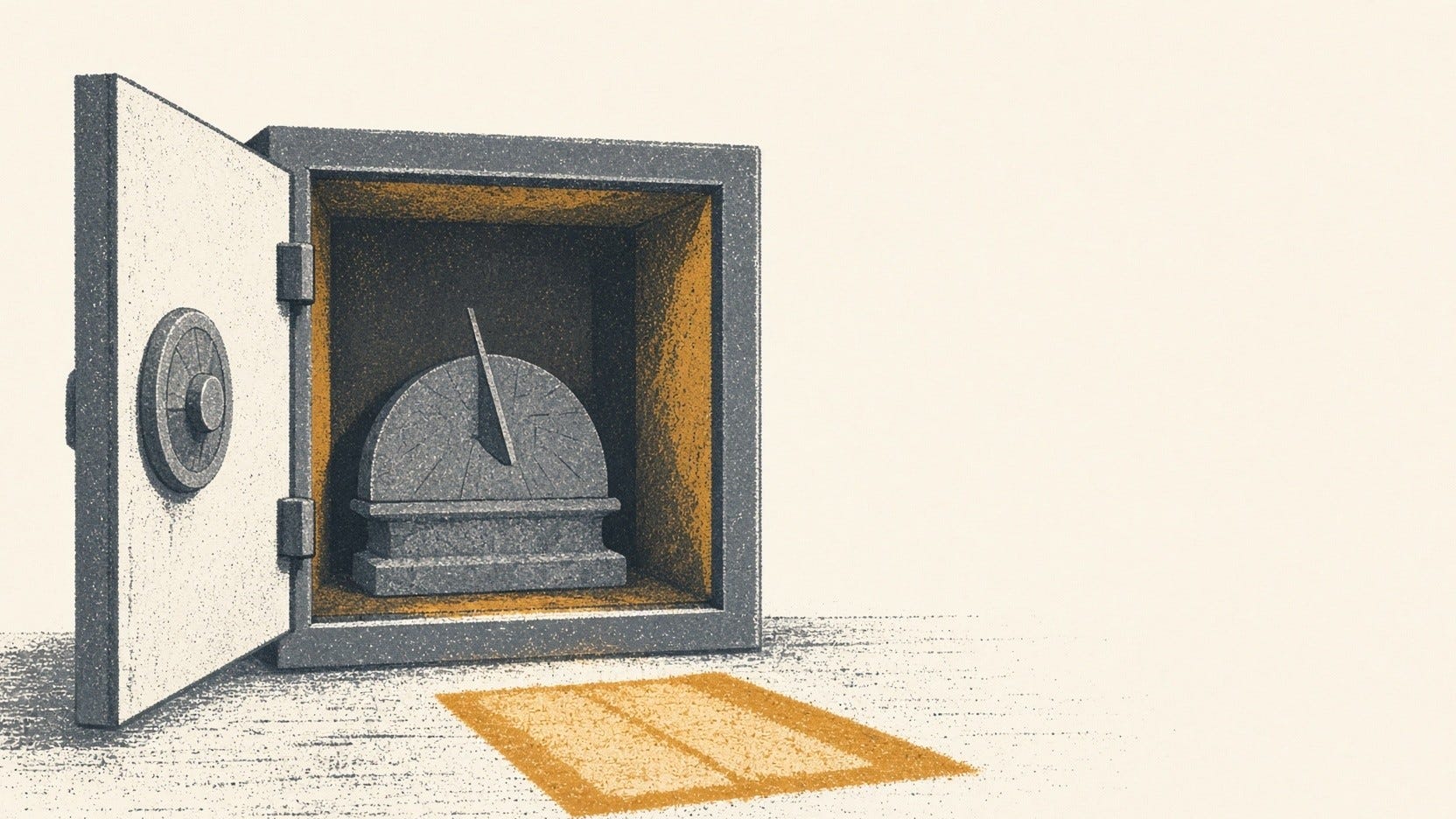
I did something halfway between vanity and archaeology: I fed all Huliwood essays into an AI and asked it what I’ve been saying.
Three and a half years, 99 essays. Finance, colonial history, consciousness, caffeine, techno-feudalism, sourdough.
I’d told you the archive was a record of curiosity going wherever it pleased – no lane, no niche, the refusal to pick one being the whole point.
The machine disagreed. It took the full essay catalogue and handed back one sentence.
Everything you value is something else, stored.
Yes. I asked a machine what I think, and it answered faster than I could have.
I wanted to argue. Then it showed me the list.
99 costumes but a *** ain’t one
Money stores time – I wrote a whole piece calling it a battery: my corporate years charged into a brokerage account.
Culture stores winters: what we flatter ourselves by calling work ethic is ten thousand Octobers of prepare or die, compressed into software and handed down.
National advantage stores older deposits – cousin-marriage bans, plagues survived, geographic luck compounding for millennia until one afternoon in 1532 it walks into a square in Cajamarca and cashes itself out as an empire.
Your gut stores data – pattern recognition passed off as mysticism.
A brand stores language: Google won so hard the verb pays rent.
An LLM stores judgment: everything we ever wrote, compressed until it talks back.
Even the self, when I went looking for it, turned out to be storage: a pattern re-saving itself onto new atoms, a whirlpool holding shape while the water changes.
So that’s the move, then. Pick up the thing everyone treats as solid – money, tradition, credentials, home – and shake it until the realer thing inside rattles. I’d been running one algorithm in countless costumes.
As worldviews go, you could do worse. It has a certain unified-field-theory swagger to it, and for about a day I walked around feeling like a man who had finally read his own manual.
Then I remembered Potosí.
The mountain that ate Spain
The story goes like this: a Quechua herder spends a cold night on a mountain in the Andes, lights a fire to keep warm, and at dawn finds silver melted out of the rocks under the embers. The mountain turns out to be laced with it.
Spain spends the next century shipping home the greatest store of value the world had ever assembled – for a stretch of the 1500s, nearly half the silver on Earth came out of that one hill in what is now Bolivia.
And what did the greatest store of value in history buy the empire that owned it?
Four sovereign defaults before the century was out. Prices did something Spain didn’t have a word for yet: they inflated.
The silver moved through Sevilla like water through a colander – to Genoese bankers, Flemish weavers, Chinese silk merchants – and Spain ended its golden age with the mountain half-hollow and the crown broke.
I know this story cold, and I’ve spent three essays on what it points at – fiat money, pension systems, a financial ledger floating free of the real one – always pointed outward. What I hadn’t done, until the machine rubbed my nose in my own archive, is point it at the sentence I’m proudest of.
The crack
That sentence is four words long: money is stored time.
Readers liked it. I liked it. I built my whole exit on it – sold everything I owned, charged six and a half years of labour into a portfolio, told myself the battery would hold until I decided what it was for.
It’s wrong by one word, though. Money was never stored time.
Money is a claim on other people’s time: the barista’s minutes, the pilot’s hours, a stranger’s afternoon, redeemable on demand.
Your own hours sit in no vault. They run out at one an hour whether you use them or not. You can trade them while they pass, but you can’t bank them.
Money stores time the way a gym membership stores fitness.
The Germans, as usual, have a word they weren’t planning to share: Torschlusspanik – gate-shut panic. Medieval towns locked their gates at dusk; arrive late and you spent the night outside the walls with the wolves and the tax collectors.
The word outlived the gates because the feeling did. Every store of value has a redemption window, and the window is a life.
Call it the Redemption Problem. We’ve spent five hundred years getting brilliant at storing value (double-entry ledgers, joint-stock companies, index funds, cold wallets) and we treat redemption as a detail that sorts itself out later.
Storing value has a whole industry behind it. Cashing it back out into a life has an annuity desk, a few bestsellers, and no heroes.
I can’t name one person history celebrates for cashing out well. (Diocletian, maybe – quit the largest empire on Earth to grow cabbages, and even then history mostly remembers the palace.)
My own book
To be clear: I happily shit on give my unsolicited opinions on anything and anyone, but only under duress when it comes to myself.
When I decided to sell everything and leave, I ran the decision through a spreadsheet first – scenario tabs, sensitivity tables, a model to tell me whether I was allowed to want what I wanted.
More than three years later the number it was guarding has grown. My willingness to draw it down has not.
Somewhere along the way the runway stopped being something to take off from and became something to protect. I check it more often than a man who trusted his decision would.
The pattern doesn’t stop at the portfolio.
I wrote a formula for where to live and I’m still stalling on its answer. I preach living now and keep putting it off.
I once staged a funeral for my corporate self and spent half the service checking whether the coffin had a return policy.
My father ran the same trade in a different asset class – a lifetime hunting a home that fits a feeling he can’t name, and this year the closest he ever came went to the highest bidder: the house in Cabo de Palos from The Last Leash.
I took notes. I changed the asset class. I’m not sure I changed anything else.
The hours get spent whether I decide how or not – deferring just means I don’t get a say.
The other side of the book
Compounding is real, and interrupting it early is how people stay poor.
The only reason I can sit here on a weekday writing fifteen hundred words about redemption is that for six and a half years I didn’t redeem anything. Deferral bought this.
The presence-preachers with no runway aren’t free; they’re one landlord letter away from the machine, and their carpe diem has a copay.
When a monk tells you to live in the moment, somebody else is growing the monastery’s rice.
So the miser is right and the monk is right, and I’ve spent three years failing to make them agree.
The obvious move is a formula – spend x% of the store per year, rebalance toward presence with age, some Kelly criterion for being alive (the gambler’s formula for bet size).
I know better than to trust it: a formula for living now is just another way of putting it off. I notice I’m still looking for one.
A man who reads his own essays and finds a single hidden spine should be the first suspect, not the last – I’ve written before that the map of knowledge has no center, and that every map was drawn by someone.
So maybe the spine isn’t in the archive at all. Maybe it’s in the man reading it.
This is essay number 100.
This is the cornerstone – the one I’d point a stranger to first – and I’d planned a verdict, the way the others mostly have one.
It doesn’t have one. And I’m still at my desk, charging the battery, writing about the sun instead of sitting in it.
Related: Money is Stored Time – the battery, the first time · Don’t Mid-Curve It – the spreadsheet that guarded the number.
Sources: Drelichman & Voth, Lending to the Borrower from Hell (2014) – Philip II’s four defaults · Potosí, UNESCO · Kris Lane, Aeon – Potosí’s share of the world’s silver